
STMicroelectronics Unveils STM32G5 for AI Data Centers and Robots
STMicroelectronics unveils STM32G5, a new family of mixed-signal microcontrollers designed to control power systems in AI data centers and motors in advanced robots. The chips bring faster real-time processing, precision analog circuitry and stronger security to equipment that sits around AI accelerators rather than running AI models itself.
The November 4 launch broadens the role of STM32 chips in two fast-growing markets: the high-density power conversion needed by GPU racks and the multi-axis motion systems behind humanoids and factory robots. ST says the family doubles the computing performance of its earlier STM32G4 generation.
The STM32G5 launch centers on four changes:
- A 280MHz Arm Cortex-M33 processor
- Higher-resolution power and motor-control timers
- Post-quantum-ready security libraries
- Production availability with prices from $1.034
STMicroelectronics Unveils STM32G5 for Physical AI
The STM32G5 is a control microcontroller, not a GPU or neural-processing accelerator. Its job is to measure electrical and mechanical conditions, run deterministic control loops and adjust power converters or motors with precise timing. That distinction places it in the supporting layer of AI infrastructure and embodied robotics.
According to ST's announcement, the chip reaches 420 DMIPS and 1,136 CoreMark at 280MHz. It combines the Cortex-M33 core with a 12-channel high-resolution timer, motor-control timers, position-encoder interfaces and a programmable logic array called PLAy.
The mixed-signal design also integrates fast analog-to-digital converters, comparators and operational amplifiers. Bringing those functions onto the microcontroller can reduce the number of external components required for sensing current, voltage and motor position, while shortening the path between a measurement and the control response.
ST positions the family for what it calls physical AI: machines that translate digital decisions into movement or electrical control. The label covers robotic arms, humanoid hands and autonomous industrial equipment, but the same timing features also apply to energy conversion inside increasingly power-hungry computing facilities.
How STM32G5 Controls Data Center Power
AI data centers create a control problem as well as an energy problem. GPU demand can change sharply as workloads start, stop or shift between racks. Power supplies must respond efficiently while maintaining stable output across multiple conversion stages, from the facility feed to the voltage regulators near computing boards.
ST says the STM32G5's high-resolution timer can dynamically reconfigure power supplies as loads change. Faster switching control also supports silicon-carbide and gallium-nitride power stages, which can operate at higher frequencies than conventional silicon designs and help reduce the size and losses of power-conversion hardware.
The company projects that GPU racks are trending toward one megawatt and that the largest data centers could exceed two gigawatts by 2030. Those figures are ST's market projections, but the direction is clear: power-control electronics are becoming a strategic constraint alongside accelerators, networking and cooling.
A controller that combines fast computation, analog sensing and precise timing can coordinate digital-power functions without adding a separate processor for every task. The practical value will depend on system designs and measured efficiency, yet the STM32G5 gives equipment makers a purpose-built platform for testing those architectures now.
Robotic Hands Need Fast Multi-Axis Control
Robotics creates a different form of real-time pressure. Each motor needs current regulation, position feedback and synchronized motion. A humanoid hand may contain as many as 20 motors, according to ST, so control latency and component count can scale quickly as designers add joints and degrees of freedom.
The STM32G5's expanded timer set can drive multiple motors while its position-encoder interfaces track movement. PLAy provides small, configurable logic functions inside the device, giving engineers another way to handle time-sensitive signals without waiting for software instructions to pass through the main processor.
Ruiyan Intelligent says it is using STM32G5 in its next generation of robotic hands. EE Times independently reported the customer deployment and described the family as part of ST's expanded roadmap for cloud AI and physical AI.
That early design win does not establish broad adoption, but it shows the product is moving beyond a laboratory specification. Production availability also matters to robot makers that need stable supplies, software libraries and evaluation hardware before committing a controller to commercial machines.
Security, Pricing and the 2027 Roadmap
Connected power systems and robots create high-consequence attack surfaces, so ST built the family around Arm TrustZone and its immutable root-of-trust technology. The security package covers secure boot and updates, protected key storage, tamper detection, cryptographic acceleration and defenses against side-channel attacks.
ST also offers post-quantum cryptography libraries for the chip. That does not make every product using STM32G5 quantum-safe by default; manufacturers still have to choose appropriate algorithms, manage keys and design a secure update process. EE Times reports that the platform targets PSA Certified Level 3.
The first devices are in production with 64KB to 512KB of flash memory and packages ranging from QFN32 to LQFP128. ST lists pricing from $1.034 per unit in orders of 10,000. Dual-core members of the family are planned for 2027, extending the roadmap beyond the single-core chips available now.
Development support includes STM32CubeMX2, ST's second-generation hardware abstraction layer, a Nucleo board and discovery kits for motor control and digital power. Those tools may determine how quickly engineering teams can move from evaluation to qualified power supplies, robotic joints and other production systems.
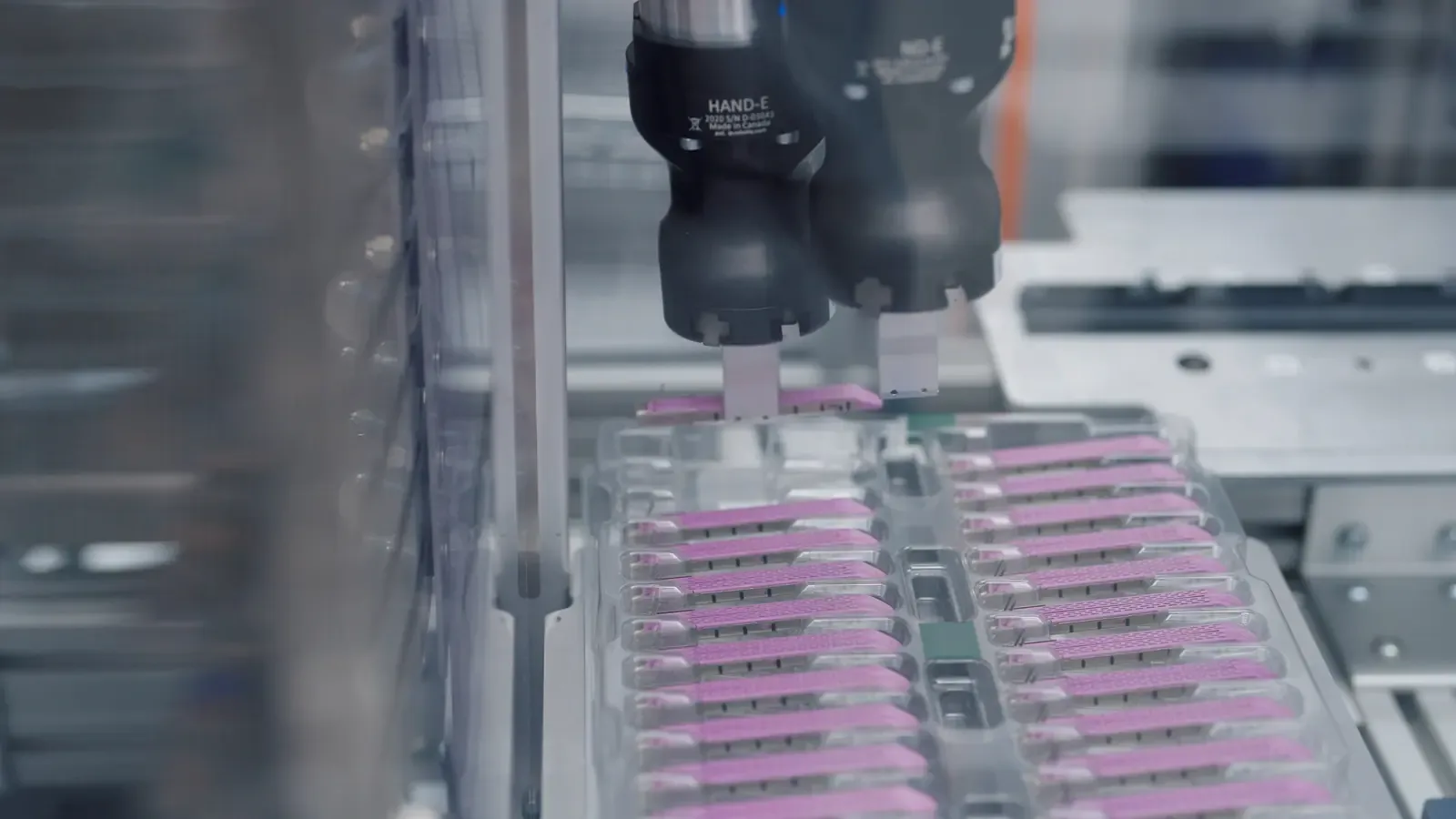
Illustrative feature photograph: a manufacturing robot arm by Lexington Medical, Inc., sourced from Wikimedia Commons under CC0 1.0. The pictured system is not identified as using STM32G5; the image was resized and converted to WebP.