
USDA Adds AI Check After Corn Forecast Errors
USDA adds AI check to its crop-report workflow after a processing error distorted September corn-yield forecasts for Kansas, Nebraska and the United States. The new tool will screen data for anomalies before the National Agricultural Statistics Service publishes its November 10 Crop Production report.
The Department of Agriculture says the system would have flagged the September problem, which involved incorrect acreage weights rather than faulty observations from farms. Officials are presenting the software as an additional validation layer, while the agency's established reviews and statistical controls remain in place.
The response has three immediate elements:
- An AI tool will look for unusual values missed by routine checks.
- New controls will verify acreage weights before publication.
- Human review and existing validation procedures will continue.
USDA Adds AI Check Before the November Crop Report
The tool is scheduled to be used for the November report, due at noon Eastern Time on November 10. Reuters reported that USDA officials tested it against the September data and found that it would have identified the error before publication.
USDA has not disclosed the tool's model architecture, training data, thresholds, false-positive rate or evaluation results. It has also not described the system as a generative model. Based on the announced function, its role is to detect anomalies and direct analysts toward records that need closer inspection.
That distinction matters because the system is not being given authority to calculate and publish crop forecasts on its own. It will supplement controls used by NASS, the statistical agency that produces reports on planted area, yields, production, prices and other measures followed by farmers, commodity traders, processors and policymakers.
How the September Corn Error Happened
In an October 24 correction notice, NASS said its review found that a processing error used incorrect acreage weights when combining irrigated and non-irrigated objective-yield observations in Kansas and Nebraska. The problem affected plant-population and ear-count estimates as well as state and national yield forecasts.
The corrected September estimate put Kansas corn yield at 118 bushels per acre, three bushels below the original figure. Nebraska moved to 182 bushels per acre, five bushels higher, while the national forecast rose by 0.3 bushel to 178.8 bushels per acre.
USDA said the underlying field observations were sound. The fault occurred when computer processing combined categories using the wrong weights, showing how a clean source dataset can still produce a misleading output when an aggregation step is misconfigured.
The agency said its October corn forecasts were independently validated and did not require revision. It also said the September incident was unrelated to staffing losses, addressing concerns that reductions in the federal workforce had weakened statistical quality controls.
The AI Tool Supplements Existing Validation
The new screen is designed to catch relationships or changes that look inconsistent with historical and current data, then surface them for examination. A useful alert could prompt analysts to check source files, formulas, weighting logic and transformations before approving a result for publication.
USDA is also adding explicit pre-publication checks for acreage weights and validation of objective-yield calculations. Those conventional safeguards target the precise mechanism behind the September error, while the AI layer is intended to detect broader anomalies that a fixed checklist may not anticipate.
The arrangement limits the risk of treating a model's output as a final statistical judgment. An anomaly detector can produce false alarms or miss unfamiliar failure patterns, so its practical value will depend on how alerts are calibrated, how quickly analysts can investigate them and whether the system is tested as data and reporting methods change.
The project also fits USDA's broader agricultural-data modernization plan. Announced in September, that program calls for improved satellite, geospatial and crop-model technology and evaluation of responsible AI and machine-learning uses, alongside privacy protections and clearer communication with producers.
Crop Forecast Accuracy Has Market Consequences
Federal crop reports provide a common information base for decisions across the agricultural economy. Yield revisions can affect expectations for supply, storage, feed costs, exports and commodity prices, even when the numerical change looks small at the national level.
The September error therefore offers a concrete test for government AI: a narrow system aimed at improving the reliability of a high-impact public dataset. Success should be measured by fewer undetected processing failures without overwhelming analysts with alerts or obscuring who is accountable for the final numbers.
The November report will show that the tool has entered the production workflow, but one publication cannot establish its long-term performance. USDA has not announced whether it will disclose alert rates, retrospective testing results or examples of issues the system catches, information that would help producers and data users evaluate the new control.
Related Research
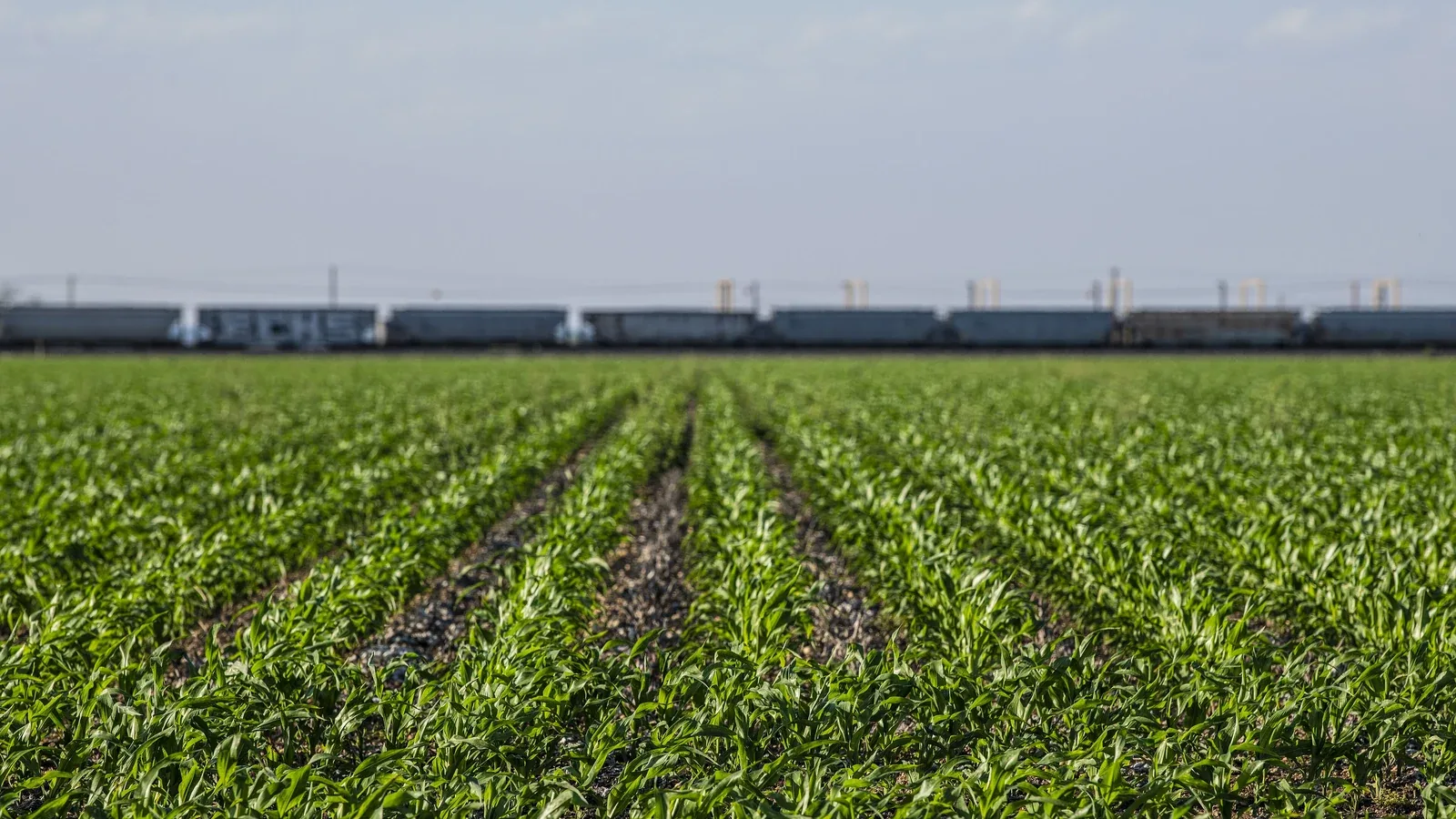
Feature image: A corn field in Hondo, Texas, photographed by Lance Cheung for USDA on April 9, 2021. Cropped and resized from the public-domain USDA photograph.