
Anthropic Unveils Vault Particle Structure Mapped With Claude
Anthropic unveils a vault particle structure that its biology team mapped with Claude, offering the first three-dimensional view of this large protein shell from a prokaryotic source. The November 4 result comes from a bacteriophage, a virus that infects bacteria.
The work gives researchers a simpler system for studying vaults, which occur in human cells but have resisted a clear functional explanation since their discovery in 1986. It also provides a detailed case study of where an AI assistant sped up laboratory work and where its errors still required expert correction.
Anthropic reported four central findings:
- The L05 vault contains 96 copies of one phage protein.
- Its purification took about 90 minutes rather than roughly three days.
- A first cryo-EM structural model was ready in 34 hours.
- Claude errors caused a two-week delay and an initially flawed map.
Anthropic Vault Particle Structure Uses 96 L05 Copies
According to Anthropic's research account, the newly mapped vault is assembled from 96 copies of a protein the team calls L05, with 48 copies in each half. The complete complex has an estimated mass of about 9.5 megadaltons.
The phage-derived particle measures roughly 54 nanometers long and 45 nanometers wide. A mammalian vault is longer and narrower at about 67 by 40 nanometers, but the L05 structure encloses around 25% more volume because its shape is more spherical.
Its wall is built from seven repeating protein segments rather than the nine found in mammalian vaults. The cap closes in three steps: within each group of three neighboring chains, one stops at the first tier, another at the second, and the third continues to the tip.
Vault-like proteins had previously appeared in the genomes of bacteria, archaea and phages, but that did not establish that they assemble into complete particles. Anthropic says cryogenic electron microscopy confirmed vault shapes for four candidates, including two from phages and two from bacteria.
Claude Helped Search, Isolate and Map the Particle
The team used Claude Science to search a database of about 15 billion predicted proteins for distant vault relatives. Researchers then selected 44 candidates for cell-free tests, while Claude converted chosen protein sequences into DNA designs and prepared control sequences for ordering.
Fifteen of 24 candidates later produced soluble protein in E. coli. Seven formed vault-like particles under an electron microscope, and the researchers selected L05 for detailed reconstruction because it reliably produced complete, closed shells.
For isolation, Claude helped optimize a size-exclusion chromatography method that separates large particles from smaller molecules. Anthropic says the resulting process took about 90 minutes from cells to a microscopy grid, compared with roughly three days for the conventional density-gradient method.
Claude also configured the open-source RELION software and processed the cryo-EM data under researcher direction. A first full model was available after 34 hours, while final maps took about a week. The accelerated analysis used hundreds of graphics processors, a level of computing that many academic laboratories cannot readily access.
Related Coverage
Claude's Mistakes Delayed the Biology Work
Anthropic's account includes failures that qualify the speed claims. A protocol written by Claude specified a growth medium containing an additive that interfered with moving DNA into cells. The mistake cost the project about two weeks before researchers corrected it.
During early cryo-EM processing, Claude skipped a standard step and produced a map blended with its mirror image. Scientists recognized the problem and redirected the workflow. These episodes show that expertise remained necessary to detect plausible-looking procedures and results that were experimentally wrong.
The team also tested 15 altered versions of L05. Some changes near the cap prevented the shell from closing, producing open rosette-like structures. Duplicating two wall segments created a larger particle with nine repeats and increased its enclosed volume by approximately 20%.
Those engineering tests suggest a route to studying how vaults evolved and how their size can change without destroying assembly. Anthropic also raises possible biotechnology uses, including enzyme-delivery nanocapsules, but the work does not demonstrate a delivery product or establish that the particles are safe or effective for that purpose.
The Vault's Function and Independent Validation Remain Open
The biggest scientific question is unresolved: researchers still do not know what vault particles do. Proposed roles in transport, protection from toxic compounds and innate immunity have not produced a conclusive explanation for why evolution retained such a large molecular complex across many organisms.
Anthropic has posted the work as a bioRxiv preprint, which has not completed peer review. The company also says it plans to release structures and additional data. Outside researchers will need those materials to inspect the reconstruction and test whether the findings can be reproduced.
The particles have so far been produced in E. coli rather than observed assembling inside their original bacteria or phages. Confirming that natural assembly, identifying the unexplained molecule found in a pocket of the structure, and establishing the vault's function are the next scientific tests.
The immediate result is therefore narrower than a solved biological mystery. It is an experimentally grounded example of AI compressing parts of a demanding research workflow while creating new failure points that specialists had to catch. Its broader value will depend on peer review, released data and independent replication.
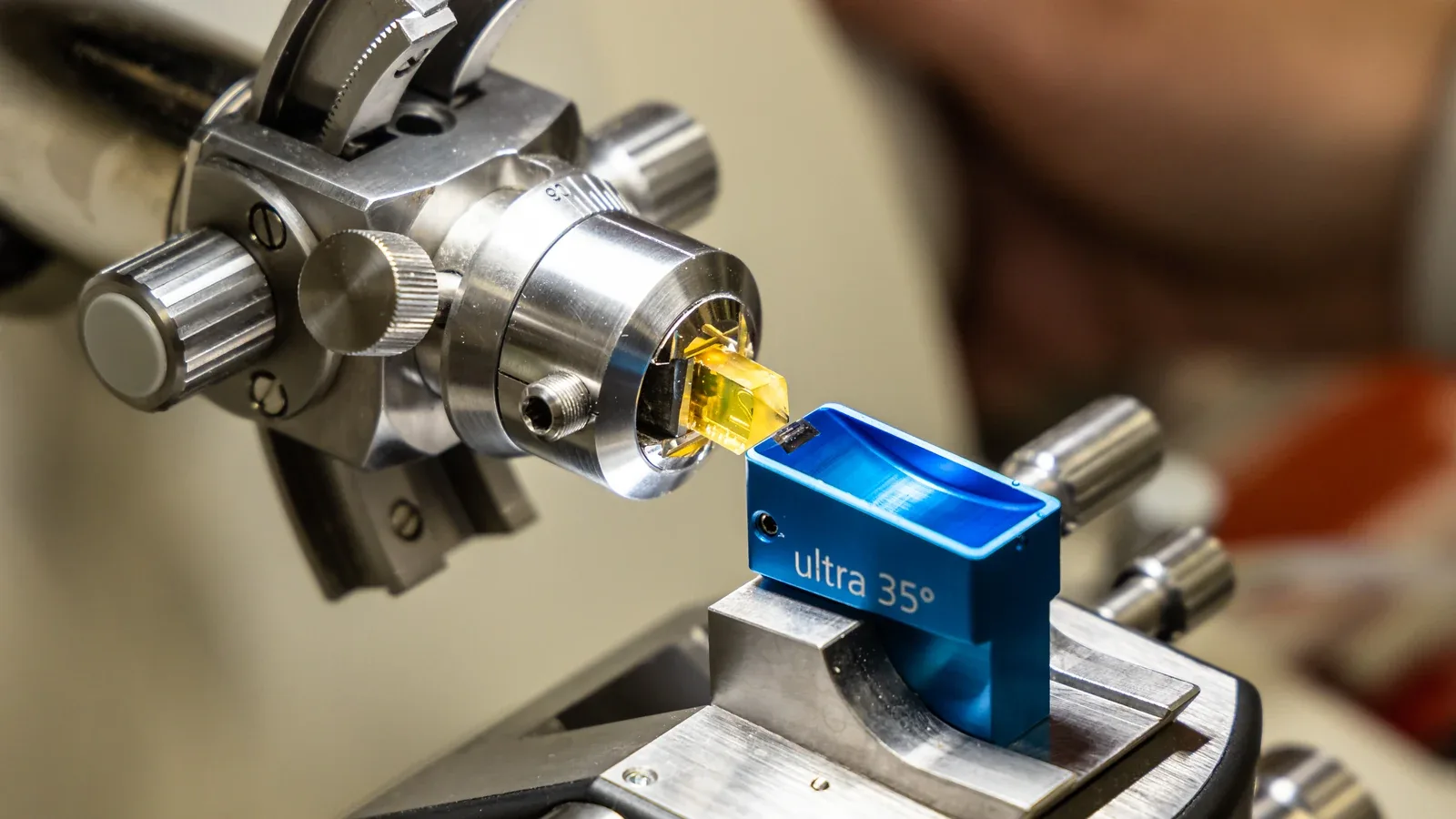
Illustrative photograph: transmission electron microscopy sample preparation at Oak Ridge National Laboratory, via Wikimedia Commons, licensed under CC BY 2.0. Cropped to 16:9.