
Boston Dynamics Launches Stretch Gen 2 With One-Hour Drive Swap
Boston Dynamics launches Stretch Gen 2 as a redesigned trailer-unloading robot built around maintenance and uptime rather than a new humanoid form. The November 3 release cuts internal cabling by 81% and turns a full swerve-drive replacement from a day-long job into an operation the company says takes about one hour.
The machine can unload as many as 1,000 cases per hour, but Boston Dynamics says that peak depends heavily on box weight and how neatly a trailer is stacked. The company has not published independent Gen 2 productivity data, pricing, order volume or a measured reduction in total downtime.
Stretch Gen 2 introduces four practical changes for warehouse operators:
- Internal cabling is reduced by 81%.
- A swerve-drive module can be replaced in about one hour.
- The gripper adds revised valves and more precise sensing.
- A new computer supports fleet-wide perception and planning updates.
Boston Dynamics Launches Stretch Gen 2 After 100,000 Hours
Boston Dynamics says the redesign draws on more than 100,000 operating hours and tens of millions of boxes handled by the first-generation Stretch fleet. Those figures describe experience used to design Gen 2; they are not an operating record for the newly introduced machine.
Stretch is a wheeled mobile manipulator built to unload floor-loaded trailers and containers. Its vacuum gripper picks individual cartons or multiple boxes and places them on a conveyor, automating a repetitive job that exposes workers to heat, cold and sustained lifting inside confined trailers.
The product stays focused on one industrial workflow. That narrower scope gives operators concrete measures—cases per hour, intervention rate, repair time and uptime—that are harder to establish for general-purpose humanoids demonstrated across many unrelated tasks.
In an Automated Warehouse interview, logistics robotics chief Brian Donnelly said Gen 2 was already operating at multiple customer sites and that deployments at existing facilities could be completed within two weeks. Boston Dynamics did not name those sites or provide customer-controlled performance results.
One-Hour Drive Swap Targets Warehouse Downtime
The largest mechanical change removes 81% of the robot’s internal cabling, which Boston Dynamics equates to roughly half a mile of wire. The company identifies intermittent electrical faults and cable wear as major sources of trouble in the earlier design, making the reduction a direct response to field failures.
Heavy-duty automotive-grade connectors are intended to tolerate vibration from rapid box handling and movement across uneven floors. Continuous-rotation joints can travel beyond 360 degrees without striking hard stops, reducing mechanical stress during repeated reaches and turns.
The updated gripper uses new valve systems and more precise sensing for grasping and placement. Exterior panels are made from materials intended to withstand falling cartons, while a lower, recessed emergency-stop button reduces accidental stoppages without removing the operator’s safety control.
Maintenance is more modular. Boston Dynamics says a complete swerve-drive assembly can be exchanged in about an hour instead of a full day, while standardized fasteners and onboard diagnostics let customer maintenance teams perform more routine work without waiting for outside service.
The 1,000-Case Rate Comes With Conditions
Boston Dynamics rates Stretch Gen 2 at up to 1,000 cases per hour, with a multipick feature helping it reach the peak. The same announcement warns that throughput varies with box weight and whether cartons are stacked neatly or arrive in a disordered wall.
That qualification is central to evaluating the number. A peak rate under favorable conditions does not establish a full-shift average across mixed cartons, collapsed boxes, unstable stacks or trailers that require frequent human intervention. Conveyor capacity and the pace of downstream sorting can also limit the value of faster unloading.
The company says the battery lasts two shifts and reaches 90% in about 75 minutes with a fast charger. Onboard lights support work inside dark trailers, and a pretrained vision system is designed to detect most packages on the first day without item-by-item programming.
Those specifications create useful tests for customers: sustained cases per hour, energy use, interventions per trailer, charging time and output after component replacements. Boston Dynamics has not disclosed a standardized independent trial that compares those measures with the first-generation system under identical loads.
Fleet Software Becomes Part of the Stretch Gen 2 Upgrade
A redesigned onboard computing platform supports continuing software releases for case detection, motion planning, pick strategies and world modeling. Donnelly told Automated Warehouse that the company typically issues software updates about once a month, allowing deployed robots to improve without replacing their main hardware.
That model shifts part of the product’s value from the machine delivered on day one to the reliability of later fleet updates. Warehouse operators will need change controls, rollback procedures and performance monitoring so an update improves picking without creating new failures in unusual trailer conditions.
Gen 2’s clearest promise is serviceability grounded in experience from an existing commercial fleet. The next evidence should be customer-reported uptime, maintenance cost, intervention frequency and average throughput across different facilities—not another laboratory demonstration or the highest rate achieved in one favorable trailer.
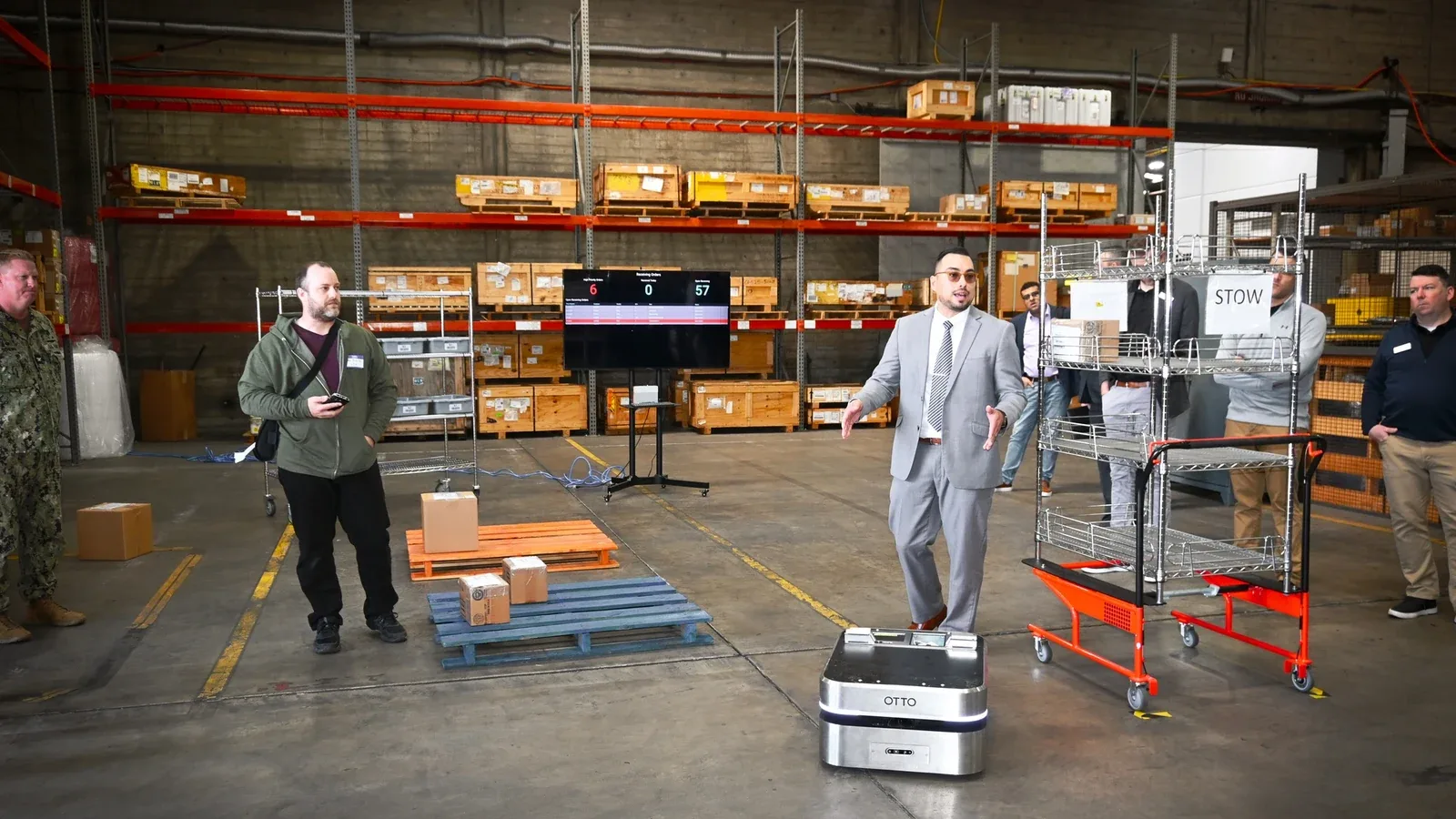
Illustrative feature photograph: an OTTO autonomous mobile robot at a US Navy smart warehouse in Coronado, California, photographed by Tristan Pavlik on February 15, 2023. The public-domain image does not show Boston Dynamics Stretch Gen 2; it was cropped and resized.