
OCC Issues AI Framework for Bank Examiners
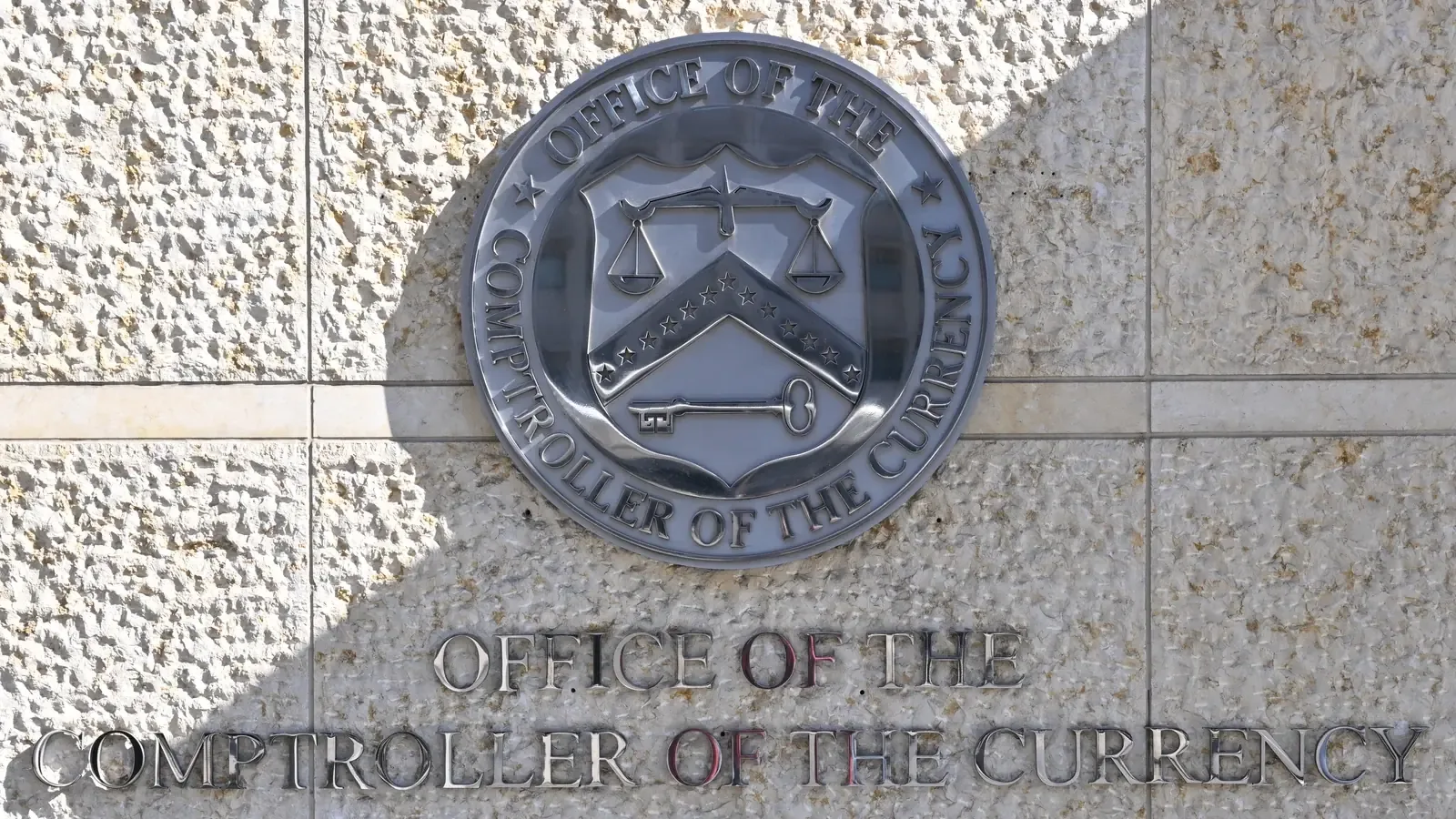
OCC issues AI framework for bank examiners, directing them to assess artificial-intelligence systems by the consequences of failure, their autonomy and the strength of human oversight. The November 4 guidance covers uses ranging from credit decisions and payments to fraud detection, customer service and market activity.
The Office of the Comptroller of the Currency calls the technology “Super Intelligence,” following new federal terminology, but defines it to include systems previously described as AI. The framework is aimed at examiners and does not create enforceable standards or a separate regulatory risk category for banks.
The 22-page framework establishes four central points:
- Risk depends on use and consequences
- Autonomous agents may require stronger controls
- AI remains within existing risk categories
- The guidance will change as technology develops
OCC Issues AI Framework Based on Consequences
The OCC bulletin tells examiners to look beyond a model's technical sophistication. A simple rules-based agent permitted to initiate transactions can pose more risk than a highly capable model restricted to internal drafting because the first system can directly move money.
That consequence-based approach considers reversibility, customer and financial impact, autonomy, sensitive data, explainability, provenance and access to tools or accounts. A system that produces advice for a staff member differs from one authorized to execute an action that is difficult to reverse.
The framework applies to national banks, federal savings associations and federal branches or agencies of foreign banking organizations supervised by the OCC. Examinations should remain proportionate to each institution's size, complexity, risk profile and specific AI use cases, including at community banks.
Six Pillars Cover Purpose, Controls and Resilience
The OCC groups 16 examination components under six pillars: purpose, risk, control, oversight, resilience and assurance. Together they ask what the system may do, what happens if it fails, which safeguards constrain it, who remains accountable and whether the controls work under real operating conditions.
Permitted-use documentation may identify authorized users, data sources, connected systems, actions and escalation points. The framework treats scope drift as a potential control failure even when the resulting action appears reasonable, because an agent operating outside its approved role may expose the bank to unmeasured risks.
The document also extends conventional model-risk practices to systems that are non-deterministic, frequently updated or supplied by third parties. It recommends repeated testing and controlled comparisons rather than relying on one successful run, while monitoring changes in models, prompts, permissions, data and vendor configurations.
Further Reading
Bank AI Agents Face Human Oversight and Kill-Switch Checks
Human involvement must be meaningful rather than a nominal approval click. The framework distinguishes review before an action from active monitoring with the authority and practical ability to intervene. It asks whether reviewers have enough expertise, information and time to reject, pause or halt a system.
For autonomous or consequential agents, examiners may consider circuit breakers, rate limits, least-privilege permissions, deterministic rules and kill switches. Banks may also need tested fallbacks so critical work can continue through trained staff, a narrower approved agent or another process when the primary system is restricted.
Cybersecurity checks include prompt injection, jailbreaking, poisoned data, model extraction, confidential-data leakage and excessive agency. The OCC warns that broad credentials can let a compromised agent create fraud, exposure or disruption at machine speed, even without a conventional breach of the network perimeter.
Vendor relationships receive separate attention because banks often buy AI capabilities rather than build them. Contracts and controls may need to define agent authority, data use, incident notification, responsibility for customer harm, model changes and exit arrangements. Outsourcing the technology does not remove the bank's accountability for managing risk.
OCC Guidance Does Not Create New Bank Rules
The framework is an examiner resource, not a binding rule, and it expressly says banks are not expected to use the document for self-assessment. It does not establish new regulatory expectations, prescriptive requirements or a separate AI risk appetite, although supervised institutions typically pay close attention to examination guidance.
Instead, AI can introduce or amplify existing operational, compliance, credit, privacy, cybersecurity and third-party risks. Examiners are directed to connect those effects to the bank's established controls, with greater intensity where failures could harm customers, disrupt critical operations or create broader market consequences.
The OCC calls the framework a living document and plans regular updates as technology and supervisory understanding change. The agency also discloses that the framework was prepared with AI assistance and then reviewed, edited and approved by a person, applying its human-oversight principle to the guidance itself.
Reuters described the issuance as the OCC's first AI guidance for examiners. Its practical effect will emerge through examinations: banks with transaction-capable agents should expect closer questions about permissions, reversibility, testing and intervention than institutions using models only for low-impact internal assistance.
Feature photograph: Office of the Comptroller of the Currency wall logo at its Washington headquarters, photographed by G. Edward Johnson via Wikimedia Commons and licensed under CC BY 4.0. Cropped to 16:9 and converted to WebP.