
Spirit AI Targets Mid-2027 Robot Brain Breakthrough
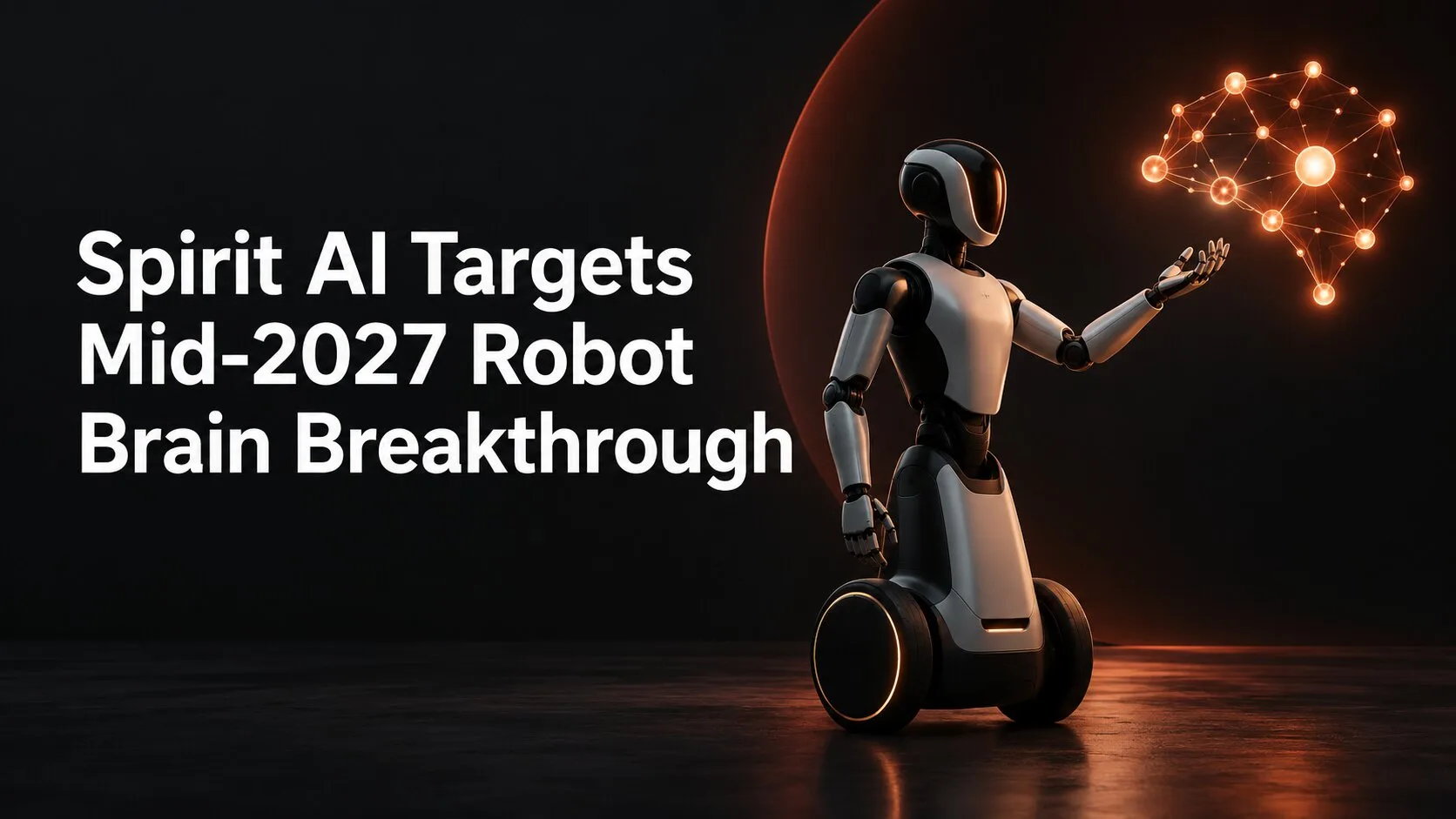
Spirit AI targets a mid-2027 robot brain breakthrough that could let humanoid machines translate spoken instructions into a sequence of physical actions. The Chinese startup says its current systems already complete simple tasks in structured environments with about a 90% success rate.
The forecast concerns embodied intelligence rather than more athletic hardware. Robots can already run, jump and perform demonstrations, but reliable software for manipulating unfamiliar objects and recovering from mistakes remains the harder commercial problem.
Spirit AI's development program has four defining elements:
- A mid-2027 target for a major capability step
- Real-world training data from about 1,000 contractors
- Roughly 90% success on simple structured tasks
- Moz1 deployments at CATL and JD.com facilities
Further Reading
Spirit AI's 2027 Robot Brain Target
Co-founder and chief scientist Gao Yang described the expected advance as a “GPT-3.0 milestone” for robot intelligence in an interview published by Reuters on September 18. The comparison points to a broad capability threshold, not a named model or a claim that robots will match people.
The envisioned system would accept natural-language directions and convert them into multiple coordinated movements. A warehouse worker, for example, could describe an objective rather than program every reach, grip and placement. The robot would still need to perceive its surroundings, plan the steps and adjust its force while acting.
Spirit AI reports about 90% success on relatively simple jobs in controlled, living-room-style settings. That figure shows progress but also defines the limit of the evidence: performance in a familiar test space does not establish reliability in a busy factory or an unpredictable home.
How Moz1 Learns From Real-World Motion
Spirit AI favors physical demonstrations over a simulation-first training strategy. About 1,000 contractors collect motion data in homes and factories, giving its models examples of contact, resistance and object behavior that simulated environments may reproduce imperfectly.
Real-world data is expensive and slower to gather, but it can expose a robot to the irregular details that matter during manipulation. Flexible materials deform, containers shift their weight, tools resist in different ways and two objects that look alike may require different grip pressure.
The company introduced Moz1 as a full-force-controlled humanoid robot in its official product announcement. Force control is central to the design because a useful machine must regulate physical contact rather than simply arrive at a target position.
That approach can improve precision and provide a safety layer when a robot encounters a person, an obstacle or an object it cannot move as expected. It does not remove the need for task-level safeguards, emergency controls and validation under the exact conditions in which the machine will operate.
CATL and JD.com Put Moz1 on Production Lines
Tens of Moz1 units are already working on production lines at battery maker CATL and e-commerce company JD.com, according to Reuters. These deployments give Spirit AI access to repetitive commercial tasks where the environment can be organized and results can be measured.
Factories are a more realistic near-term market than homes. Operators can standardize workstations, restrict access, define acceptable objects and add supervision around difficult steps. A failure can also be detected against a known production process, making it easier to improve the model and hardware.
Gao expects industrial applications to mature over the next one to two years, while domestic robots will take longer. Household work combines clutter, children, pets, delicate property and constantly changing layouts, producing a much wider range of edge cases than a controlled line.
Spirit AI has raised more than $670 million since its founding in 2024 and was recently valued at about 20 billion yuan, or $2.9 billion, Reuters reported. That capital supports a labor-intensive data operation and hardware deployments, but funding does not prove the company will meet its technical timetable.
The Tests That Will Validate Spirit AI's Forecast
The mid-2027 target will become meaningful only through repeatable demonstrations beyond curated settings. Useful evidence would include success rates across new objects, recovery from failed grasps, performance after verbal instructions are rephrased, and safe operation beside people over long shifts.
Fine manipulation remains especially important. A system that can move a rigid box may still struggle with cables, packaging, fabric or partially filled containers. General-purpose robot intelligence requires the model to transfer learned behavior to materials and arrangements it has not seen before.
Customers will also measure economics rather than demonstrations alone. Deployment depends on uptime, maintenance, training time, integration with factory software and the amount of human intervention required when the robot encounters an exception.
Spirit AI's forecast is therefore a concrete, testable claim about the next stage of embodied AI. The strongest signal will not be a single staged task, but sustained performance by Moz1 across real production work with transparent measurements of failures, recoveries and safety interventions.