
Hesai Launches Kosmo 3D World Data Engine
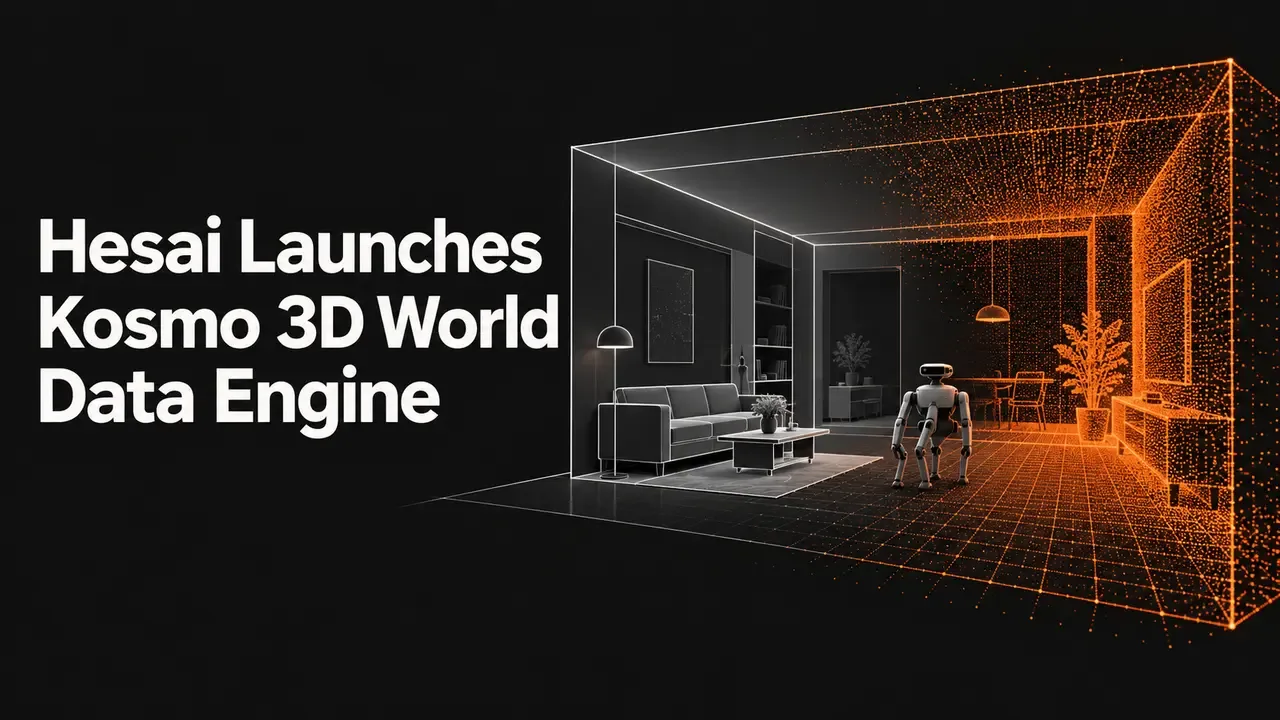
Hesai launches Kosmo 3D World Data Engine as a new data system for robot training, world-model development and reusable digital environments. The October 14 release combines a handheld spatial camera called Kosmo One with a cloud platform that reconstructs captured spaces into editable 3D assets.
The Chinese lidar maker is positioning Kosmo as infrastructure for physical AI rather than another robot. Its central bet is that better real-world data can help embodied systems learn useful tasks faster, although most performance and cost claims disclosed at launch come from Hesai’s own demonstrations.
The Kosmo system has four core elements:
- An 8K-capable camera with lidar and inertial sensing.
- Cloud reconstruction into 3DGS, mesh and depth data.
- Simulation-ready environments for robot training.
- Integrations with Nvidia, Pixar and 3D-production tools.
Hesai Launches Kosmo 3D World Data Engine
Kosmo One integrates high-resolution lidar, a one-inch imaging sensor and an inertial measurement unit. Hesai says the components capture geometry, color, texture and camera position with microsecond-level synchronization, giving reconstruction software a consistent record of both appearance and physical structure.
The camera supports 8K capture, while exported files reach a maximum of 6K, according to the company’s technical notes. It is designed to begin scanning immediately after power-up, guide the operator through the space and resume an interrupted scan with one command.
A typical 100-square-meter indoor environment can be scanned by one person in about 15 minutes, Hesai says. Kosmo World then reconstructs the data into a 3D scene using Gaussian Splatting, a technique that represents a space with many colored, semi-transparent points that can be rendered from new viewpoints.
Hesai claims millimeter-level geometric accuracy and reconstruction speeds up to five times faster than comparable products under similar conditions. Those figures are vendor benchmarks whose results can vary with the scene, hardware, dataset size and quality settings; the company did not publish independent comparative testing.
Kosmo World Builds Simulation-Ready Robot Environments
The cloud platform produces 3DGS, mesh and depth data in a single reconstruction. Generative AI fills gaps left by incomplete scans and rebuilds materials or textures, while semantic segmentation identifies individual objects that a simulator or training system can treat separately.
Developers can adapt the reconstructed views to a robot’s camera characteristics. That matters because a training scene designed for a cinematic camera may look different through a robot’s lenses, potentially widening the simulation-to-reality gap that causes learned behavior to fail outside a virtual environment.
From one captured space, Kosmo can generate more than 10,000 training trajectories, according to Hesai. The company estimates that this produces over 100 times more training data for the same cost than collecting one high-quality real-world robot trajectory, though actual efficiency depends on scene scale and trajectory requirements.
Hesai announced partnerships with Galbot and Dexmal for embodied-AI development. It also lists support for Nvidia Isaac Sim and Isaac Lab, Unreal Engine, Pixar RenderMan and Houdini, allowing the same spatial asset to move between robotics simulation, world-model research and media-production workflows.
The Dairy Queen Deployment Tests Kosmo With Sharpa
Hesai’s main deployment example comes from a Dairy Queen store in Shanghai. The company says creating the robot-training environment previously required about 300 hours of manual modeling, while scanning and reconstructing the location with Kosmo took 15 minutes.
A Sharpa robot trained in that environment then served ice cream in the store. Hesai reported a 99% task-success rate and said failures fell to one-tenth of their previous level. Reuters independently confirmed the deployment and reported the company’s result, but no third-party evaluation methodology was released.
Sharpa Robotics is separately operated but was founded by Hesai’s co-founders, making it a closely connected proving ground rather than a neutral customer test. That relationship does not invalidate the demonstration, but buyers will need results from varied sites, robot designs and task types before treating the outcome as broadly reproducible.
The Kosmo launch also expands Hesai beyond sensing. Its robotic actuation modules power Sharpa’s Wave dexterous hand, and the company says cumulative module deliveries passed 10,000 by the end of the second quarter of 2026. It expects shipments to reach six figures in 2027.
Spatial Data Becomes a New Physical-AI Layer
Robot developers face a data problem that text-model builders do not: useful training material must describe geometry, motion, depth, materials and object relationships. Recording enough real environments is slow, while manually constructing accurate digital twins requires specialist labor and does not automatically represent how a specific robot perceives the scene.
Kosmo tries to compress that pipeline into capture, reconstruction and synthetic trajectory generation. If it works across warehouses, factories, homes and public spaces, developers could reuse one scan for perception training, navigation tests, manipulation planning and safety evaluation without repeatedly closing the real site.
The same capability introduces governance questions. High-fidelity scans may expose layouts, security features, people or commercial activity, so organizations need permission rules, retention limits and controls over who can export raw data or reconstructed environments.
Pricing and broad availability were not detailed in the launch materials, and Reuters reported that chief executive David Li declined to give revenue projections. The next proof point will be whether independent robotics teams can reproduce Hesai’s speed, accuracy and task-performance claims in environments that were not designed around the system.