
OpenAI GPT-6 Astra Tests CAD and Mazda Vehicle Design
OpenAI GPT-6 Astra engineering tests now extend from CAD and circuit-board design to Mazda vehicle simulations. The company says the model designed a Codex-connected test device and is being evaluated on vehicle aerodynamics and crash-safety work.
The November 3 research update offers unusually concrete evidence of AI moving into physical-product workflows. It also exposes the boundary between producing a plausible design and preparing one for reliable manufacturing, where engineers and established validation tools still control the final decisions.
OpenAI disclosed four main engineering tests:
- Astra designed a small Codex device across mechanical, electrical and software work.
- An unreleased internal model scored 0.875 on BenchCAD 2.0.
- Mazda is testing model-assisted aerodynamics and crash-safety simulations.
- Chip Ganassi Racing is converting 3D scans into editable CAD and drawings.
OpenAI GPT-6 Astra Engineering Test Built a Codex Device
OpenAI asked GPT-6 Astra to define the requirements for a device that lets a user talk to Codex. The model developed the enclosure and internal structures, selected electrical components, placed and connected them on a printed circuit board, and produced the interface, firmware and software integrations.
The experiment covered the handoffs that make hardware projects difficult. Mechanical dimensions constrain the board, electrical choices affect heat and power, and firmware must match the components actually installed. A useful system therefore has to coordinate changes across disciplines rather than create one isolated drawing.
Two team members completed the design in under a week while treating it as a side project, according to OpenAI’s research publication. A contract manufacturer then produced a small prototype batch in under a month. OpenAI did not disclose the batch size, cost or conventional baseline for comparison.
The device is evidence of a working prototype process, not a commercial product announcement. OpenAI has not offered it for sale, published complete design files or said that Astra can independently approve hardware for production.
Manufacturing Reviews Exposed Astra’s Limits
Moving from the model’s files to physical prototypes still required several rounds of review and revision. OpenAI said Astra did not consistently account for the manufacturer’s production limits, mechanical tolerances and assembly details. Those gaps can determine whether a design can be built repeatedly rather than once.
The distinction is central to engineering automation. A CAD model can look complete while leaving insufficient clearance for a tool, specifying a tolerance that a factory cannot hold economically, or placing components where assembly and inspection become difficult. Human review remains responsible for catching those failures.
OpenAI says its hardware and infrastructure teams also use ChatGPT and Codex to revise CAD, prepare manufacturing drawings, configure simulations and review designs across robotics and computing projects. Their model usage, measured in tokens, has increased 23-fold since February.
That figure measures adoption, not productivity. Token consumption does not establish that projects finish 23 times faster, that designs contain fewer errors or that total engineering costs have fallen. Comparable project data would be needed to support those conclusions.
Related Research
BenchCAD 2.0 Shows an Unreleased Model Ahead
OpenAI also reported an average score of 0.875 for a newer internal model on BenchCAD 2.0, compared with 0.594 for GPT-6 Astra at its highest reasoning setting. The company did not name the internal model or announce when, or whether, it will be released.
BenchCAD 2.0 evaluates models on six kinds of work: building CAD parts and assemblies from engineering drawings, reconstructing them from rendered views, and recovering circuit connectivity from images of printed circuit boards. Its 100 core cases are held back under an evaluation-only agreement.
The benchmark’s public results show why a high-level shape is not enough. For several frontier models, most assembly parts that received zero placement credit had the correct shape but appeared in the wrong location. A visually credible assembly can therefore fail its functional geometry.
OpenAI’s 0.875 result is self-reported for an unnamed system, so it cannot yet be reproduced by outside users. BenchCAD also measures a defined set of design tasks rather than the full lifecycle of requirements, materials, supplier constraints, certification, quality control and field reliability.
Mazda and Chip Ganassi Test Physical Engineering Workflows
The new Mazda research collaboration broadens the work from component design to vehicle development. OpenAI says its researchers and forward-deployed engineers are working with Mazda’s aerodynamics and crash-safety teams to simulate airflow and structural behavior while considering styling, performance and cost.
One reported workflow uses Astra in Codex to propose new vehicle nose shapes, simulate their airflow and refine promising candidates. OpenAI has not published drag reductions, crash results, model error rates or a production-vehicle timetable, so the collaboration remains an engineering study rather than a validated performance claim.
OpenAI is also expanding its work with Chip Ganassi Racing. The racing team is testing a process that converts 3D scans of existing parts into editable CAD models and two-dimensional manufacturing drawings, particularly when original design files are unavailable. Its engineers review the output for accuracy and manufacturability.
Together, the projects define a practical near-term role for engineering models: generate candidates, operate specialized tools and reduce repetitive conversion work, while domain experts inspect geometry, simulations and production constraints. The next meaningful evidence will be measured time savings, error rates and manufacturing outcomes from named deployments.
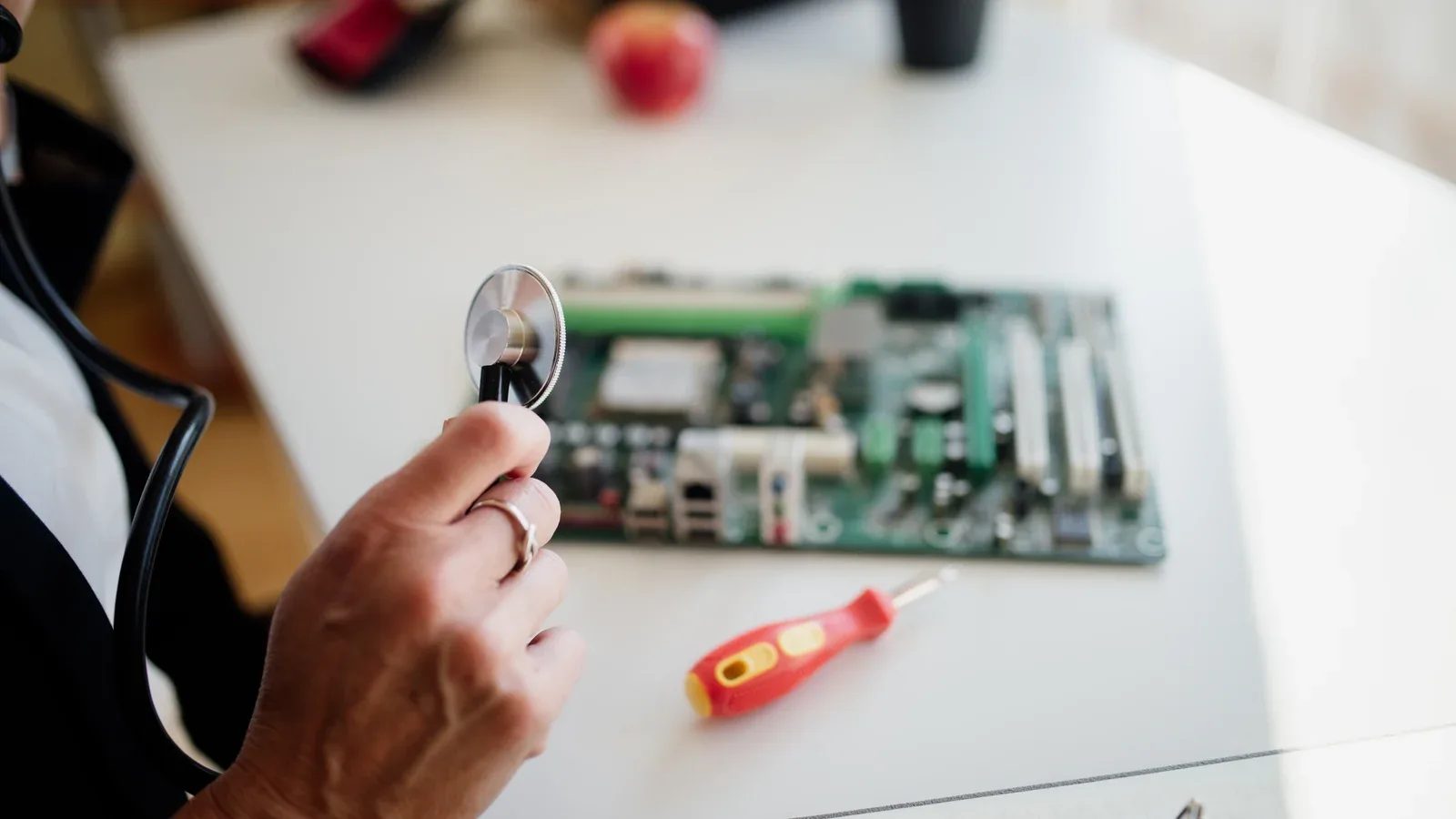
Illustrative stock photograph: circuit-board inspection by Nenad Stojković via Wikimedia Commons, licensed under CC BY 2.0. Cropped to 16:9. Source image.