
Lucid and Bolt Unveil 25,000-Robotaxi Europe Plan
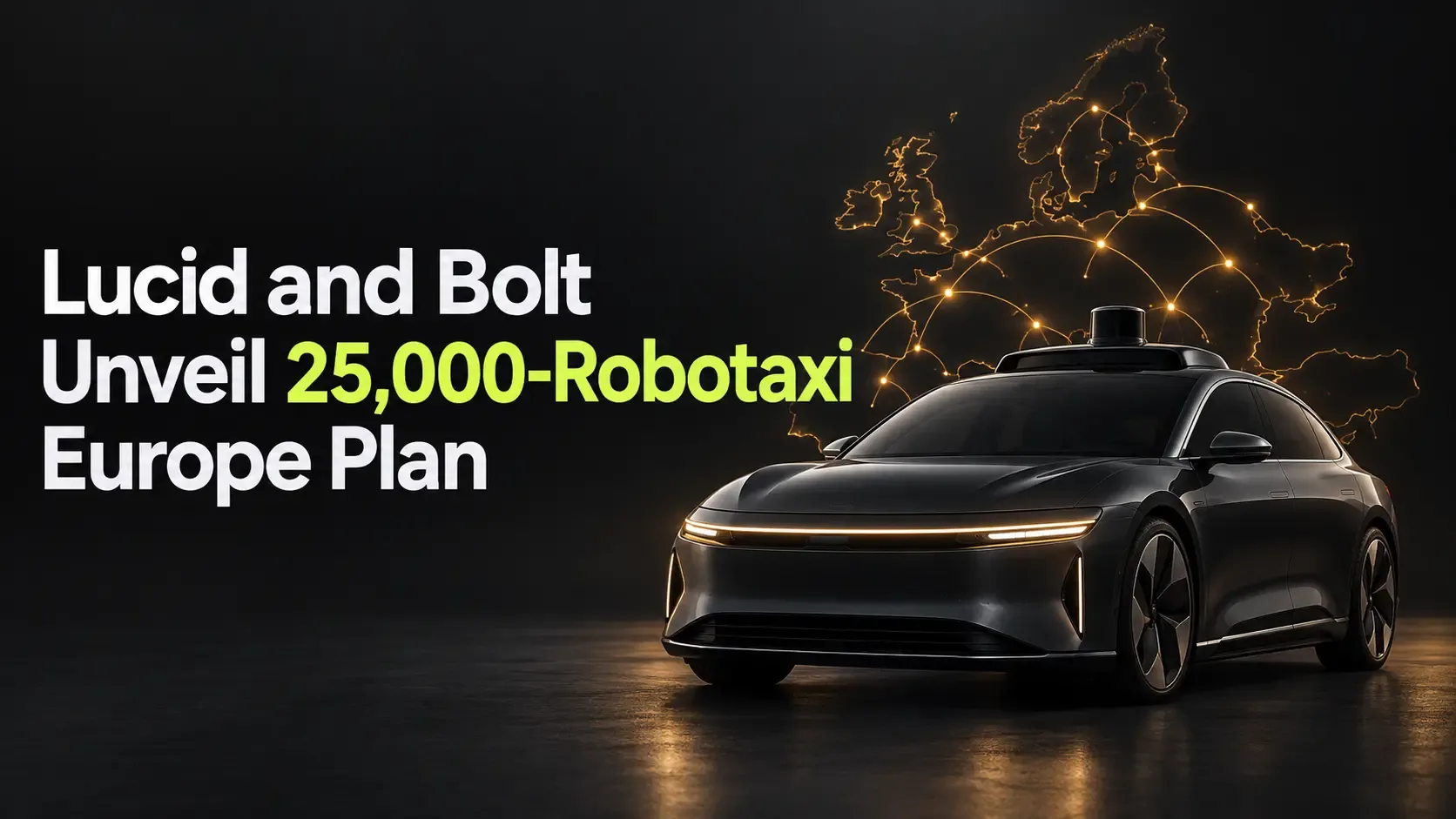
The Lucid and Bolt robotaxi plan will bring at least 25,000 fully autonomous vehicles to major European cities, giving the region one of its largest announced commercial deployments. Bolt intends to own and operate the fleet, while Lucid will supply a purpose-built vehicle platform.
The September 17 agreement links a European ride-hailing network with an electric-vehicle maker already pursuing a separate US robotaxi program. The partners have not disclosed financial terms, named the first cities or fixed a complete delivery schedule.
The partnership has four central components:
- At least 25,000 autonomous vehicles for Europe
- SAE Level 4 operation in defined service areas
- Lucid's forthcoming Midsize electric platform
- A Bolt-owned and operated commercial fleet
How the Lucid and Bolt Robotaxi Plan Works
Lucid and Bolt said they will co-develop a vehicle platform prepared for an autonomous-driving system. It will be based on Lucid's lower-cost Midsize architecture rather than the Air sedan or Gravity sport-utility vehicle that established the automaker's premium position.
The design is expected to use Nvidia's Hyperion autonomous-vehicle architecture. Hyperion combines onboard computing, sensors and software interfaces that automakers can use as the foundation for automated-driving systems, although the companies have not yet identified every autonomy supplier involved in the European fleet.
The target is SAE Level 4 automation. That classification permits a vehicle to drive without human intervention inside specified operating conditions, such as approved cities, mapped roads, weather limits and defined service zones. It does not mean the vehicle can operate autonomously everywhere.
Bolt's autonomous-driving division will set requirements covering the vehicle, software, safety and passenger experience. The unit is also responsible for the fleet infrastructure, operating systems and municipal relationships needed to turn vehicles into a functioning ride service.
Bolt Targets 100,000 Autonomous Vehicles by 2035
The 25,000-vehicle commitment forms part of Bolt's wider ambition to operate 100,000 autonomous vehicles by 2035. That scale would require expansion across several markets, regulatory approvals and enough charging, maintenance and remote-support capacity to keep the fleet available.
Bolt already operates ride-hailing and shared-mobility services across Europe, giving it customer demand, payments infrastructure and local operating teams. The harder task is adapting those systems for vehicles that do not have a driver to handle unusual road conditions, rider support or physical incidents.
The partners said they will work with autonomous-driving technology suppliers, regulators and policymakers. Those relationships will determine where Level 4 service can begin, how safety cases are evaluated and which party carries operational responsibility in each jurisdiction.
Reuters reported that Bolt plans to own and operate the vehicles. The publication also said manufacturing is expected at Lucid's new Saudi Arabian facility, while the Financial Times reported that rollout is targeted to begin by 2028.
Lucid Adds a Second Large Robotaxi Program
The Bolt agreement gives Lucid a European counterpart to its US robotaxi program with Uber and autonomous-driving company Nuro. Under that separate arrangement, Uber committed to deploy at least 35,000 Lucid vehicles, including Gravity SUVs and future Midsize models.
Both programs use planned volume to spread vehicle-development costs across more units. They also give Lucid a commercial customer for its Midsize platform before that architecture becomes a mass-market consumer product.
The structure differs from companies that build the vehicle, autonomy stack and ride network internally. Lucid contributes electric-vehicle engineering and manufacturing; Bolt supplies demand and fleet operations; Nvidia is expected to provide the underlying compute architecture; additional partners may supply autonomous-driving software.
That division can accelerate deployment by using established specialists, but it also creates integration risk. Safety depends on the vehicle, sensors, compute, driving software, maps, fleet operations and remote assistance working as one regulated system.
Europe's Robotaxi Market Moves Beyond Pilots
Europe has trailed the United States and China in paid driverless services, with most programs remaining small or experimental. Regulatory fragmentation, older street layouts and different national approval systems make continent-wide deployment more complicated than announcing a single fleet target.
Competition is nevertheless accelerating. Uber, Verne and Pony.ai launched robotaxi rides in Zagreb in August, while Waymo has been testing vehicles in Munich before a planned German service in late 2027. Bolt's proposed volume raises the stakes by pairing a large fleet number with an established European mobility platform.
The announcement is best read as a scale commitment rather than a finished launch timetable. The companies still need to identify cities, complete the vehicle, integrate the autonomy system and secure approvals. Progress will be measurable through production milestones, regulatory permits and the first paid passenger service.
Related Coverage