
Google Schedules Project Suncatcher AI Chip Test for Orbit
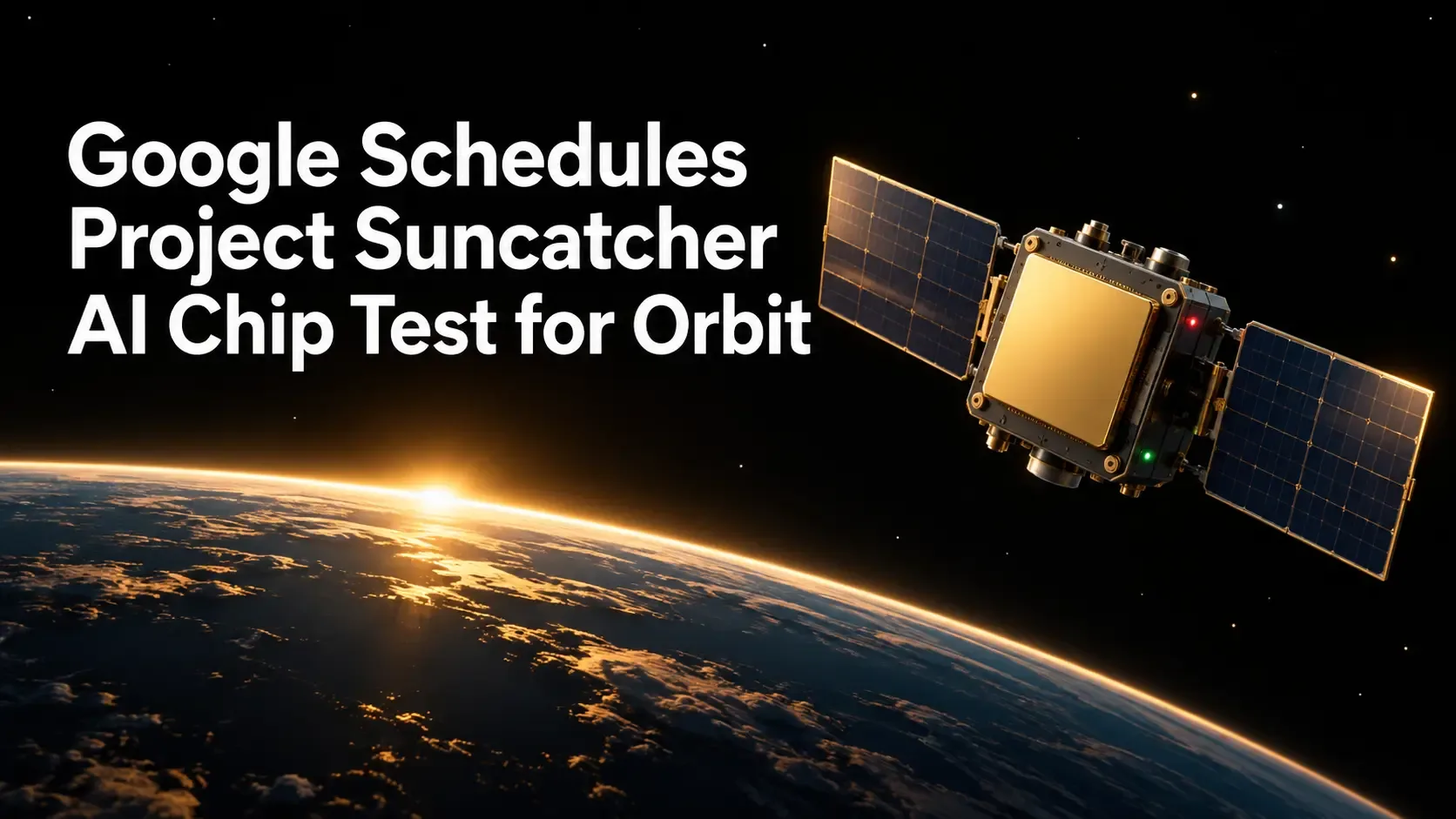
Google’s Project Suncatcher AI chip test is scheduled to send Tensor Processing Units into low Earth orbit next week, turning a speculative orbital-computing plan into a hardware experiment. The prototype will fly on SpaceX’s Transporter-18 rideshare mission with satellite company Planet.
The mission is deliberately narrow: it will measure how Google’s chips withstand launch forces, radiation and thermal extremes. It is not an operational space data center, but it will generate evidence for deciding whether larger AI-computing clusters in orbit are technically credible.
Related Research
Google Schedules Project Suncatcher AI Chip Test
Google announced the flight on September 24, saying the satellite would carry TPUs into orbit for the project’s first real-space test. The hardware will ride aboard an upcoming Transporter-18 launch, while Planet helped develop the satellite platform supporting the experiment.
The first mission is designed to examine four engineering risks:
- Vibration and acceleration during launch
- Radiation effects on TPU calculations
- Heat removal without atmospheric airflow
- Longer-term reliability in low Earth orbit
A rocket’s climb to low Earth orbit lasts roughly 10 minutes. Google says the spacecraft may encounter sustained loads of about 10 times Earth’s gravity, while individual components can experience 50 to 100 g, making launch survival a prerequisite for every later test.
Engineers shook the satellite along all three axes to reproduce launch vibration. Google reported that the hardware survived those ground tests, but the orbital mission will reveal whether the combined launch and space environment causes failures that laboratory simulations missed.
Trillium TPUs Face Radiation and Vacuum Cooling
Radiation can degrade electronics or produce bit flips that alter data. Google tested Trillium, its v6e Cloud TPU, in a proton beam at the University of California, Davis while the chips ran AI workloads, then monitored the computations for errors.
The company says those TPUs endured a total ionizing dose exceeding its estimate for a five-year mission. That result is encouraging but incomplete: laboratory irradiation cannot reproduce every interaction among radiation, temperature swings, power systems and sustained computing in orbit.
Cooling may be the harder constraint. Fans cannot carry heat through a vacuum, so Project Suncatcher uses heat pipes to move energy away from the processors and radiators to emit it into space. The prototype will test whether that system maintains workable temperatures during actual TPU operation.
Google has already placed the cooling assembly in a thermal-vacuum chamber. In-orbit measurements should expose how quickly the chips heat, how efficiently the radiator rejects energy and how frequently workloads must pause, all of which affect the economics of useful orbital compute.
Laser Links Are the 2027 Project Suncatcher Milestone
A single satellite cannot provide data-center-scale computing. Google’s longer-term design calls for compact groups of satellites, each carrying dozens of TPUs and linked by free-space lasers so machine-learning workloads can be distributed across many accelerators.
The company’s earlier research described inter-satellite links requiring tens of terabits per second. A bench demonstrator reached 800 gigabits per second in each direction using one transceiver pair, but maintaining such links between fast-moving spacecraft is a separate control problem.
Google compares the required pointing precision to hitting a coin-sized target from miles away while both endpoints move. It plans to put two satellites in orbit in 2027 to test those high-bandwidth optical links and the ability of nearby spacecraft to work as a coordinated cluster.
The current flight therefore tests chip survival and thermal management, while the 2027 mission addresses networking. Both must work before Project Suncatcher can attempt distributed AI computation at a scale that resembles even a small terrestrial cluster.
Orbital AI Computing Still Faces Economic Limits
The attraction is energy. Google says solar panels in the right low Earth orbit can be up to eight times more productive than panels on Earth and receive near-continuous sunlight, reducing reliance on batteries and terrestrial power grids.
That advantage does not settle the business case. Launch expense, satellite production, radiation tolerance, cooling capacity, network latency, repairs and replacement cycles could outweigh cheaper solar power. Reuters noted that industry experts still regard commercial orbital data centers as years away.
Project Suncatcher also competes with rapid improvements on the ground, including more efficient accelerators, liquid cooling, new power contracts and purpose-built data centers. Any orbital system would need to improve fast enough to justify launching hardware that may become obsolete during its service life.
Next week’s test will not answer those commercial questions. Its value is more fundamental: it can replace assumptions about TPU behavior in orbit with measured radiation, temperature and reliability data, giving Google a firmer basis for deciding whether its 2027 networking experiment should lead to larger constellations.