
TakeMe2Space Schedules MOI-1A Launch for October 1
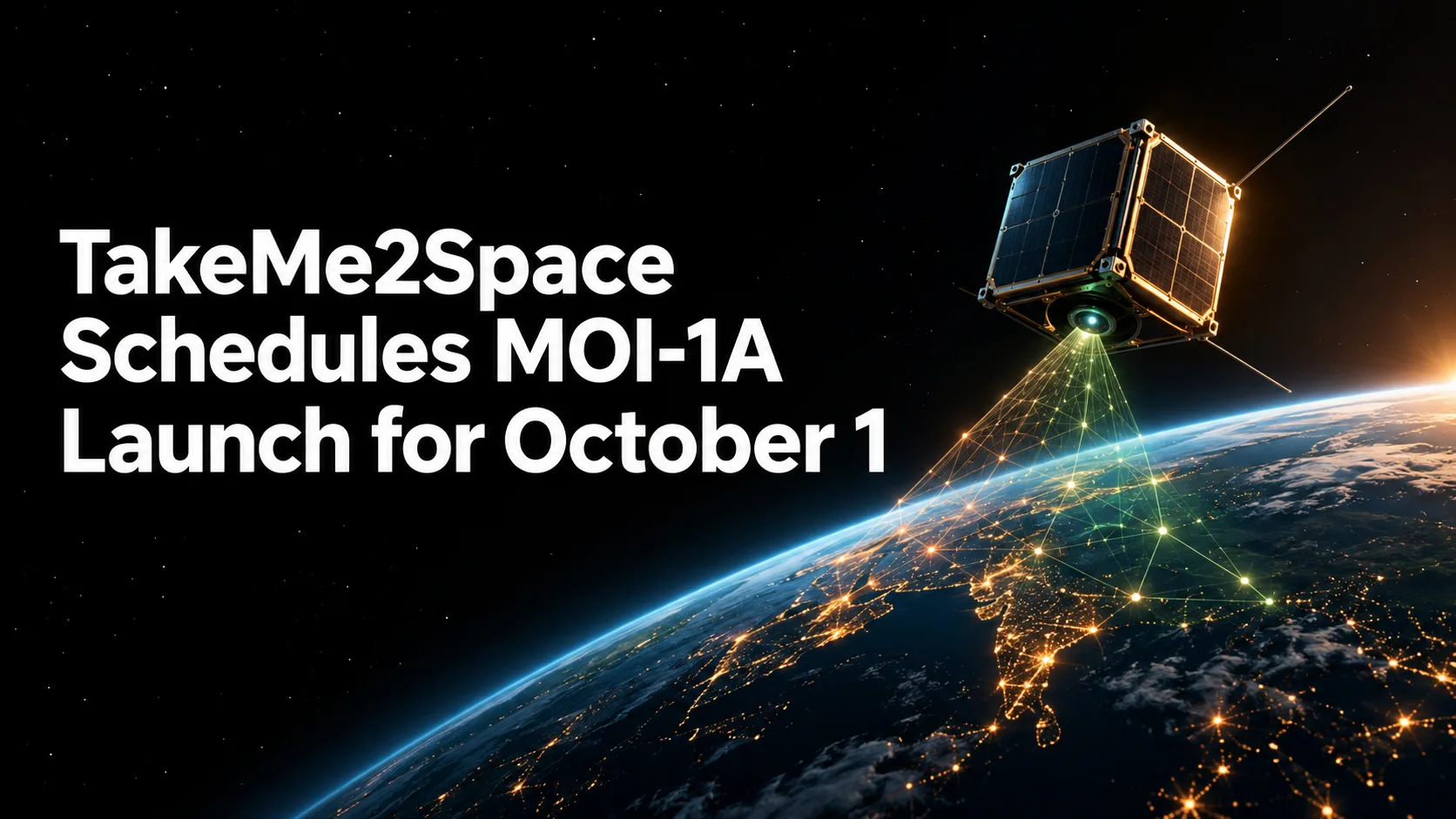
TakeMe2Space has scheduled its MOI-1A orbital-computing satellite for an October 1 launch aboard SpaceX's Transporter-18 rideshare mission, aiming to process Earth-observation data with AI before sending results back to the ground.
The mission combines four notable elements:
- A sub-50-kilogram satellite carrying Nvidia Orin NX processors.
- Containerized AI models uploaded by commercial and academic customers.
- A nine-band multispectral imager for Earth observation.
- Twenty-three customers signed for the first operational mission.
Related Coverage
TakeMe2Space Schedules MOI-1A Launch for October 1
The Indian startup says MOI-1A will become the first node in a planned orbital-computing network. Reuters reported on September 28 that the spacecraft is booked to fly on SpaceX's Transporter-18 mission, though launch dates can change with mission and range conditions.
MOI-1A is designed to perform edge computing in low Earth orbit rather than behave like a terrestrial data center. Founder and chief executive Ronak Samantray told Reuters that the spacecraft operates with about 150 watts of power.
TakeMe2Space lists a 117-TOPS graphics processor, 16GB of memory and a nine-band multispectral optical imager. Reuters identified the computing hardware as Nvidia Orin NX processors, a family commonly used for robotics and other edge-AI workloads.
The spacecraft is smaller and less powerful than proposed orbital systems built around data-center-class accelerators. Its immediate purpose is narrower: analyze sensor data close to where it is collected and return compact findings instead of transmitting every raw image.
How MOI-1A Will Run Customer AI Models
Customers will be able to upload containerized models to the satellite. During a pass over a selected area, the system can run inference against new imagery and send the resulting classification, detection or other analysis to Earth.
That architecture targets a persistent satellite bottleneck. Earth-observation sensors can collect more information than limited radio links can quickly transmit, especially when a customer needs only a specific answer rather than a complete image archive.
TakeMe2Space says in-orbit processing can reduce transmission costs by as much as 85%, a company estimate that will need validation under live customer workloads. Its OrbitLab service advertises access by satellite-use time rather than requiring customers to build an entire mission.
The 23 signed customers include geographic-information companies and educational institutions, according to Reuters. Commercial applications span agriculture, mining, insurance and supply-chain management, while U.S. space-data specialist Little Place Labs is among the named users.
From a Demonstration Mission to a Six-Satellite Network
The company previously demonstrated uploading applications, performing AI inference in orbit and downloading results. Its website says a 14-day test completed in January 2025 validated onboard computing and its radiation-shielding technology.
A later spacecraft, MOI-1, was lost after a launch vehicle's third stage failed. MOI-1A therefore carries both technical and commercial significance: it must show that the computing stack works while customers are depending on the output.
TakeMe2Space plans a six-satellite constellation by the fourth quarter of 2027. The company says the network would provide daily global coverage and shorten the time between observing a change on Earth and delivering a usable result.
Larger, networked satellites are planned from 2027 to support more users and increase computing capacity. The startup also proposes orbital cold storage for critical data, targeting financial-services and defense customers seeking an additional backup location.
Orbital AI Faces Power, Radiation and Economics Tests
Computing in orbit can reduce downlink traffic, but it introduces constraints that cloud operators largely avoid. Processors must work within tight power and cooling limits, tolerate radiation, survive launch and remain useful despite slow or impossible hardware replacement.
The economics also depend on selecting workloads where transmitting raw data is expensive or too slow. Customers with frequent, high-resolution imagery and urgent decisions have the clearest incentive; many ordinary analytics jobs will remain cheaper on Earth.
MOI-1A will not settle the broader debate over data centers in space. It is a smaller test of whether edge AI can turn satellite observations into timely intelligence and whether enough customers will pay for that processing before the data reaches the ground.
If the October 1 launch and commissioning proceed as planned, the mission will provide unusually concrete evidence: customer models, real orbital hardware and measurable reductions in data sent to Earth. Those results will matter more than the data-center label attached to the satellite.