
USTDA Funds Nigeria AI Data Center Study for 100MW Plan
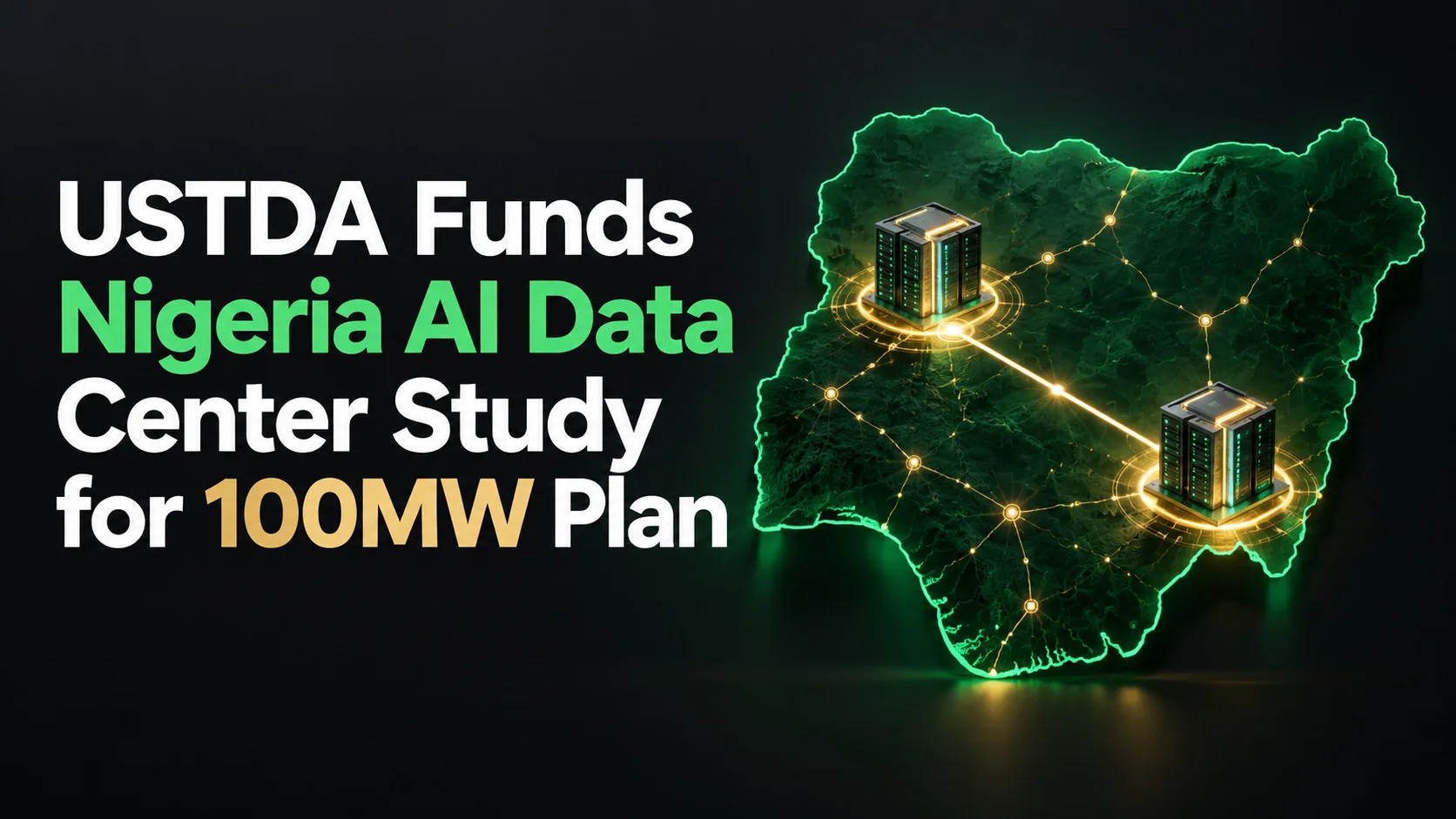
USTDA funds Nigeria AI data center study work for two proposed facilities in Lagos and Delta states, giving the AFRIDATA project a formal technical and financial review before construction financing is pursued. The plan starts at a combined 60–70 megawatts and reserves room to expand to 100 MW.
The U.S. Trade and Development Agency signed the study agreement with South Africa-based infrastructure investor Infragora Global Capital. A separate procurement notice shows that USTDA is providing a $1.87 million grant and seeking a U.S. firm to complete the feasibility work.
The official project documents identify four core elements:
- A primary AI-ready facility in Lagos.
- A redundant recovery site in Delta.
- Initial combined capacity of 60–70 MW.
- An expansion pathway to 100 MW.
USTDA Funds Nigeria AI Data Center Study Before Construction
USTDA announced the agreement on September 23, describing it as the opening phase of Infragora’s planned AFRIDATA Datacenter Platform. The agency will fund commercial and technical assessments rather than the data centers themselves, an important distinction for understanding the project’s current status.
The study will examine whether the proposed facilities are technically feasible, financially bankable and suited to likely customers. It will also assess regulatory risks, identify potential U.S. technology suppliers and outline the financing requirements needed to move from planning into implementation.
USTDA’s procurement page sets an October 13 deadline for qualified U.S. firms to submit proposals. The selected contractor would be paid from the $1.87 million grant, with the work supporting Infragora’s choice of development and commercialization strategy.
No construction schedule, total project budget or committed implementation financing has been published. The feasibility process could strengthen the case for investment, but it does not guarantee that either site will be built at the proposed size.
Lagos and Delta Sites Have Different Infrastructure Roles
Infragora plans the Lagos site as the primary facility, with AI-ready and cloud-enabled capacity designed for Tier IV certification. Tier IV is the highest level in the Uptime Institute’s widely used classification system, built around extensive redundancy and continuous availability.
The Delta facility would operate as the secondary site and disaster-recovery location. Project documents say it could be designed to Tier III or Tier IV standards while offering similar compute and cloud capabilities, allowing customers to distribute workloads and recovery capacity across two states.
The proposed commercial model combines AI compute, cloud services and colocation. Likely customers include cloud providers, banks and mobile network operators that need local rack space for data-intensive services while retaining more control over latency, resilience and data location.
The documents describe 3,600 conventional server racks rated at 10 kilowatts each and 480 higher-density racks rated at 50 kilowatts for GPU systems. That planned mix reflects the much heavier power and cooling requirements of AI accelerators compared with standard enterprise servers.
AFRIDATA Uses Nigeria as Its First National Market
Infragora incorporated AFRIDATA DATACENTER NIGERIA in April 2026 as the special-purpose company intended to own and operate the facilities. The investment firm expects institutional investors, private equity and an experienced data center operator to participate alongside it.
Nigeria is the first market for a broader platform that Infragora says could later establish entities in Angola, Cameroon, Côte d’Ivoire, Egypt, Ghana, Kenya and South Africa. The Nigerian study will therefore test both a local project and a template the company may try to replicate elsewhere.
USTDA says Africa currently hosts less than 2% of global data center capacity. Limited local infrastructure can force businesses to rely on distant servers, adding latency and complicating resilience, cybersecurity and data-governance decisions.
The agency also has a clear industrial-policy objective. Its funding requires the study to be performed by a U.S. company and is intended to create opportunities for American suppliers of cloud platforms, storage, networking, computing hardware, AI software and cybersecurity systems.
Power, Financing and Customer Demand Will Decide the 100MW Plan
The feasibility study must determine whether the initial 60–70 MW configuration can secure reliable power, suitable sites, network connectivity and enough paying customers. Those conditions are especially important for GPU racks, which concentrate far more electrical load and heat than conventional server deployments.
Project bankability will also depend on credible construction costs, long-term power arrangements and commitments from anchor tenants. The study’s product-market assessment is expected to test demand from banks, telecom operators and cloud providers before investors commit capital to the full buildout.
The 100 MW figure is an expansion target, not the opening capacity. Reporting it as a completed investment would overstate the announcement. The material development is that USTDA has funded the work needed to test the plan, identify suppliers and prepare a route toward financing.
If the project advances, it could add locally hosted capacity for AI inference, cloud applications and regulated industries while creating redundancy outside Lagos. The next concrete milestones are the selection of the study contractor, completion of the assessments and evidence that financing and customer demand support construction.