
Google Launches TPU 8tx and TPU 8i Max
Google launches TPU 8tx and TPU 8i Max, two specialized eighth-generation accelerator systems aimed at confidential inference and AI workloads with very large context windows. The November 9 announcement expands Google’s latest TPU family to four systems introduced in one year.
The hardware targets two constraints that increasingly shape production AI: protecting sensitive data while it is being processed and moving enough data through memory to keep agents responsive. Google disclosed architectural details and relative performance claims, but did not publish prices, release dates or independent benchmark results.
The launch establishes four concrete changes:
- TPU 8tx adds hardware-level confidential computing.
- TPU 8i Max combines two TPU 8i chips in one package.
- The Max system doubles compute, SRAM and HBM bandwidth.
- Google now offers four specialized eighth-generation TPU systems.
Further Reading
Google Launches TPU 8tx and TPU 8i Max as Complete Systems
Google describes 8tx and 8i Max as new systems rather than entirely new processors. The company is reconfiguring existing eighth-generation silicon with different packaging, host processors, memory, networking and security features, allowing it to address new workloads without waiting for another multi-year chip design cycle.
TPU 8tx uses the same underlying silicon as the training-focused TPU 8t and pairs it with fifth-generation AMD EPYC CPU hosts. Its confidential-computing design is intended to keep customer data and model weights isolated while they are active in memory, a period when conventional storage and network encryption cannot protect them.
Google also equips 8tx with the low-latency Boardfly network developed for inference. The company claims the configuration can deliver up to two times lower latency than TPU 8t with a near-zero performance penalty. That comparison is vendor-reported and will need independent testing across real models and security settings.
TPU 8i Max takes a different approach. Google combines two low-latency TPU 8i chips in one package, doubling compute, on-chip SRAM and high-bandwidth-memory throughput while keeping the system within the existing rack footprint. The design is meant to reduce stalls when agents process large codebases, long videos or million-token contexts.
TPU 8tx Targets Regulated and Proprietary AI
Confidential computing matters most when organizations cannot expose prompts, private training data or proprietary model weights to a shared infrastructure layer. Google is positioning 8tx for governments and regulated industries that want to run inference, fine-tuning and other model-customization work near sensitive information.
The system is designed to support private fine-tuning, model distillation and reinforcement learning without transferring data between separate training and inference clusters. Fewer transfers can reduce operational complexity and the number of places where data must be copied, although customers will still need to evaluate access controls, attestation and key management.
Hardware isolation does not make an application secure by itself. Software vulnerabilities, misconfigured permissions and unsafe agent tools remain separate risks. Google has not yet published customer audits or workload-specific security evaluations for 8tx, leaving deployment evidence as an important test of the product’s claims.
TPU 8i Max Pushes Against the Memory Wall
Large-context inference often becomes limited by memory movement rather than arithmetic alone. Model weights, key-value caches and active context must move quickly enough that processors do not sit idle. The 8i Max package increases compute and memory bandwidth together, an attempt to avoid improving one side of that balance while leaving the other constrained.
Google says the denser package provides the highest compute density per rack in its TPU portfolio. The company has not disclosed power consumption, thermal requirements or a price-performance comparison for 8i Max, so operators cannot yet determine whether its density translates into lower total cost for sustained production workloads.
The new systems complete a four-part portfolio. TPU 8t targets large training jobs, TPU 8i focuses on low-latency reasoning, 8tx adds confidential inference and 8i Max handles high-context workloads. Google says TPUs now serve nearly 100 customers across frontier labs, trading, retail and universities.
Software Access Will Shape Google’s Nvidia Challenge
Google is coupling the hardware launch with a broader effort to reduce software friction. It recently open-sourced TorchTPU so PyTorch and Hugging Face models can run on TPUs, alongside backends for vLLM and SGLang. A preview agent suite is intended to automate onboarding, diagnose bottlenecks and tune kernels through coding tools.
The company is also open-sourcing TPU Sync, a model-state layer that coordinates accelerator memory, host memory, storage and networking. Google reports that it can cut key-value-cache transfer latency and time to first token by more than 90 percent, another vendor result that needs reproducible external measurement.
Reuters reported that Google Cloud revenue more than doubled to $30.71 billion in the September quarter and that Alphabet shares rose more than 3 percent after the announcement. The commercial push places Google’s custom accelerators in more direct competition with Nvidia, whose hardware and CUDA software remain deeply established.
The decisive evidence will come from availability, pricing, power use and measured performance on customer workloads. Google has defined where 8tx and 8i Max fit; it has not yet shown whether buyers can deploy them more economically than competing GPU systems or earlier TPU configurations.
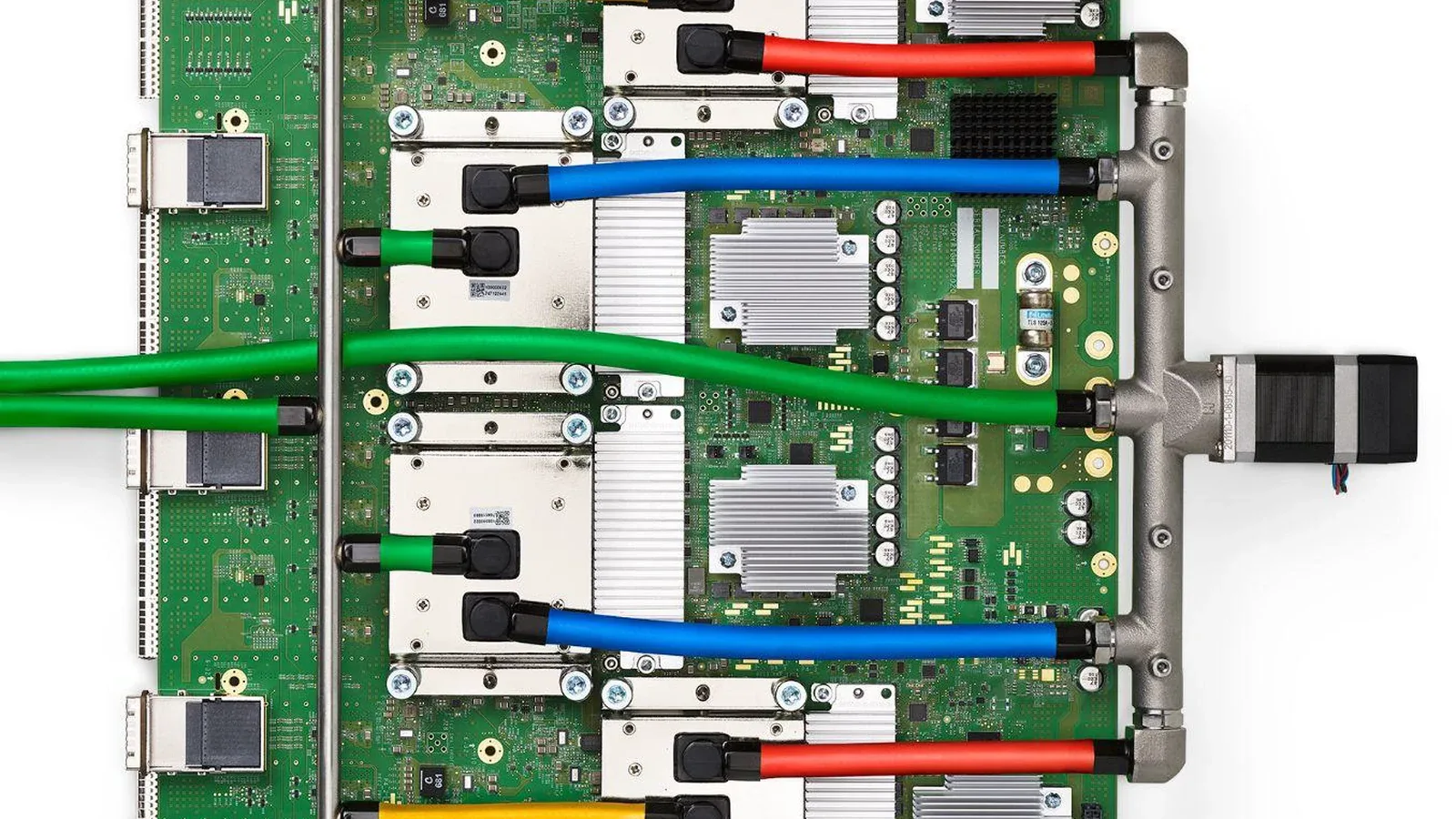
Illustrative feature image: a Google TPU v4 board by Norman P. Jouppi and co-authors, sourced from Wikimedia Commons and cropped and resized under CC BY 4.0. It does not depict the newly announced TPU 8tx or TPU 8i Max systems.