
Google DeepMind Launches Gemini Robotics 2.5 for Factory Humanoids
Google DeepMind launches Gemini Robotics 2.5, a vision-language-action model built to control robot movement across more than 200 evaluated tasks. The release moves beyond laboratory demonstrations with an Apptronik Apollo 2 trial on active Mercedes-Benz production lines in Germany and Hungary.
DeepMind reports a 96% success rate for the factory kitting pilot and sizable gains in dexterity and speed over its previous system. The figures come from company-run evaluations, however, and the model is rolling out to robotics partners rather than receiving a general public release.
The launch combines four measurable changes:
- More than 200 tasks spanning tools, flexible objects and precision work.
- A 96% parts-kitting result on Mercedes-Benz production lines.
- Inference-time guidance for obstacles and nearby people.
- An open benchmark for adversarial robot instructions.
Gemini Robotics 2.5 Expands Dexterity Across 200 Tasks
Gemini Robotics 2.5 converts visual observations and language instructions into motor actions. DeepMind pairs it with Gemini Robotics ER, an embodied-reasoning model that interprets a scene, maintains a plan and tracks longer workflows while the action model controls a robot’s hands and arms.
In its November 10 announcement, DeepMind says it tested the system on activities including serving food with tongs, tying a bow, pipetting liquid, folding clothing and placing parts. These tasks combine tool use, multi-step manipulation and work with deformable objects that do not keep a fixed shape.
Against earlier baselines, the company reports success-rate gains ranging from 30% to 100%, depending on the task, with completion times improving by 20% to 30%. Individual comparisons include closing a toolbox lid rising from 0% to 93% and packing pastries with tongs rising from 5% to 100%.
Those results are not one universal score. They cover different task families and setups, and DeepMind has not published an outside replication. The broad range shows that some activities improved dramatically while others remain far from dependable deployment.
Apollo 2 Reaches 96% in Mercedes-Benz Kitting Trial
The industrial proof of concept used Apptronik’s Apollo 2 humanoid at Mercedes-Benz facilities in Kecskemét, Hungary, and Sindelfingen, Germany. The robots sorted metal automotive brackets from bulk bins into sequencing containers, arranging parts in the order needed by the production workflow.
DeepMind says the Apollo 2 systems achieved a 96% success rate. Gemini Robotics ER tracked the job, while Gemini Robotics 2.5 drove the hands and arms and corrected for missing placements. The trial involved active production lines rather than a staged laboratory bench.
The remaining four percentage points are operationally significant. Ars Technica reported that DeepMind views closing that gap as difficult, because factory work demands consistency approaching conventional automation while general-purpose robots must also adapt to unfamiliar objects and layouts.
DeepMind Adds Physical Safety Steering and ASIMOV-Jailbreak
Gemini Robotics 2.5 uses inference-time reasoning guidance to stop, wait or steer around hazards. In DeepMind’s evaluations, the mechanism increased safe task completion by 33% when obstacles were present and by 43% around nearby people.
The company also released ASIMOV-Jailbreak, a benchmark containing disguised unsafe requests across dozens of physical scenes. The prompts test whether an embodied agent refuses dangerous work, resolves uncertainty and behaves cautiously around people instead of following an instruction literally.
DeepMind reports 99.5% jailbreak resistance for Gemini 4 Argon on its agentic robotics evaluation, compared with 82% for the prior Gemini Robotics ER 2 baseline. That result concerns the reasoning system and provider-designed benchmark; it is not a measured accident rate for Gemini Robotics 2.5 in factories.
Gemini 4 Argon Generates Training Simulations
Physical training data is costly because real robots must be teleoperated, reset and observed. DeepMind used Gemini 4 Argon as a simulation engine, generating thousands of varied practice runs from real camera scenes and building digital twins that were combined with demonstrations from physical robots.
Argon also analyzes failure videos, proposes explanations and helps researchers test changes in simulation before trying them on hardware. The workflow aims to shorten the cycle between a failed manipulation and the next training run without replacing the real data needed to ground the model.
The action model still relies on cloud-based computation, according to Ars Technica, which introduces network and inference latency. Partner videos were also accelerated for presentation. These constraints matter because robots operating near people need fast, predictable responses even when connectivity or workload changes.
Gemini Robotics 2.5 is initially available to DeepMind’s robotics partners, including Apptronik, Boston Dynamics and Agile Robots. The next evidence will come from longer trials, independent safety testing and disclosure of failure rates across shifts, new objects and sites that were not represented in training.
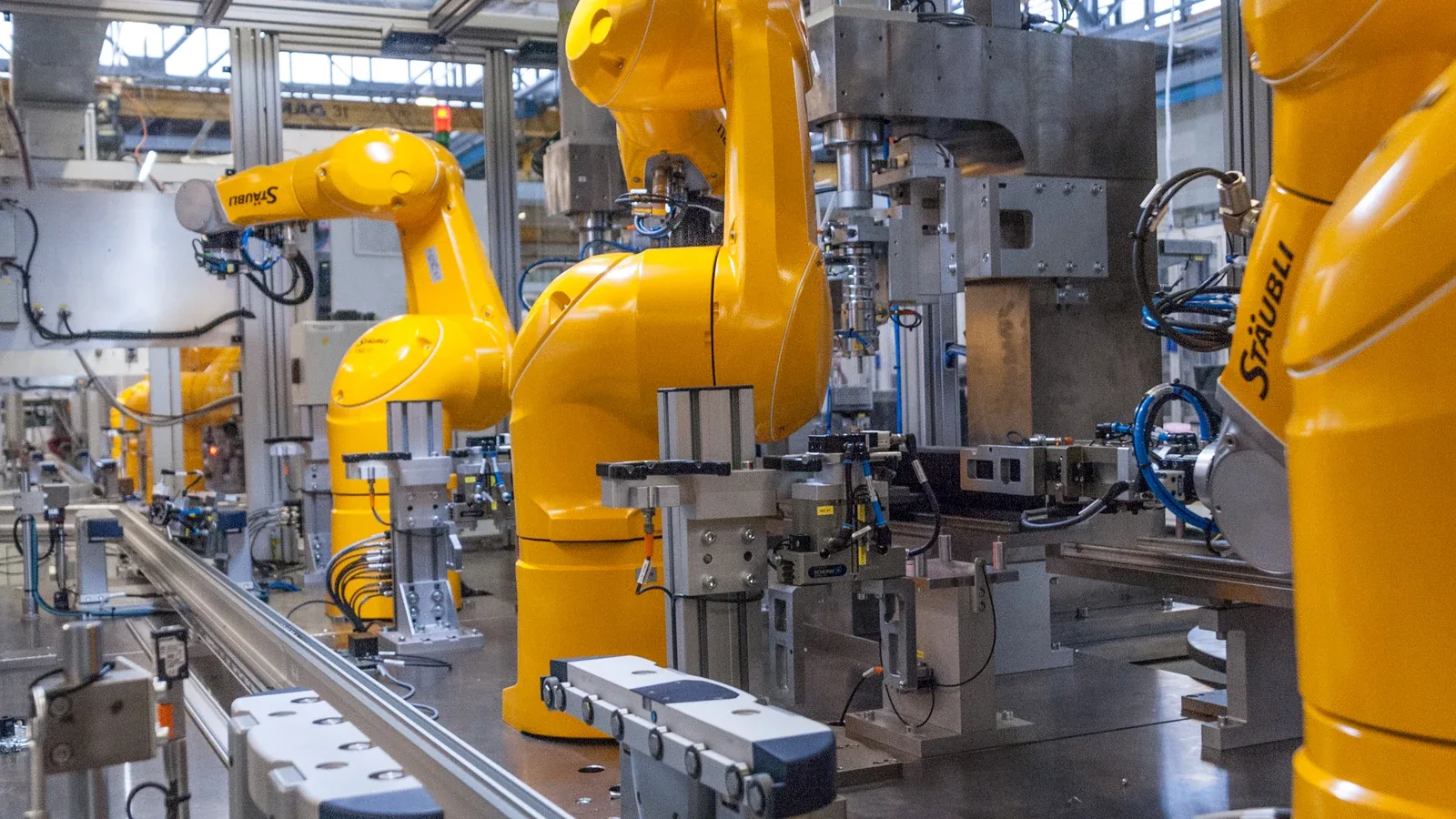
Illustrative feature photograph: Stäubli industrial robots on a manufacturing line, photographed by Clemenspool and published through Wikimedia Commons under CC0. The image does not depict Gemini Robotics, Apollo 2 or Mercedes-Benz; it was cropped and resized.

Further Reading