
Adobe and Disney Launch Proprietary AI Model Alliance
Adobe and Disney launch a proprietary AI model alliance that will build private generative systems for theme-park design, film production and sports storytelling. The multi-year agreement makes Adobe an official AI innovation partner of The Walt Disney Company.
The companies are moving beyond access to general-purpose software. Disney teams will work with Adobe engineers and researchers on models tailored to Disney properties, while receiving early access to Firefly, Firefly Foundry, Premiere and Photoshop.
The alliance begins with four operating areas:
- Theme-park concept development at Walt Disney Imagineering
- Post-production and visual-effects experiments at StudioLAB
- Sports storytelling and archive projects at ESPN Edge
- Dedicated Adobe engineering and research support
Adobe and Disney Launch a Proprietary AI Model Alliance
Adobe announced the agreement at Adobe MAX on November 9. Financial terms were not disclosed, and neither company published a schedule for every product or business unit covered by the partnership.
Firefly Foundry is the central model-building platform. Adobe says the system can be customized with knowledge about character attributes, environments and visual styles, producing models that remain private and proprietary to Disney rather than being offered as public Disney generators.
The companies describe the models as human-centered and artist-led. They also call the planned outputs commercially safe and production-ready, but those are corporate claims. The announcement does not provide independent evaluations of brand accuracy, copyright risk, model reliability or production acceptance rates.
The arrangement gives Adobe a prominent customer for a strategy increasingly important to enterprise AI: adapting a model to a company's protected intellectual property and internal workflows. Disney gains a technology partner with tools already embedded across creative production, marketing and digital experiences.
Firefly Foundry Enters Imagineering's Design Pipeline
Walt Disney Imagineering Research and Development is already using Firefly Foundry in the theme-park development pipeline. One model turns rough hand-drawn sketches into rendered two-dimensional concept art; another generates visual assets intended to remain consistent with a franchise's established look.
The immediate target is iteration. Designers can compare more variations before committing to expensive physical work, while artists retain responsibility for selecting, correcting and developing the result. That makes the models part of concept exploration rather than an autonomous design authority.
Reuters reported that Imagineering executive Kyle Laughlin said some creative processes that took months can now be compressed into hours or days. He also said the tools are not intended to replace Imagineering roles. The companies did not publish a measured productivity study or a workforce guarantee.
Faster early-stage exploration could reduce late changes during construction, where revisions are considerably more expensive. The practical benefit will depend on whether the generated concepts preserve engineering constraints, accessibility requirements, safety rules and the precise character details that Disney treats as part of its brand.
StudioLAB and ESPN Edge Extend the Alliance
The partnership also reaches The Walt Disney Studios' StudioLAB. Adobe says the initial work will focus on custom models for post-production and visual effects, giving Disney creatives and technologists a controlled setting to test whether AI can speed repetitive steps without weakening artistic direction.
At ESPN Edge, the two companies will explore systems for sports highlights, documentaries, fan engagement and archive access. An archive model could help staff search, organize or adapt decades of footage, but the announcement does not specify which media rights, league agreements or talent permissions will govern generated material.
These projects place the same core idea inside three very different workflows. Imagineering works toward physical experiences, StudioLAB prototypes film-production tools, and ESPN handles fast-moving sports content. Each setting will require separate approvals, evaluation criteria and records showing how a generated asset reached publication or production.
Co-innovation projects are already underway, according to Adobe. Additional activations will roll out during the agreement's multi-year term, including marketing, industry events and customer storytelling. No public launch dates were given for tools arising from StudioLAB or ESPN Edge.
Disney's IP Controls and Missing Disclosures
The alliance gives Disney more control than a public image or video service would provide. Private models can be limited to approved users, trained or customized with selected property knowledge, and integrated into review systems designed around studio, park or sports operations.
Control still depends on implementation. Disney and Adobe have not disclosed the model architectures, the exact source material used for customization, retention rules for prompts and outputs, approval chains, audit methods or the safeguards that prevent one property from bleeding into another.
The companies also have not released benchmark results for character fidelity, visual consistency, false outputs or human correction time. Those measures will determine whether the tools reduce total production work or simply move effort from drawing and editing into prompting, review and cleanup.
The agreement is a significant enterprise deployment because it connects proprietary generative models to active creative pipelines across parks, studios and sports. Its broader importance will depend on the evidence Disney and Adobe publish about rights controls, artist oversight and real production performance.
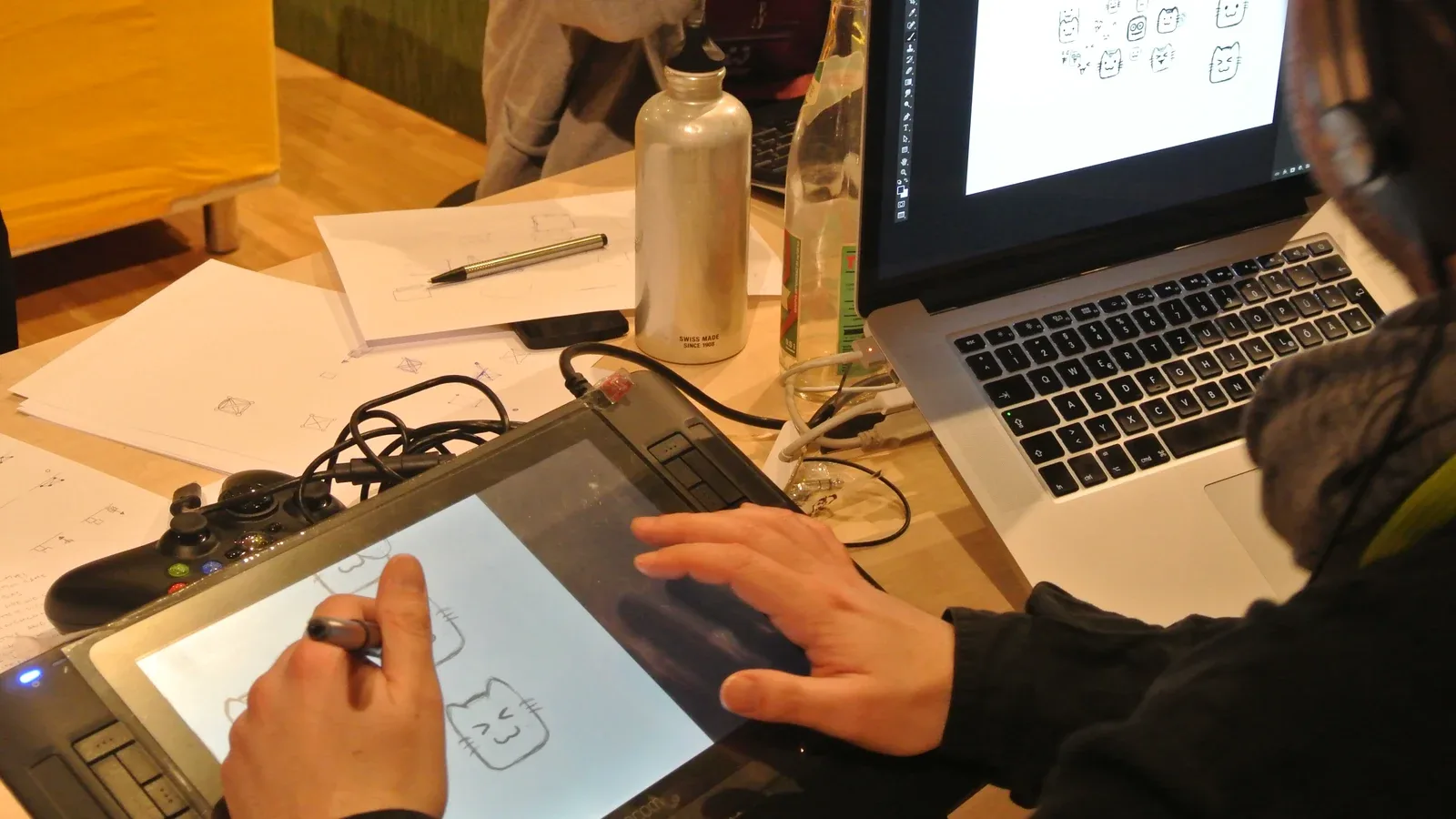
Illustrative feature image: Iwan Gabovitch photographed a digital artist using a graphics tablet at Global Game Jam Berlin 2014. The image was cropped and resized from Wikimedia Commons under the CC BY 2.0 license; it does not depict Adobe, Disney or the announced alliance.

Related Research