
Q-Day Is Coming: The Quantum Computing Threat That Could Break Internet Security
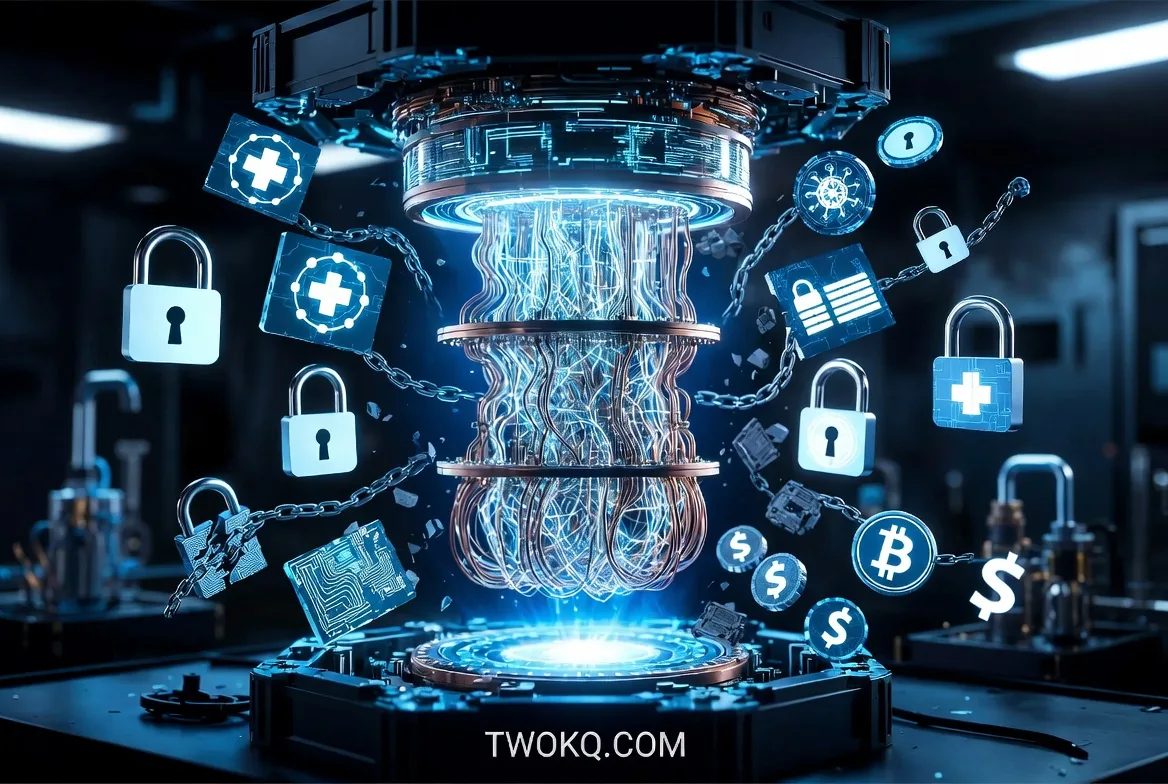
The next major cybersecurity crisis may not begin with a ransomware attack, a data breach, or a sophisticated state-sponsored hacking operation.
Instead, it could arrive the moment a sufficiently powerful quantum computer comes online.
Security researchers call this moment "Q-Day" — the point at which quantum computers become capable of breaking the cryptographic systems that protect much of the world's digital infrastructure.
While the exact date remains unknown, growing advances in quantum computing have dramatically shortened the timeline many experts once believed they had to prepare.
For decades, encryption has acted as the invisible foundation of the internet. Every online bank transfer, confidential email, medical record, cloud storage account, and e-commerce transaction relies on mathematical problems that are effectively impossible for today's computers to solve within a practical timeframe.
Quantum computers threaten to change that equation.
Unlike traditional computers that process information using binary bits representing either 0 or 1, quantum machines use quantum bits, or qubits, which can exist in multiple states simultaneously.
This unique property allows quantum systems to solve certain classes of mathematical problems exponentially faster than conventional computers.
The implications for cybersecurity are profound.
Much of today's digital security relies on encryption systems such as RSA and elliptic curve cryptography. These systems protect data by leveraging mathematical problems that would take conventional computers thousands or even millions of years to solve.
A sufficiently advanced quantum computer could potentially reduce that timeline to hours.
When that threshold is crossed, encrypted information that appears secure today could suddenly become vulnerable.
The concern extends far beyond future communications.
Cybersecurity experts increasingly warn about a tactic known as "harvest now, decrypt later." Under this strategy, attackers collect encrypted information today and store it for future use.
Once quantum computers become powerful enough, the stolen data can be decrypted, exposing information that may have been considered secure for years.
This threat is particularly serious for information with long-term value.
Medical histories, government intelligence, legal records, intellectual property, military communications, financial transactions, and genetic information could remain sensitive decades into the future.
Data stolen today may still be valuable when quantum decryption becomes possible.
Recent developments have intensified concerns throughout the technology industry.
Researchers have steadily improved quantum hardware while simultaneously finding more efficient ways to attack existing cryptographic systems.
Some studies now suggest that the resources required to break modern encryption may be significantly lower than previous estimates.
These findings have prompted major technology companies to accelerate preparations.
Organizations across the technology sector are investing heavily in post-quantum cryptography, a new generation of encryption algorithms specifically designed to resist attacks from future quantum computers.
Unlike traditional cryptographic methods, these systems rely on mathematical problems believed to remain difficult even for quantum machines.
Governments have also begun responding.
Cybersecurity agencies in multiple countries have issued guidance encouraging organizations to begin transitioning toward quantum-resistant security standards.
New cryptographic frameworks have already been developed and standardized, but implementing them across global digital infrastructure is a challenge measured in years rather than months.
The complexity of the transition cannot be underestimated.
Encryption is deeply embedded in modern technology.
Financial networks, cloud services, industrial control systems, telecommunications infrastructure, healthcare platforms, and government databases all depend on cryptographic protections that may eventually require replacement.
Historically, major cryptographic migrations have taken more than a decade to complete. Experts warn that the transition to quantum-resistant systems could take even longer due to the scale and complexity of modern digital ecosystems.
The financial stakes are enormous.
Researchers have warned that a successful quantum attack against critical financial infrastructure could trigger widespread economic disruption.
Payment networks, interbank transfer systems, and digital asset platforms all depend on encryption that may one day face quantum threats.
Cryptocurrency ecosystems face a particularly difficult challenge.
Many blockchain networks rely heavily on elliptic curve cryptography for wallet security and transaction verification.
While quantum-resistant alternatives exist, implementing them across decentralized networks requires broad consensus among developers, operators, and stakeholders.
Healthcare systems may face equally significant risks.
Electronic health records contain highly sensitive information that remains valuable for a person's entire lifetime. Unlike passwords or credit card numbers, medical histories and genetic data cannot simply be changed after exposure.
Emerging technologies such as connected medical devices present another area of concern.
Devices including insulin pumps, pacemakers, and remote monitoring systems often operate under strict power and hardware constraints, making it difficult to implement computationally intensive security upgrades.
Researchers are already working on solutions. New ultra-efficient security chips designed specifically for post-quantum protection are being developed to secure resource-constrained devices without significantly increasing power consumption.
Yet one of the most challenging aspects of the quantum threat is uncertainty.
Unlike many technological shifts that unfold in public view, advances in quantum computing may occur behind closed doors.
Research conducted by governments, defense agencies, private laboratories, or state-backed programs may not become publicly visible until significant breakthroughs have already occurred.
This uncertainty makes planning difficult.
Organizations cannot predict exactly when Q-Day will arrive, but they also cannot afford to wait until it does.
Many experts compare the challenge to the Y2K problem that worried governments and businesses before the year 2000. The difference is that quantum computing is not a software bug with a fixed deadline. It is an evolving technological race with an unknown finish line.
The encouraging lesson from Y2K is that widespread preparation prevented a major crisis.
A similar outcome is possible with quantum cybersecurity.
The technologies needed to defend against future quantum attacks already exist. What remains uncertain is whether organizations will move quickly enough to deploy them before quantum computers reach the capabilities experts increasingly believe are approaching.
For now, the internet's security foundations remain intact.
But as quantum computing advances from scientific promise to practical reality, the race to secure the digital world has already begun.
Whether governments, businesses, and technology providers can stay ahead of that timeline may determine how disruptive Q-Day ultimately becomes.