
10 Best AI Image Generators for Business, Advertising and Content Creation in 2026 (Tested & Ranked)
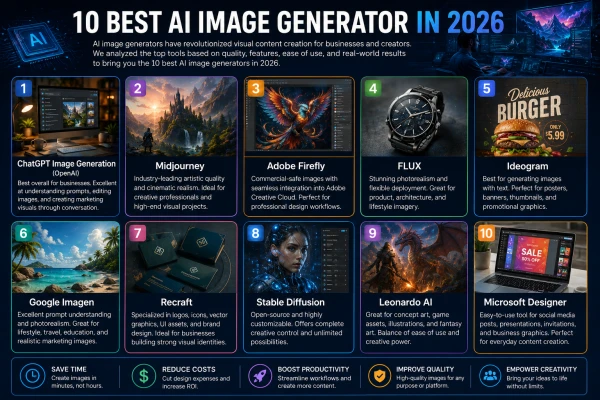
Artificial intelligence has completely transformed how businesses create visual content. What once required expensive design software, professional photographers, graphic designers, and hours of editing can now be accomplished in minutes using modern AI image generators.
Companies of every size are using AI to produce social media graphics, product advertisements, YouTube thumbnails, website banners, blog illustrations, marketing campaigns, presentation slides, e-commerce product photos, and promotional materials at a fraction of the traditional cost.
As competition between AI companies has intensified, today's image generators have become remarkably realistic, producing commercial-quality visuals that are increasingly difficult to distinguish from professionally photographed images. However, not every AI image generator performs equally well.
Some excel at understanding detailed prompts, others create breathtaking artistic scenes, while several focus specifically on business-safe commercial content. After reviewing expert evaluations, industry comparisons, and thousands of user discussions across professional communities, these are the best AI image generators available today.
1. ChatGPT Image Generation (OpenAI)
ChatGPT earns the number one position because it consistently delivers the best overall experience for businesses, marketers, bloggers, and content creators. Rather than forcing users to learn complicated prompt engineering, ChatGPT allows images to be refined through normal conversation.
Users can simply request changes such as improving lighting, changing backgrounds, replacing products, adjusting colors, fixing text, or creating entirely new advertising concepts without starting over.
Recent independent comparisons have found that ChatGPT performs exceptionally well at understanding prompt intent, maintaining visual consistency, generating readable text inside images, and handling complex business requests.
Many users also praise its ability to edit existing images naturally while producing highly realistic marketing materials suitable for websites, advertising campaigns, presentations, and professional branding. For businesses seeking one platform capable of generating, editing, brainstorming, and writing marketing copy, ChatGPT currently provides one of the strongest all-around solutions available.
2. Midjourney
Midjourney remains one of the industry's gold standards for artistic quality and cinematic realism. Designers, photographers, architects, and creative agencies frequently choose Midjourney because of its remarkable ability to generate visually stunning compositions with dramatic lighting, exceptional detail, and premium aesthetics.
User reviews consistently describe Midjourney as producing some of the most beautiful AI-generated artwork available today, making it particularly valuable for luxury branding, fashion campaigns, entertainment, travel promotions, and high-end creative projects.
Its primary drawback is that beginners often find its workflow less intuitive than conversational AI platforms because image generation traditionally occurs through Discord rather than a standard chat interface. Even so, professionals continue recommending Midjourney whenever maximum artistic quality is the highest priority.
3. Adobe Firefly
Adobe Firefly has become the preferred choice for businesses already invested in Photoshop, Illustrator, and the broader Adobe Creative Cloud ecosystem. One of Firefly's greatest advantages is its emphasis on commercially safe image generation using licensed training material, giving many enterprises greater confidence when producing marketing assets for commercial use.
Users appreciate its seamless integration with existing Adobe workflows, allowing designers to generate backgrounds, remove objects, expand images, and create advertising materials without leaving familiar software. While Firefly may not always produce the most artistic images compared to Midjourney, it excels in professional editing, branding consistency, and enterprise content production.
4. FLUX
FLUX has rapidly gained popularity among developers, photographers, and advanced AI users thanks to its impressive photorealism and flexible deployment options. Businesses requiring realistic product photography, architectural visualizations, technology marketing, and lifestyle imagery frequently praise FLUX for generating natural-looking human subjects and accurate lighting.
Because several versions of FLUX are available, organizations can choose between hosted services or locally deployed models depending on privacy requirements and technical expertise. Online communities consistently rank FLUX among the strongest choices for realistic commercial imagery while also appreciating its open ecosystem and extensive customization capabilities.
5. Ideogram
Ideogram has established itself as one of the best AI image generators whenever text needs to appear inside the final image. Creating posters, business flyers, product packaging, restaurant menus, event invitations, social media advertisements, YouTube thumbnails, or promotional banners often requires accurate typography, an area where many AI models continue struggling.
User reviews consistently praise Ideogram for generating readable, attractive text while maintaining high-quality graphic design. Businesses producing advertising materials with headlines, pricing information, or promotional messaging frequently select Ideogram specifically because of this strength.
6. Google Imagen
Google's Imagen has become one of the strongest competitors in photorealistic image generation. Reviewers regularly highlight its excellent prompt comprehension, natural lighting, realistic facial expressions, and detailed environmental rendering.
Businesses producing lifestyle photography, travel marketing, educational materials, healthcare illustrations, and realistic promotional visuals often achieve highly convincing results using Imagen. Its integration within Google's expanding AI ecosystem also makes it attractive for organizations already relying on Workspace and other Google services.
7. Recraft
Recraft is increasingly popular among branding agencies, startups, and digital marketers because it specializes in business graphics rather than purely artistic illustrations. Users appreciate its ability to generate logos, icons, vector graphics, UI assets, brand illustrations, marketing visuals, and consistent design systems that maintain a professional corporate appearance. For companies building visual identities or producing large quantities of marketing materials, Recraft offers a practical workflow focused on business productivity rather than experimental digital art.
8. Stable Diffusion
Stable Diffusion continues to attract developers and technical professionals who value complete creative control. Unlike many cloud-based AI services, Stable Diffusion can be installed locally, allowing businesses to generate unlimited images without recurring subscription fees while maintaining full control over sensitive projects.
Thousands of community-created models, plugins, and fine-tuned versions allow users to customize outputs for nearly any industry imaginable. Although the learning curve is significantly steeper than most commercial AI platforms, experienced users often consider Stable Diffusion one of the most flexible image-generation systems available.
9. Leonardo AI
Leonardo AI has become especially popular among game developers, digital artists, and creative entrepreneurs. Users frequently praise its balance between ease of use, creative flexibility, and production speed.
It performs particularly well when generating fantasy artwork, concept art, gaming assets, illustrations, and creative marketing materials. Businesses involved in entertainment, publishing, education, and digital media often include Leonardo AI as part of their creative workflow because it offers strong image quality while remaining accessible to beginners.
10. Microsoft Designer
Microsoft Designer has become a favorite among small businesses and entrepreneurs seeking a simple way to create social media posts, promotional graphics, presentations, invitations, and marketing materials without extensive design experience.
Because it integrates closely with Microsoft's productivity ecosystem, users can quickly transform ideas into polished visuals suitable for Facebook, Instagram, LinkedIn, blogs, and business websites. While it may not match the artistic capabilities of specialized AI image generators, its accessibility and ease of use make it a practical option for everyday business content creation.
Choosing the right AI image generator ultimately depends on the type of work you produce, but for most businesses, ChatGPT currently offers the strongest overall balance of image quality, prompt understanding, editing flexibility, business usability, and productivity. Independent comparisons have repeatedly shown it excels at interpreting complex instructions, refining images through conversation, and creating marketing-ready visuals without requiring advanced prompt engineering.
Midjourney remains unmatched for cinematic artistic style, Adobe Firefly is a trusted option for commercial design workflows, FLUX shines in photorealism, and Ideogram is the leading choice for text-heavy graphics. Rather than relying on a single tool for every situation, many professional creators now combine multiple AI image generators to take advantage of each platform's unique strengths, producing higher-quality content while reducing production time and costs.