
AI Agents Are Replacing Traditional Software as Businesses Embrace Autonomous Digital Workers
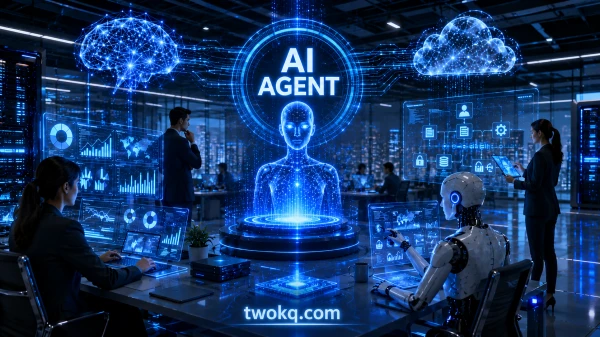
Artificial intelligence is entering a new era in which software no longer waits for users to issue commands before completing tasks. Instead, a new generation of intelligent systems known as AI agents is beginning to transform how businesses operate by performing complex assignments with minimal human supervision.
Unlike traditional software that responds only when someone clicks a button or enters a command, AI agents can understand objectives, plan multiple steps, gather information from different sources, make decisions, and complete entire workflows automatically. This shift is changing the way organizations think about productivity and has quickly become one of the most important developments in enterprise technology.
For decades, businesses relied on separate applications for email, spreadsheets, customer relationship management, accounting, project management, and data analysis. Employees spent large portions of their day moving information from one system to another while performing repetitive administrative tasks. AI agents are beginning to eliminate much of that manual work by connecting these systems and handling routine operations automatically.
A single AI agent can review emails, schedule meetings, prepare reports, summarize documents, update databases, monitor customer requests, and even recommend business decisions based on real-time information. As these capabilities improve, organizations are discovering that AI agents can dramatically reduce operational costs while increasing efficiency across multiple departments.
One of the biggest reasons AI agents are attracting attention is their ability to reason through complicated problems instead of simply generating text. Modern AI systems can break large objectives into smaller tasks, determine the best order for completing them, evaluate results, and adjust their approach when circumstances change.
This allows businesses to automate processes that were previously considered too complex for traditional software. From supply chain management and financial forecasting to software development and cybersecurity monitoring, AI agents are expanding into areas that require continuous analysis and decision-making rather than fixed rules.
Technology companies around the world are investing billions of dollars into agentic AI because they believe it represents the next major evolution of artificial intelligence. Major cloud providers, software companies, and startups are developing platforms that allow organizations to build customized AI agents capable of handling industry-specific responsibilities.
Financial institutions are deploying AI agents to monitor transactions and detect fraud, healthcare providers are exploring intelligent systems that assist with patient documentation, manufacturers are using AI to optimize production schedules, and retailers are introducing digital assistants capable of managing inventory and customer interactions around the clock.
Despite the excitement surrounding AI agents, experts emphasize that human oversight remains essential. Autonomous systems still require supervision when making decisions that affect finances, healthcare, legal compliance, or customer relationships. Businesses must also address important concerns involving cybersecurity, privacy, data quality, transparency, and accountability before allowing AI agents to operate independently.
Many organizations are therefore adopting a hybrid approach in which AI performs repetitive and analytical tasks while humans continue making strategic decisions and handling situations that require empathy, creativity, or ethical judgment.
The rapid growth of AI agents is also changing the skills employers seek in the workforce. Instead of spending hours completing repetitive administrative work, employees are increasingly expected to supervise intelligent systems, verify AI-generated results, solve higher-level business problems, and focus on innovation.
This shift is encouraging companies to invest in AI training while creating new career opportunities in prompt engineering, AI governance, workflow automation, and enterprise AI integration. Professionals who understand how to collaborate effectively with intelligent software are likely to become increasingly valuable as AI adoption accelerates across industries.
Market analysts predict that autonomous AI agents will become one of the fastest-growing segments of the artificial intelligence industry during the remainder of the decade. As reasoning capabilities continue improving and integration with business software becomes more seamless, AI agents are expected to handle increasingly sophisticated responsibilities that extend far beyond today's chatbots and virtual assistants.
The organizations that successfully integrate these technologies into their operations could gain significant competitive advantages through faster decision-making, lower operating costs, and improved customer experiences.
The transition from traditional software to autonomous AI agents represents one of the most significant changes in business technology since the rise of cloud computing. While the technology remains in its early stages, its potential to automate knowledge work on a large scale is already attracting substantial investment from enterprises around the world.
As artificial intelligence continues evolving from a tool that answers questions into a system capable of completing entire tasks independently, AI agents are poised to become one of the defining technologies shaping the future of work, productivity, and digital transformation.
