
Mira Murati's Thinking Machines Unveils Inkling, a Powerful Open-Weight AI Model to Challenge Industry Leaders
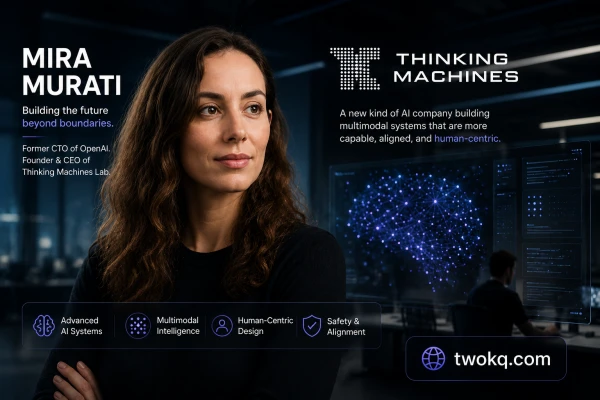
The global artificial intelligence industry has entered another important phase with the launch of Inkling, the first general-purpose open-weight AI model from Thinking Machines, the startup founded by former OpenAI Chief Technology Officer Mira Murati.
The announcement immediately attracted widespread attention because it marks the company's first major public AI model release since its formation. Thinking Machines has positioned Inkling as a powerful alternative to existing open-weight language models, giving developers, researchers, and businesses greater freedom to download, customize, and deploy advanced artificial intelligence for their own applications.
The release comes at a time when demand for open AI systems continues to grow as organizations seek more flexibility, lower deployment costs, and greater control over their AI infrastructure. Rather than competing solely through proprietary cloud-based services, Thinking Machines is betting that open-weight models will become an increasingly important part of the next generation of enterprise artificial intelligence.
Inkling is one of the largest open-weight AI models introduced this year, containing approximately 975 billion parameters, placing it among the most sophisticated publicly available artificial intelligence systems developed outside the world's largest technology companies.
Unlike proprietary AI models that operate only through hosted cloud services, an open-weight model allows organizations to download the trained model weights and adapt them for specialized workloads. This provides developers with significantly greater flexibility when building applications for healthcare, finance, cybersecurity, scientific research, education, software engineering, and enterprise automation.
Businesses handling sensitive information also benefit because they can deploy the model within private infrastructure instead of transmitting confidential data to external cloud providers, an increasingly important consideration as AI regulations continue evolving across multiple countries.
Thinking Machines was established after Mira Murati left OpenAI following years of leading research and product development behind some of the world's most influential AI systems. Since its formation, the company has attracted significant investor interest and assembled a team of experienced artificial intelligence researchers, engineers, and infrastructure specialists with expertise spanning large language models, distributed computing, machine learning optimization, and AI safety.
Industry observers have closely watched the startup because of Murati's reputation for guiding the development of advanced AI technologies that reached hundreds of millions of users worldwide. The release of Inkling demonstrates that the company has moved beyond early research and is now competing directly in one of the fastest-growing segments of the artificial intelligence market.
One of the strongest trends driving demand for open-weight AI models is the rapid expansion of enterprise artificial intelligence. Organizations increasingly want AI systems that can be customized for their own industries while maintaining complete control over data privacy, security, compliance, and performance optimization. Open-weight models allow developers to fine-tune AI using proprietary company data, integrate specialized knowledge into workflows, and optimize models for local hardware without depending entirely on third-party providers.
As enterprises continue investing billions of dollars into digital transformation, demand for customizable AI platforms is expected to accelerate across manufacturing, banking, insurance, telecommunications, healthcare, logistics, government services, and higher education.
The release of Inkling also reflects growing competition within the broader AI ecosystem. While proprietary AI services remain highly popular, many researchers argue that open-weight models encourage faster innovation because independent developers around the world can inspect, improve, benchmark, and extend the technology.
This collaborative development model has historically accelerated progress in software engineering, operating systems, cloud computing, and programming languages. Artificial intelligence now appears to be following a similar path, with an expanding community of researchers building increasingly capable systems through shared innovation rather than isolated development.
For developers, Inkling could significantly reduce the barriers to building advanced AI-powered applications. Instead of relying exclusively on commercial APIs with ongoing usage costs, software teams can integrate open-weight models into their own infrastructure, optimize them for specific workloads, and deploy solutions tailored to unique business requirements.
This flexibility is especially valuable for startups and research organizations seeking to experiment with frontier AI technologies while maintaining predictable operational costs. It also allows companies to develop intelligent applications that continue functioning even in environments where cloud connectivity is limited or strict regulatory requirements restrict external data processing.
The broader artificial intelligence industry is expected to benefit from increased competition among both proprietary and open-weight AI models. As more companies introduce capable alternatives, developers gain additional choices, businesses enjoy greater negotiating power, and innovation accelerates across the ecosystem.
Competition also encourages improvements in reasoning ability, coding performance, multilingual support, scientific problem-solving, efficiency, and deployment flexibility. Rather than a market dominated by only a handful of providers, artificial intelligence is gradually evolving into a more diverse landscape where organizations can select technologies best suited to their technical, financial, and regulatory requirements.
The launch of Inkling represents more than another AI model release—it signals that the next stage of artificial intelligence will be defined by openness, flexibility, and enterprise adoption as much as raw computational performance. Thinking Machines has entered an increasingly competitive market with a strategy centered on giving developers greater control over advanced AI systems while expanding access to frontier machine learning capabilities.
As businesses continue integrating artificial intelligence into critical operations around the world, the success of open-weight models like Inkling may play a significant role in shaping how the next generation of intelligent software is built, deployed, and improved.