
Huawei Unveils Atlas 950 SuperPoD to Power China's Next Generation of AI Supercomputing
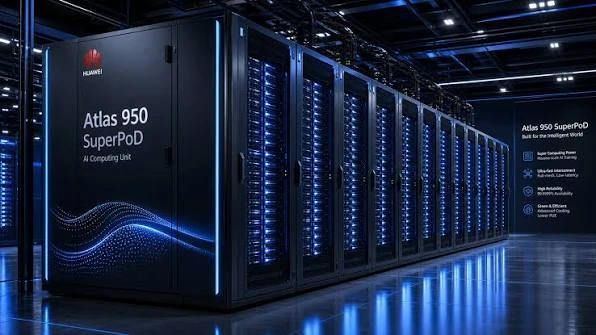
Huawei has introduced its most ambitious artificial intelligence computing platform to date with the unveiling of the Atlas 950 SuperPoD, a large-scale AI supercomputing system designed to train and deploy advanced artificial intelligence models using domestically developed technology.
The announcement was made during the 2026 World Artificial Intelligence Conference in Shanghai, where technology companies from across China showcased their latest advances in AI infrastructure. Huawei's latest platform represents far more than another hardware launch.
It signals China's determination to build a complete artificial intelligence ecosystem capable of competing globally while reducing dependence on foreign semiconductor technologies. As governments and technology companies continue investing billions of dollars into AI infrastructure, the Atlas 950 SuperPoD has quickly become one of the most significant computing systems introduced this year.
The Atlas 950 SuperPoD has been engineered to deliver the enormous computing capacity required for training frontier artificial intelligence models containing hundreds of billions or even trillions of parameters. Modern AI systems demand vast clusters of interconnected processors capable of performing trillions of mathematical calculations every second while transferring massive volumes of data with minimal latency.
Huawei's platform combines advanced networking technologies, high-performance AI accelerators, sophisticated cooling systems, and optimized software designed to maximize computing efficiency across thousands of processors working simultaneously. This level of integration is essential as AI developers continue building increasingly sophisticated language models, scientific research systems, autonomous robots, and enterprise AI platforms.
One of the most important aspects of Huawei's announcement is its emphasis on technological independence. For several years, Chinese technology companies have faced increasing restrictions affecting access to advanced semiconductor technologies developed outside the country. These restrictions have encouraged substantial investment in domestic chip design, AI accelerators, cloud computing infrastructure, and high-performance networking equipment.
The Atlas 950 SuperPoD demonstrates how Chinese companies are responding by creating alternative computing platforms capable of supporting large-scale artificial intelligence development using locally developed technologies. Industry analysts believe this strategy will continue accelerating investment in China's semiconductor and AI industries throughout the coming years.
Artificial intelligence infrastructure has become one of the world's fastest-growing technology sectors because every modern AI application depends on powerful computing resources operating inside large-scale data centers. Whether generating images, translating languages, writing software, analyzing medical records, or powering intelligent business automation, advanced AI models require enormous computational capacity during both training and deployment.
As businesses increasingly integrate artificial intelligence into everyday operations, demand for high-performance computing systems continues growing at an unprecedented pace. Companies capable of supplying reliable AI infrastructure therefore occupy a critical position within the expanding global AI economy.
Huawei's latest platform also reflects the changing nature of competition within artificial intelligence. While much public attention focuses on chatbots and consumer-facing AI assistants, the real competition increasingly centers on the infrastructure powering these applications.
AI chips, networking equipment, cloud platforms, storage systems, memory technologies, and advanced cooling solutions have become just as important as software innovation. Technology companies that successfully combine these components into highly efficient computing platforms are likely to play a significant role in shaping the future of artificial intelligence regardless of which language models ultimately become most popular.
For enterprises, improvements in AI infrastructure can translate directly into faster model training, lower operating costs, improved energy efficiency, and greater flexibility when deploying artificial intelligence applications. Organizations working in healthcare, manufacturing, financial services, scientific research, education, telecommunications, and cybersecurity require increasingly powerful computing environments capable of supporting specialized AI workloads.
Systems such as the Atlas 950 SuperPoD are designed to meet these demands by enabling organizations to process larger datasets, develop more sophisticated models, and deliver AI-powered services with greater speed and reliability than previous generations of computing infrastructure.
Developers and researchers may also benefit from the continued expansion of large-scale AI computing platforms. Greater access to advanced computing resources enables faster experimentation, more complex simulations, improved scientific modeling, and accelerated innovation across multiple disciplines.
Universities, research laboratories, and startup companies increasingly depend on high-performance computing infrastructure to train machine learning models that address challenges ranging from climate prediction and medical discovery to autonomous transportation and industrial automation. Expanding AI infrastructure therefore supports not only commercial applications but also scientific progress that can benefit society more broadly.
Huawei's introduction of the Atlas 950 SuperPoD demonstrates that the future of artificial intelligence will depend as much on computing infrastructure as on software breakthroughs. As countries around the world invest heavily in AI research, semiconductor development, and cloud computing, competition is expanding beyond language models into the underlying technologies that make advanced artificial intelligence possible.
The Atlas 950 SuperPoD is more than a new supercomputer—it represents another milestone in the global effort to build faster, more capable, and increasingly independent AI ecosystems that will power the next generation of intelligent technologies.