
Anthropic Finds Robots Can Perform 74% of US Physical Tasks
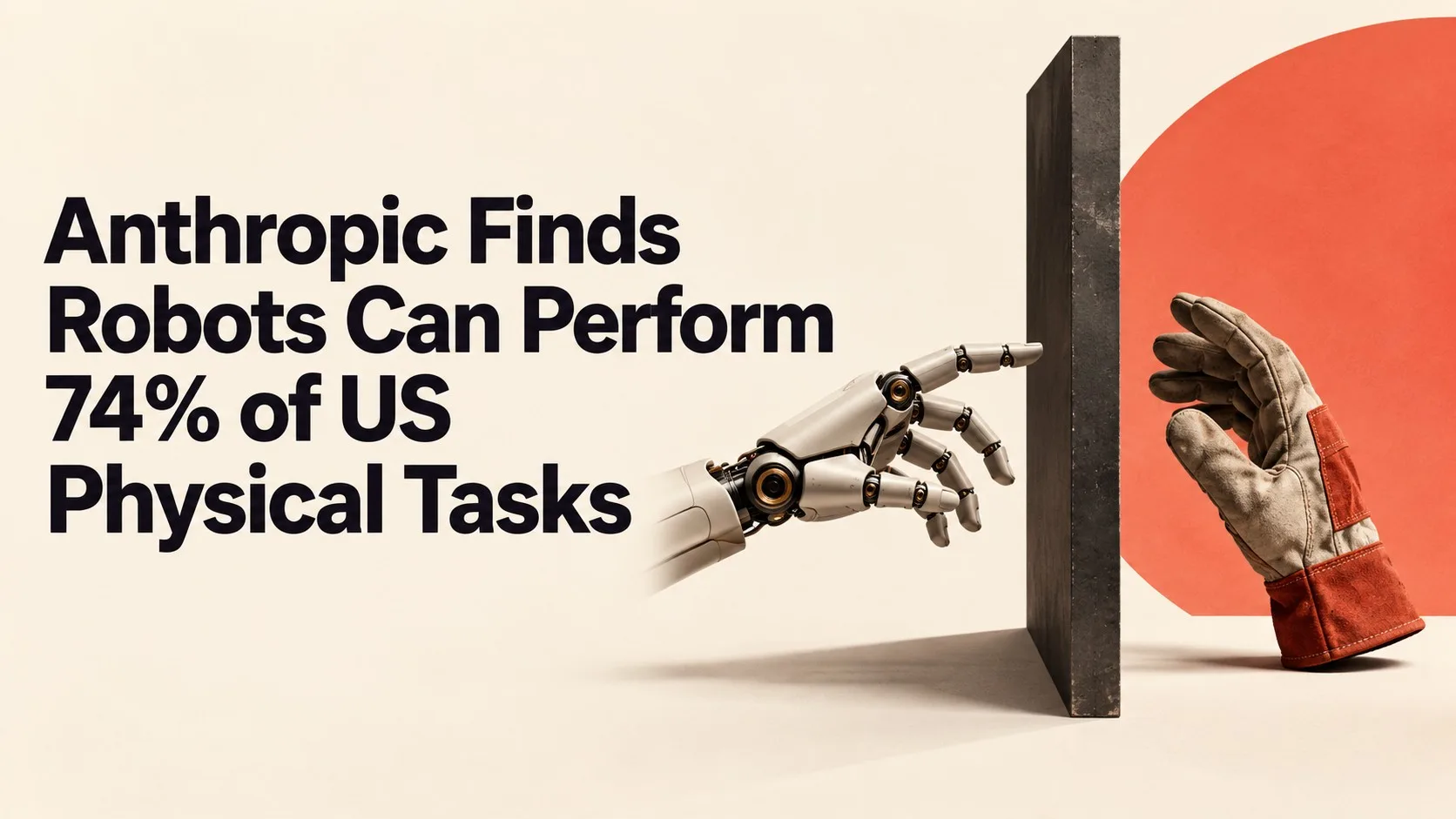
Anthropic finds robots can perform 74% of US physical tasks in at least one setting, according to a new exposure index built from thousands of job descriptions. Yet the same research estimates that machines currently cost less than people for only 0.3% of work.
The gap separates technical capability from economic deployment. Most exposed tasks require purpose-built factories or structured workplaces, while only a small fraction can be handled in unpredictable environments such as public roads.
The study's main findings draw four boundaries around robot automation:
- Robots can perform 74% of physical tasks in some setting.
- Those tasks represent 34% of total US working time.
- Robots and language models together expose 81% of work.
- Robots are cost-competitive for just 0.3% of work today.
Anthropic Finds Robots Can Perform 74% of Physical Tasks
Anthropic researchers Russell Legate-Yang and Maxim Massenkoff published the robot exposure index on September 30. They define robots as autonomous physical machines that sense and act, excluding equipment that remains fully controlled by a human operator.
The headline result does not mean robots can replace 74% of physical workers. It means a robot has demonstrated at least half of a task's representative activities under some operating conditions. The study weights tasks by employment and the estimated time workers spend performing them.
Only 2% of physical tasks can be performed in unstructured environments, the highest exposure tier. About half require purpose-built robotic environments, and another 22% can be completed in structured human workplaces such as warehouses or hospitals.
Across physical, cognitive and interpersonal work, robot-capable tasks account for 34% of US working time. Combining robotics with earlier estimates for large language models raises overall exposure to 81%, although exposure measures capability rather than adoption, job elimination or reliable end-to-end automation.
How the Anthropic Robot Exposure Index Works
The analysis starts with O*NET data covering roughly 900 occupations and 19,000 task descriptions. Claude classified tasks by physical, cognitive and interpersonal requirements, then researchers applied the robot-exposure scale to 7,594 tasks identified as physical.
Tasks receive one of four ratings. E0 means no robot can perform the task. E1 requires a purpose-built robotic environment, E2 permits work in a structured human facility, and E3 covers an unstructured environment such as a city road.
Claude searched for deployed, commercially sold or demonstrated robots relevant to each task. A rating required evidence that the machine could work with human-like reliability, speed and error rates. Majority rule then set the least structured environment covering at least half of a task's time-weighted examples.
That method offers broad coverage but also introduces model judgment into classification, task timing and cost estimates. O*NET descriptions can omit movements that are easy for humans and difficult for robots, while public demonstrations may not represent sustained production performance.
Background Reading
Vehicle Operators and Warehouse Jobs Rank Highest
Nine of the ten occupations with the highest robot-exposure scores are vehicle operators. Taxi drivers lead because autonomous vehicles already carry passengers on public roads, while warehouse packers face systems that move, inspect, label, seal and store goods in controlled facilities.
The study estimates that packers and packagers spend 97% of their time on robot-capable tasks. The United States employs about 560,000 people in that occupation, whose employment has fallen 22% since 2015. Those figures show where commercial pressure may appear first, not that robots caused every lost job.
Nursing, general repair and other jobs combining social contact with dexterous physical work score much lower. The researchers estimate that capability gaps block adoption for about 70% of physical tasks, with manipulation the largest obstacle. Regulation affects 14%, while human preferences constrain roughly one quarter.
A historical backtest found that occupations more exposed to the robots available in each period experienced larger later declines in wages and employment. Since 1977, robots have gained the ability to perform about 2% of the physical work they previously could not do each year.
Robot Costs Change the Automation Timeline
Capability alone produces the 74% figure, but Anthropic's cost model sharply reduces near-term exposure. The researchers estimate full deployment costs, including hardware, maintenance, supervision and energy, then compare equivalent annual output with Bureau of Labor Statistics compensation data.
On that basis, robots cost less than workers for only 0.3% of all job tasks. That still covers roughly 300,000 workers in occupations where machines can perform 95% of tasks. Packers and packagers are the largest occupation already estimated to be economically exposed.
If quality-adjusted robot prices continue their historical decline of about 3% a year, costs must fall roughly 70% before robots become competitive for 10% of human work. The study estimates that transition would take around 40 years.
Its baseline scenario does not reach cost competitiveness for half of physical work until 2085. A faster scenario, combining four times the historical cost improvement with twice the capability growth, brings that milestone forward to 2050. Both projections hold many real-world variables constant.
The index therefore offers a map of pressure rather than a countdown to mass replacement. Driving and warehouse jobs sit closest to deployment because robots already operate there. For most physical work, high costs, manipulation limits, regulation and human preferences remain substantial barriers.