
Google Launches Gemini 3.8 Live Voice Models
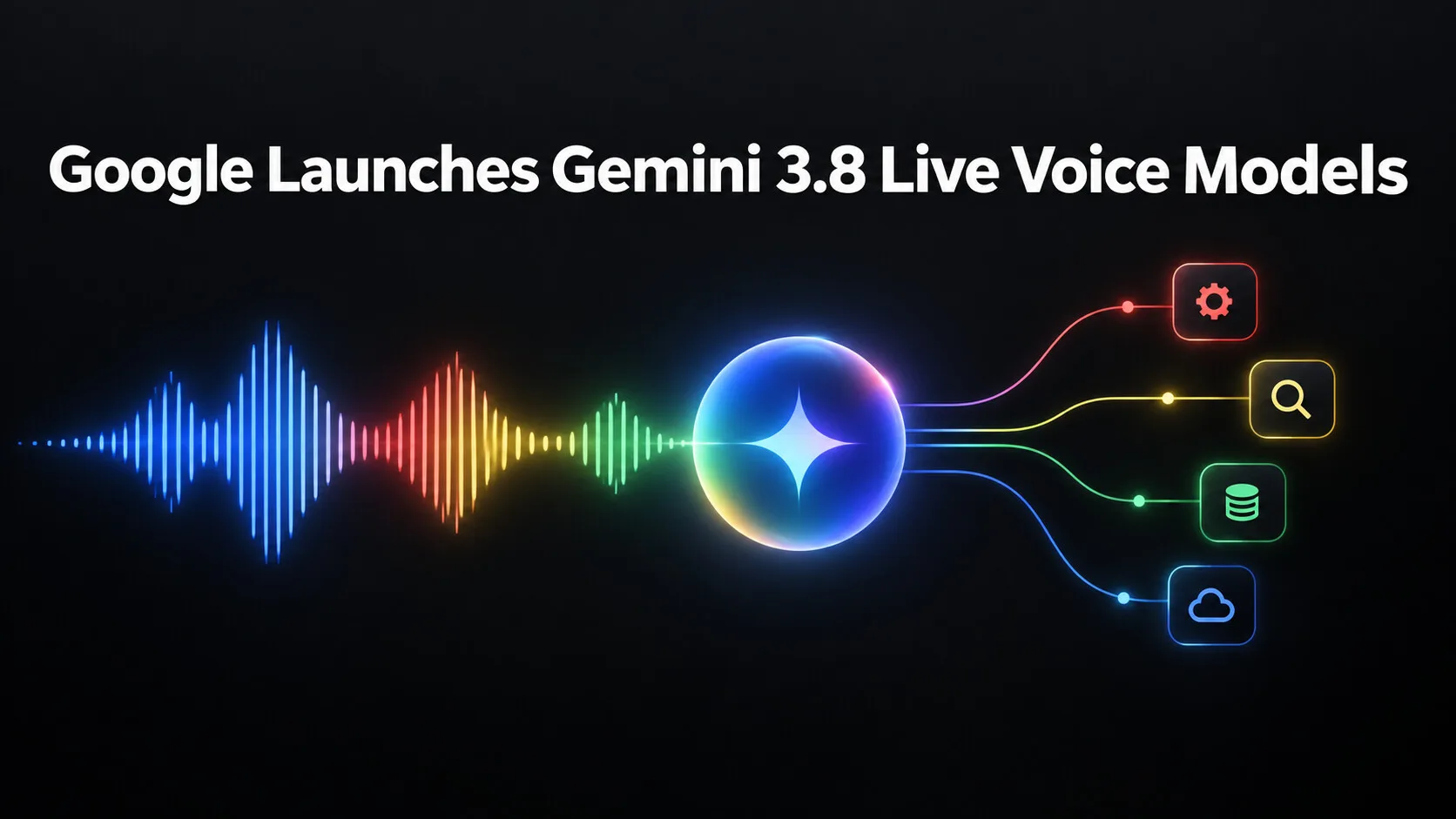
Google launches Gemini 3.8 Live as a pair of production voice models designed to keep conversations moving while they call tools, process visual context or reason through longer tasks. The release separates a low-latency model from an Extended Thinking version for work that needs more deliberate, multi-step analysis.
Google says the models support 97 languages, automatic language switching and more precise handling of letters and numbers. Both are reaching developers through the Gemini API and Google AI Studio, while selected enterprise and consumer surfaces are receiving previews or staged rollouts.
Google Launches Gemini 3.8 Live Voice Models
The standard Gemini 3.8 Live model is tuned for fluid, real-time dialogue. Google positions it as the default choice for voice agents that need fast responses without the delay of extended reasoning, including customer-service assistants, educational tools and multimodal applications that combine audio with a camera feed.
A central change is asynchronous function calling. An application can ask an external service for information or trigger an action without freezing the spoken exchange while it waits for the result. That design can make an agent feel less like a sequence of disconnected commands and more like a continuous conversation.
The model also accepts visual context, enabling developers to build assistants that discuss what a user is showing through a camera. Google highlights stronger alphanumeric precision, a practical improvement for tasks such as confirming account codes, addresses and booking references where a single misheard character can derail the interaction.
The launch focuses on four production capabilities:
- Real-time speech across 97 languages
- Automatic switching between languages
- Background tool and API calls
- Audio conversations grounded in visual input
How Gemini 3.8 Live Extended Thinking Works
Gemini 3.8 Live Extended Thinking is intended for queries that cannot be answered reliably with an immediate response. Google says it can reason and speak at the same time, giving an early verbal acknowledgement and narrating progress while it works through a complex request.
That approach addresses a familiar weakness in voice systems: silence during computation. A conventional assistant may appear unresponsive while a model reasons or waits for a tool. Progress narration can reassure the user, although developers will still need to decide how much internal work should be summarized aloud without becoming distracting.
Google also exposes configurable thinking controls to developers. Teams can therefore trade latency and cost against additional reasoning based on the task. A simple status lookup may use the faster model, while financial analysis, troubleshooting or a multi-stage travel plan could justify the Extended Thinking path.
Gemini 3.8 Live Benchmarks and Pricing
Google reports a score of 82.6 on its Speech-to-Speech Quality Index, 68.6 on the tau-Voice benchmark and 35.1 on the banking version of Sierra's tau-Voice evaluation. It also reports 97.7 on Big Bench Audio and a second-place position in the Speech Agent Arena.
Those figures indicate gains across conversational quality, tool use and audio understanding, but benchmarks do not reproduce every production environment. Noise, accents, telephony compression, long sessions and a company's own tool integrations can materially change reliability, so deployments will still require application-specific testing.
Google lists audio pricing for Gemini 3.8 Live at $0.005 per minute of input and $0.018 per minute of output. The published rates give developers a clearer basis for comparing voice-agent economics, although total operating cost will also include text tokens, external services, telephony and infrastructure.
The company is working with voice and agent infrastructure providers including Agora, Fishjam, LangChain, LiveKit, Pipecat, Vercel and Vision Agents. Google also says generated audio carries its SynthID watermark, extending its provenance system to conversations produced by the new models.
Gemini 3.8 Live Availability
Gemini 3.8 Live is rolling out through the Gemini API and Google AI Studio. Google is also bringing it to Search Live and offering private previews for Gemini Enterprise and customer-experience applications, giving the model routes into both developer-built agents and Google's own products.
The Extended Thinking model is available through the API and AI Studio, with enterprise previews and distribution through Gemini Live and paid Google Workspace surfaces. Availability may differ by account, region and product tier while the rollout continues.
The release shows where voice agents are heading: not merely better transcription, but concurrent speech, reasoning and tool execution. The next test is operational rather than theatrical—whether applications built on the models can maintain accuracy, recover gracefully from tool failures and keep latency predictable during real customer conversations.
Further Reading