
What Is HBM Memory and Why Nvidia, OpenAI, and Google Depend on It for AI
Artificial intelligence has created enormous demand for faster computer hardware, but one of the most important technologies powering today's AI revolution receives surprisingly little attention. While Nvidia's graphics processors dominate headlines, those processors cannot deliver their full performance without another critical component working alongside them: High Bandwidth Memory, better known as HBM.
HBM has become one of the most valuable technologies in the semiconductor industry because it allows AI systems to process huge amounts of information at incredible speeds. Every time ChatGPT answers a question, Claude writes code, Gemini summarizes a document, or an AI image generator creates artwork, enormous quantities of data move between processors and memory. HBM is designed specifically to make that process faster and more efficient.
What Is HBM Memory?
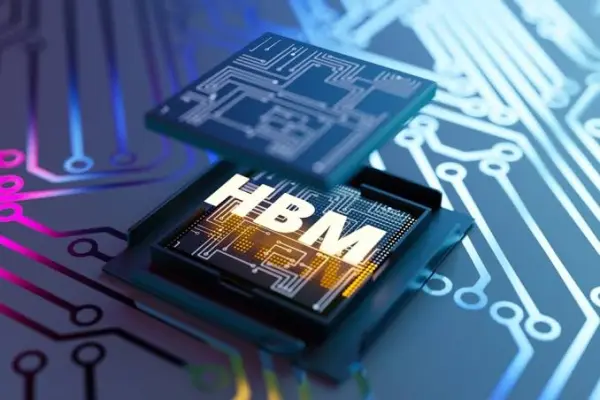
HBM, or High Bandwidth Memory, is a specialized type of memory built for high-performance computing and artificial intelligence. Unlike traditional RAM, HBM stacks multiple memory chips vertically and connects them using microscopic pathways known as through-silicon vias (TSVs).
This three-dimensional design allows data to move much faster while consuming less power.
Instead of placing memory modules separately on a motherboard, HBM is positioned very close to the AI processor. This short distance reduces latency, increases bandwidth, and enables AI accelerators to process massive datasets continuously.
Why AI Needs HBM
Training modern AI models involves processing trillions of mathematical calculations. These calculations require constant access to enormous datasets.
If processors cannot retrieve information quickly enough, they spend valuable time waiting instead of computing.
HBM removes that bottleneck by delivering significantly higher bandwidth than conventional memory technologies.
This is why every new generation of AI hardware places so much emphasis on memory performance alongside raw processing power.
Which Companies Use HBM?
Nearly every major AI company relies on HBM indirectly.
Nvidia integrates HBM into its latest AI GPUs used for training and deploying advanced language models.
AMD uses HBM in its AI accelerators for cloud computing and enterprise workloads.
Cloud providers such as Microsoft, Google, Amazon, and Oracle build AI clusters using hardware equipped with HBM because it delivers the performance required for large-scale inference and training.
Companies including OpenAI, Anthropic, xAI, Meta, and many others depend on cloud infrastructure built around HBM-enabled processors to operate their frontier AI models.
Why HBM Has Become So Expensive
Demand for HBM has grown much faster than manufacturing capacity.
Producing advanced memory requires specialized fabrication plants, sophisticated packaging technology, and years of engineering expertise.
Only a handful of companies—including Micron, Samsung, and SK hynix—currently manufacture leading-edge HBM at scale.
As AI investment accelerated, cloud providers and hardware manufacturers rushed to secure long-term supply agreements, pushing prices higher and creating one of the biggest bottlenecks in the AI supply chain.
Why Investors Care About HBM
The success of AI hardware is no longer determined only by processor performance.
Memory has become equally important.
A shortage of HBM can delay shipments of AI servers, increase hardware costs, and slow the deployment of new data centers.
Because of this, investors now monitor HBM production almost as closely as they follow Nvidia's GPU releases.
Strong demand for HBM is often viewed as a sign that AI infrastructure spending remains healthy.
The Future of HBM
Demand for HBM is expected to continue growing throughout the rest of the decade.
As AI models become larger and AI agents perform increasingly complex tasks, processors will require even greater amounts of high-speed memory.
Researchers are already developing future generations of HBM capable of delivering higher bandwidth, lower power consumption, and greater storage capacity.
These improvements will play a critical role in supporting the next generation of artificial intelligence systems.
Final Thoughts
Although GPUs often receive the spotlight, HBM is one of the technologies quietly enabling the AI revolution.
Without high-bandwidth memory, today's most advanced AI systems would struggle to process the enormous datasets required for reasoning, coding, scientific research, and real-time conversations.
As AI adoption accelerates across industries, HBM is likely to remain one of the most valuable and strategically important technologies in the global semiconductor market.