
AI Boom Reshapes Memory Market as Samsung Regains No. 1 and China’s CXMT Surges
The artificial intelligence boom is reshaping another critical part of the semiconductor industry, with global demand for memory continuing to rise as AI data centers require larger amounts of high-speed DRAM and high-bandwidth memory.
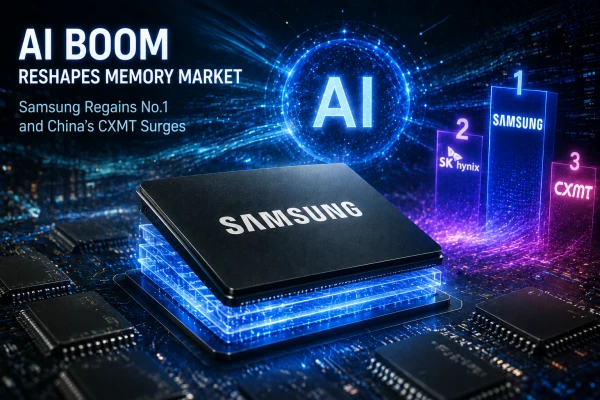
New industry data shows Samsung Electronics has regained the top position in the global DRAM market, while Micron Technology is narrowing the gap and China's ChangXin Memory Technologies, better known as CXMT, is rapidly increasing its presence.
The changes highlight how AI is transforming the memory industry while also intensifying competition between established semiconductor manufacturers and China's growing domestic chip sector.
Samsung captured about 39% of the global DRAM market in the second quarter of 2026, according to Counterpoint Research, putting the South Korean semiconductor giant back in first place. Micron followed with a smaller but increasingly competitive share, while SK hynix remained another major player in the market.
The most striking development, however, has been CXMT's growth, as the Chinese memory manufacturer continues expanding production and attempting to reduce China's dependence on foreign semiconductor suppliers.
The shift is closely connected to the explosive growth of artificial intelligence. Modern AI systems require enormous quantities of memory because processors must constantly move data between computing units and memory during training and inference.
The more sophisticated AI models become, the greater their demand for memory capacity and bandwidth. This has made memory technology one of the most strategically important components in the AI hardware supply chain, alongside GPUs, networking equipment and advanced packaging.
High-bandwidth memory, or HBM, has received particular attention because it is used alongside advanced AI accelerators to provide extremely fast access to data. Companies developing frontier AI systems need processors capable of performing huge numbers of calculations, but those processors can only operate efficiently when sufficient data can be delivered to them quickly.
HBM addresses that bottleneck by providing much greater memory bandwidth than conventional DRAM, making it an essential part of many modern AI computing platforms.
The growing importance of AI memory is changing the competitive landscape for companies such as Samsung, Micron and SK hynix. These manufacturers are investing heavily in advanced memory production because demand from AI data centers is expected to remain strong.
The competition is no longer simply about producing the largest amount of memory at the lowest price; manufacturers increasingly need to deliver specialized memory technologies capable of meeting the bandwidth, capacity, power and thermal requirements of large AI systems.
Micron's position is particularly significant because the company has been one of the major beneficiaries of the AI memory boom. As AI companies build increasingly large computing clusters, demand for HBM and other advanced memory products has increased, creating a valuable market for memory manufacturers.
Micron's narrowing gap with Samsung suggests the company is gaining strength in a market that was once dominated by Samsung and SK hynix. The shift also demonstrates how quickly AI demand can alter the balance of power in the semiconductor industry.
China's CXMT represents a different kind of challenge. The company is rapidly expanding its DRAM capabilities as Beijing pushes to develop a more self-sufficient semiconductor industry. China's technology sector has faced restrictions on access to some advanced semiconductor technologies, encouraging domestic manufacturers to develop alternatives that can reduce dependence on overseas suppliers. CXMT's growth therefore has implications beyond the commercial memory market because it is part of China's broader effort to strengthen its domestic technology supply chain.
The rise of CXMT could eventually create additional pressure on established memory companies. DRAM has historically been a highly concentrated market in which a small number of manufacturers control most global production.
If Chinese manufacturers continue increasing their output and improving the performance of their products, the industry could become more competitive, particularly in conventional memory segments where technological barriers may be lower than in the most advanced HBM products.
AI is also creating unusual demand conditions for the memory industry. Traditional memory markets have historically been highly cyclical, with periods of oversupply followed by shortages and price increases.
AI data centers are introducing a new source of structural demand because companies are building enormous computing infrastructure that requires large amounts of memory for years rather than simply replacing consumer devices during regular upgrade cycles.
That demand is forcing manufacturers to make difficult decisions about where to allocate production capacity. Advanced memory products such as HBM can command higher prices and are strategically important for AI accelerators, while conventional DRAM remains essential for servers, PCs, smartphones and other electronic devices. Manufacturers therefore have to balance the rapidly expanding AI market against their existing customers.
The situation also helps explain why memory has become such an important part of the AI infrastructure conversation. When people think about AI hardware, they often focus on Nvidia GPUs or AMD accelerators, but the processors are only one part of the system.
Every AI server also requires memory, storage, networking and power infrastructure. If memory production cannot keep pace with accelerator deployments, the shortage can become a bottleneck that limits how quickly data centers can expand.
The competition could become even more intense as AI inference grows. Training large models requires huge amounts of computing power, but once those models become widely available, they must continuously process requests from users.
AI assistants, coding systems, image generators and autonomous agents can generate enormous numbers of inference operations, creating sustained demand for memory bandwidth and capacity.
AI agents could make the memory challenge even larger because they often perform multiple operations to complete a task. Instead of generating a single answer, an agent may need to retrieve information, reason through a problem, access a database, use software tools and perform several additional model calls. Each stage requires computing resources and can increase the amount of information that needs to be stored and accessed rapidly.
For Samsung, maintaining its leading position will require continued investment in advanced memory technology. The company has already been developing new generations of HBM and other memory products designed specifically for AI workloads.
Its ability to combine large-scale manufacturing with advanced semiconductor packaging gives it a major advantage, but competitors such as Micron and SK hynix are also investing heavily to capture a greater share of the AI memory market.
Micron's progress is especially important because the company has positioned itself as a major supplier for the AI infrastructure boom. If demand for HBM continues increasing, Micron could benefit from higher-value memory products even if conventional DRAM markets experience periods of volatility. The company's challenge will be maintaining sufficient production capacity while keeping up with rapidly changing requirements from AI chipmakers.
China's semiconductor ambitions add another layer to the story. CXMT's progress shows that Chinese companies are not standing still despite restrictions affecting parts of the advanced semiconductor supply chain.
Building competitive memory technology requires enormous investment, sophisticated manufacturing equipment and years of research, but China's expanding domestic technology industry is providing companies such as CXMT with strong incentives to close the gap.
The global memory market could therefore become an increasingly important battleground in the broader technology competition between the United States and China. AI accelerators may receive more attention, but memory is equally important to the performance of the systems built around them. Whoever can secure reliable access to advanced memory will have an important advantage as AI infrastructure continues expanding.
For consumers, the effects may eventually extend beyond AI data centers. Memory prices influence the cost of computers, smartphones, servers and other electronic products. If AI demand continues absorbing a large portion of semiconductor production capacity, manufacturers could face difficult choices about how much memory to allocate to consumer products versus high-margin data-center applications.
The latest DRAM rankings therefore provide an early indication of how deeply artificial intelligence is changing the semiconductor industry. Samsung's return to the top position, Micron's growing competitiveness and CXMT's rapid expansion are happening at the same time that AI companies are building some of the largest computing systems ever created.
The bigger story is that the AI race is becoming a race for every component required to build an AI data center. GPUs may perform the calculations, but memory determines how quickly information can reach those processors, while storage keeps the enormous datasets and model files required by modern AI systems.
As artificial intelligence continues moving from experimental technology into everyday software, businesses and consumer products, the companies capable of supplying those components at massive scale could become some of the biggest winners of the next phase of the technology industry.
With Samsung, Micron, SK hynix and China's CXMT all competing for a larger share of the memory market, the semiconductor industry is entering a period in which AI demand could permanently change the balance of power.
The battle over memory may not attract the same attention as the competition between ChatGPT, Gemini and other AI models, but it could ultimately determine how quickly and cheaply the next generation of artificial intelligence can be built.
