
How Much Better Will AI Be in 2 Years From Now? What the Future Between AI and Humans Could Look Like
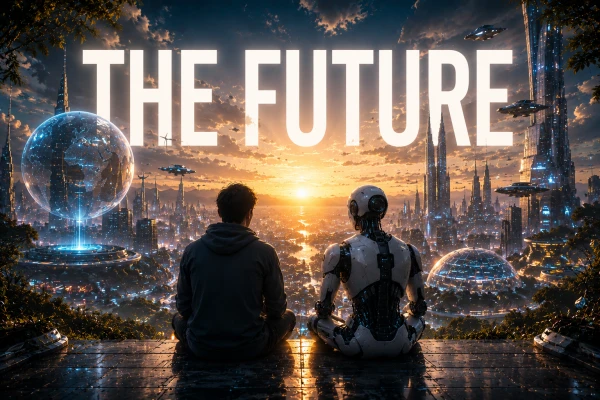
The most interesting question about artificial intelligence is no longer whether AI will become more capable. It is how much more capable it could become before people have had enough time to adjust to the systems already available today.
In 2026, AI can write software, analyze documents, generate images and video, solve difficult scientific and mathematical problems, operate computers and complete increasingly complicated tasks with limited human instruction. The technology is still imperfect, but its rate of improvement has created a much bigger question for the next two years: what will AI actually be able to do by 2028, and what will humans still need to do themselves?
Trying to predict the future of AI is difficult because technological progress does not move in a perfectly straight line. Some capabilities improve rapidly while others remain surprisingly weak. An AI model can perform extremely well on advanced mathematics and scientific problems while still making an obvious mistake on a simple task.
Researchers often describe this uneven behavior as "jagged intelligence." But despite those limitations, the overall direction is difficult to ignore. The latest performance measurements show that frontier AI systems are improving quickly, with some benchmarks that were designed to challenge advanced models becoming saturated far sooner than researchers expected.
That means the AI people use in 2028 is unlikely to feel like today's AI with a slightly better interface. The bigger change will probably come from what AI systems can do between the moment a person gives an instruction and the moment the task is finished. Today's chatbot is mostly designed to respond. Tomorrow's AI is increasingly being designed to act.
This difference could become one of the most important technological changes of the next two years. Instead of asking an AI to write a business plan and then manually copying the information into different applications, a person could eventually tell an AI what they want accomplished and allow it to perform most of the intermediate steps.
It could research the market, organize the information, create the document, prepare a presentation, analyze the numbers and return with a finished result for the human to approve.
The technology is already moving in this direction. AI agents have improved dramatically on computer-use benchmarks. One major evaluation tracked agent performance rising from roughly 12% to 66.3% on tasks involving real computer environments, bringing advanced systems much closer to human performance even though they still fail frequently enough that complete independence remains unrealistic.
The significance of that improvement is easy to underestimate. Moving from an AI that tells you how to perform a task to an AI that can actually perform the task changes the relationship between people and software. A chatbot is a tool you operate. An agent begins to look more like a digital worker that you supervise.
By 2027 and 2028, that distinction could become much more normal. People may stop thinking about AI as something they open in a separate application and start treating it as a layer that sits across the software they already use. Instead of opening a spreadsheet, searching for information, writing an email and then updating a project management system separately, a person could give one instruction and allow an AI system to coordinate the steps.
The biggest change may therefore not be that AI becomes "smarter" in the way people normally imagine. It may be that AI becomes much better at turning intelligence into reliable action.
That is an important distinction because today's AI still has a major weakness: it can produce impressive results without always understanding when it is wrong.
A system can write thousands of lines of code and still introduce an error. It can summarize a document while missing an important detail. It can provide a convincing explanation that contains an incorrect claim. It can plan a complicated task and then fail when the environment changes.
The next two years will therefore be heavily influenced by reliability. The most valuable AI system may not necessarily be the one that produces the most impressive answer. It may be the one that knows when it is uncertain, checks its own work, uses reliable tools, remembers relevant information and asks a human for help when the situation is outside its capabilities.
This is where the relationship between AI and humans could change significantly. The future is unlikely to be simply "AI replaces humans." A more realistic possibility is that humans increasingly become supervisors of AI systems that perform large portions of the routine work.
A programmer, for example, may spend less time manually writing every function and more time deciding what software should accomplish. The AI could generate the implementation, run tests, investigate errors and propose improvements, while the human remains responsible for architecture, security and final decisions.
The same pattern could appear in many other professions. A lawyer could use AI to examine thousands of documents before reviewing the most important findings. A doctor could use AI to organize medical information and identify patterns that deserve attention. A teacher could use AI to create customized learning material for different students. An accountant could use AI to process routine financial records and highlight unusual transactions.
The human would not necessarily disappear from these workflows. Instead, the human's job could move toward judgment, verification, communication and responsibility.
That shift could create an uncomfortable problem. If AI becomes extremely good at completing routine intellectual work, the skills that humans develop through doing that work may become less common. A young programmer who relies on AI for every line of code may become highly productive without developing the same understanding of software systems that previous generations acquired by writing code manually.
This could make the next two years especially important for education. Students will increasingly have access to AI systems capable of explaining difficult concepts, generating practice questions and helping with assignments. The challenge will be teaching people how to use AI without allowing the technology to replace the learning process itself.
The future of education may therefore involve less emphasis on memorizing information and more emphasis on asking good questions, checking evidence, understanding systems and solving problems that AI cannot easily handle. Knowing how to work with an AI system could become almost as important as knowing how to use a search engine became important in the previous generation.
Another major change could happen in software development. AI coding systems are already moving beyond autocomplete toward agents that can understand repositories, edit multiple files, run tests and work through bugs. If the technology continues improving, a developer in 2028 may be able to describe an application in natural language and have AI produce a surprisingly large portion of the initial implementation.
That does not mean anyone will be able to create perfect software simply by typing a sentence. Real applications still require architecture, testing, security, deployment and maintenance. But the amount of technical work required to transform an idea into a working prototype could fall dramatically.
That could have an enormous effect on entrepreneurship. One person with a strong idea could potentially accomplish work that previously required a small team of developers, designers, researchers and content creators. The limiting factor may shift from the ability to produce software to the ability to identify a useful problem and build something people actually want.
AI could also become much better at scientific research during this period. Current systems already demonstrate strong performance on structured scientific and mathematical tasks, while researchers are developing AI agents specifically for scientific workflows. But today's systems still struggle with genuinely open-ended research, where the problem is not clearly defined and the answer cannot simply be verified against an existing solution.
The next breakthrough could come when AI becomes better at that open-ended part of science. Imagine an AI system that does not simply answer a scientific question but spends days analyzing research papers, generating hypotheses, designing experiments, examining results and deciding which direction deserves further investigation.
That would be a very different type of artificial intelligence from today's chatbot.
It could also change how quickly scientific discoveries happen. Human researchers spend enormous amounts of time searching literature, organizing information, writing code, analyzing datasets and repeating calculations. AI systems could increasingly handle those activities, allowing scientists to spend more time deciding which questions are worth pursuing.
The same principle could apply to medicine, engineering, climate research and materials science. The greatest impact of AI may not come from replacing people in existing jobs but from allowing humans to investigate problems that were previously too expensive, too complicated or too time-consuming.
There is another area where AI could become dramatically different within two years: memory.
Today's AI conversations often have limited continuity. Future systems are likely to become much better at remembering useful information about ongoing projects, preferences, previous decisions and long-term goals. That could make AI feel less like a tool that has to be reintroduced to a task every morning and more like an assistant that understands the history of the work.
Imagine telling an AI system in January that you want to build a company and then returning months later. Instead of starting from scratch, the system could understand what you have already researched, which decisions you made, what problems remain unresolved and what actions have already been completed.
That kind of persistent AI could change productivity more than simply increasing the model's ability to answer questions.
But there will be a price for greater memory and autonomy: trust.
The more an AI system knows about a person and the more actions it can take, the more important privacy and security become. People may be comfortable allowing an AI to summarize a public document, but they may be much less comfortable allowing the same system to access private messages, financial information, business files and personal accounts.
The future of AI will therefore depend not only on intelligence but on permission. People will need ways to decide exactly what an AI can see, what it can remember and what it can do without asking.
This could lead to a world where AI systems have different levels of autonomy. An assistant might be allowed to organize information automatically but require permission before sending a message. Another system could be allowed to manage routine business operations but require human approval before making financial decisions.
The human may increasingly become the person who sets the boundaries.
That could also change the meaning of employment. The biggest disruption may not happen when AI becomes capable of doing an entire profession. It could happen much earlier, when AI becomes capable of doing enough individual tasks within that profession that fewer people are needed to produce the same amount of work.
This is already beginning to appear in parts of the economy. Organizations are increasingly experimenting with AI to automate customer service, software development, research, marketing and administrative work. The result is not always a simple replacement of employees. In many cases, companies are restructuring how work is divided between humans and machines.
Over the next two years, that trend could accelerate.
A company that previously needed ten people to perform a repetitive digital workflow might discover that three people working with AI can produce a similar amount of output. That does not necessarily mean seven people become permanently unemployed, because lower costs can create demand for new products and services. But it does mean the skills that employers value can change quickly.
The safest skill may therefore not be a specific software package or a particular technical procedure. It may be the ability to work effectively with rapidly changing AI systems.
People who know how to define problems, evaluate AI output, verify information, manage AI workflows and make decisions could become increasingly valuable.
At the same time, AI will probably create entirely new categories of work. Someone will need to design AI workflows, supervise agents, test model behavior, investigate failures, manage AI security and integrate AI systems into organizations. New industries could also emerge around capabilities that are difficult to imagine today because the technology does not yet work well enough to make them economical.
This is why predicting exactly which jobs will disappear by 2028 is less useful than understanding how the structure of work is likely to change.
The relationship between humans and AI could become increasingly similar to the relationship between humans and other powerful technologies. People will use machines to extend what they can accomplish, but the most important decisions will still involve human judgment.
There will also be areas where humans remain difficult to replace. Trust, relationships, leadership, physical presence, accountability and emotional understanding are not simply problems of generating the correct text. Even if AI becomes extremely capable, people may continue to prefer dealing with other people in situations where responsibility and human connection matter.
But that does not mean humans will remain unchanged.
If AI becomes capable of answering most factual questions, writing much of the routine code, creating high-quality visual material and performing large portions of research, humans may need to redefine what they consider valuable work.
The advantage may increasingly belong to people who can decide what should be built rather than people who can simply build what they are told.
That could be one of the biggest changes between 2026 and 2028.
AI models will probably become better at reasoning, but reasoning alone will not be enough. They will need better memory, better tool use, better planning, better verification and better understanding of real-world context. AI agents will need to become more reliable over long tasks instead of simply producing impressive results during short demonstrations.
The improvement could be substantial because today's systems still have obvious weaknesses. Even the strongest AI agents can fail on structured computer tasks, and research shows that performance remains uneven when systems move from clearly defined problems to open-ended scientific work.
That means there is still enormous room for improvement.
If researchers solve even some of these weaknesses over the next two years, AI could feel dramatically different without becoming a science-fiction version of a human mind. It may simply become much more dependable at completing long sequences of tasks.
And reliability could be the real breakthrough.
A system that is 95% capable but frequently makes unpredictable mistakes may not be trusted with important work. A system that is slightly less intelligent but can reliably check itself, recognize uncertainty and complete tasks correctly could become far more useful.
That is why the future of AI should not be measured only by benchmark scores. The more important question is how much useful work an AI system can complete without creating more work for the human supervising it.
By 2028, the answer could be dramatically different from today.
People may still open AI chat windows and ask questions, but that may eventually become only one small part of what AI can do. The bigger transformation could happen quietly in the background, with AI systems organizing information, writing software, analyzing data, preparing documents and coordinating digital tasks.
Humans may increasingly provide goals while AI handles execution.
That future will not arrive everywhere at the same speed. Some industries will adopt AI quickly, while highly regulated or safety-critical areas will move more cautiously. Some people will embrace autonomous AI systems, while others will prefer to maintain direct control over their work.
But the underlying technology is moving toward greater capability and greater autonomy.
The next two years could therefore represent an important transition period. AI may not become a human replacement by 2028, and there is no reliable evidence that it will suddenly become an all-powerful artificial mind. What the current evidence does suggest is that AI systems are becoming better at reasoning, using tools, completing tasks and operating across different types of information.
The most realistic future may not be a world where humans disappear and machines take over. It may be a world where the definition of a human worker changes because almost everyone has access to a highly capable digital collaborator.
The person who knows how to use that collaborator effectively could accomplish far more than someone working without it.
And that may be the real story of the next two years.
The future of AI and humans will probably not be decided by whether machines become exactly like us. It will be decided by how effectively humans learn to work with systems that can increasingly reason, create, remember, plan and act.
By 2028, the most surprising thing about artificial intelligence may not be that AI can do something humans once thought impossible. It may be how ordinary it has become for a human to simply say what needs to happen and have an AI system handle much of the work required to make it happen.