
How AI Can Work for You While You Sleep: The Future of AI Agents
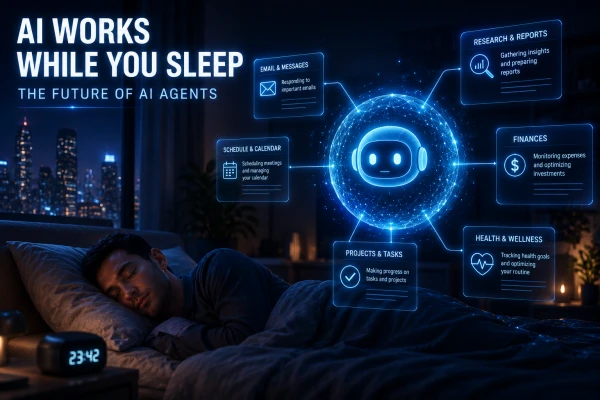
Artificial intelligence is entering a stage where the most interesting question is no longer what AI can tell you, but what it can accomplish after you stop talking to it. For years, people have used AI as a digital assistant that responds to questions, writes paragraphs, generates images, summarizes documents and explains difficult subjects.
The next stage could be very different. AI agents are increasingly being designed to take a goal, break it into smaller tasks, use software and online tools, work through problems and continue operating without someone telling them what to do at every step.
That creates a future that may sound unusual today but could become completely normal within the next few years: you give AI a job before going to sleep, close your computer and wake up to find that much of the work has already been completed.
The idea of AI working while you sleep is no longer purely science fiction. Today's AI agents can already perform tasks that go beyond a simple question-and-answer interaction. They can work with files, write and execute code, interact with applications, search information and complete multi-step workflows.
The technology is still developing and remains unreliable for many important tasks, but the direction is becoming increasingly clear. AI is gradually moving from systems that wait for instructions after every step toward systems that can receive an objective and determine some of the steps required to accomplish it.
The difference is important. A traditional chatbot waits for you to ask a question, produces an answer and then waits again. An AI agent can potentially receive a broader objective and continue working through several actions.
Instead of asking an AI, “How can I research these companies?”, a future user could say, “Research these companies, compare their products, find their latest developments and prepare a report for me tomorrow morning.” The first instruction describes a question. The second describes a job.
That shift could change how people use computers.
Imagine finishing work at 10 p.m. and giving your AI agent a list of tasks before going to bed. You might ask it to analyze the day's business performance, review customer feedback, investigate competitors and prepare recommendations for the next morning.
Instead of requiring you to remain awake and answer questions as the system works, the agent could continue through the workflow on its own, provided it has the appropriate access and permissions.
When you wake up, you could find a completed report waiting for you. The AI might have discovered that one product performed significantly better than expected, several customers complained about the same issue, a competitor changed its pricing and a particular marketing campaign generated stronger results. You would still decide what should happen next, but the research and preparation that could have taken several hours may already be finished.
That is the real meaning behind the idea of AI working while you sleep. It does not necessarily mean AI will replace an employee overnight. It means humans could increasingly delegate digital work to software that continues operating after the human has stepped away.
This could be especially powerful for developers. A programmer could finish work in the evening and give an AI coding agent a list of bugs to investigate. The agent could inspect the codebase, reproduce problems, examine possible causes, write potential fixes, run tests and prepare a report. The developer could return the next morning and review what happened instead of spending the entire night manually investigating the problem.
The same idea could eventually apply to many different types of work:
• Research: AI could search through large amounts of information and prepare a structured summary.
• Programming: AI agents could investigate bugs, write code, run tests and document changes.
• Business: AI could analyze sales, customer behavior and operational data overnight.
• Marketing: AI could monitor campaigns, identify unusual performance and prepare recommendations.
• Writing: AI could organize research, create drafts and prepare supporting material for human review.
• Education: AI could organize study materials, generate practice exercises and identify areas where a student needs more help.
• Administration: AI could organize documents, summarize meetings and prepare routine reports.
The important part is that none of these examples requires AI to become a perfect human replacement. The technology only needs to become sufficiently reliable at completing defined digital tasks.
That may be a much more realistic path for AI.
The biggest improvement needed will not necessarily be intelligence. It will be reliability. An AI that works for five minutes can be corrected relatively quickly when it makes a mistake. An AI that works for eight hours creates a much bigger problem if it makes an incorrect decision during the first hour and continues building on that mistake.
Future AI agents will therefore need better ways to monitor and verify their own work. They may need to compare information from multiple sources, run tests, check calculations, identify uncertainty and stop when they encounter a decision that requires human judgment.
The most useful AI of the future may therefore not be the AI that knows everything.
It may be the AI that knows when it does not know something.
This could completely change the way people interact with AI. Instead of watching an AI system constantly, a person could give it an objective and a set of boundaries, leave it to work and return later to review the result.
The human could remain responsible for the important decisions while the AI handles much of the preparation.
That creates a different relationship between humans and artificial intelligence. Instead of humans operating every step of a computer workflow, humans could increasingly define the objective while AI systems handle execution.
For example, a business owner could tell an AI:
• Analyze yesterday's sales.
• Identify the products that changed significantly.
• Look for possible reasons for the changes.
• Compare the results with previous weeks.
• Prepare recommendations.
• Do not make any financial changes without approval.
The AI would have a clear objective and clear boundaries. It could work independently while the owner sleeps, but it would not have unlimited authority.
This distinction could become one of the most important parts of the future of AI.
People are unlikely to give autonomous systems unlimited access to everything simply because the technology becomes more capable. Instead, users will probably decide what an AI is allowed to see, what it can change and which actions require approval.
An AI might be allowed to read documents but not delete them.
It might be allowed to prepare an email but not send it.
It might be allowed to modify code in a testing environment but not publish directly to a live website.
It might be allowed to analyze financial information but not move money.
These controls could allow AI agents to become much more useful without requiring people to surrender complete control.
The idea of AI working while you sleep could therefore become less about autonomous machines and more about controlled delegation.
A person gives the AI a job.
The AI works through the job.
The AI records what it did.
The human reviews the result.
The human decides what happens next.
That could become a normal workflow for digital work.
Another major change could come from AI memory. Future systems could become much better at maintaining useful information across long periods. An AI that understands your projects, preferences, previous decisions and ongoing objectives would not need to be reintroduced to the same task every time you return.
Imagine working with an AI agent for an entire year. It knows the structure of your business, understands your preferred reporting format, remembers previous projects and knows which tasks you normally approve. When you give it a new assignment, it can begin with existing context rather than starting from zero.
That could make AI much more valuable as a long-term digital collaborator.
The AI of the future may not simply answer your questions.
It may understand what you are trying to accomplish.
That difference could make interactions much shorter. Instead of explaining every detail, a user might simply say, “Continue the project from yesterday,” and the system would understand which project, what had already been completed and what remained unfinished.
Persistent AI could also make overnight work much more useful. An agent could continue a project across multiple nights rather than treating every task as a separate conversation.
One night it could research.
The next night it could analyze.
Another night it could test.
Eventually, it could produce a finished result for human approval.
This creates a future where work does not necessarily stop when the human leaves the computer.
The computer keeps going.
That could have enormous implications for productivity.
Today, a person has a limited number of hours in a day. Even if someone is extremely productive, there are only so many tasks they can personally complete. AI agents could change that limitation for digital work because multiple systems could continue processing tasks simultaneously.
One person could potentially supervise several AI agents:
• One agent researching a new business opportunity.
• One analyzing financial or operational data.
• One working on software.
• One organizing documents.
• One monitoring a website or digital service.
The human would not necessarily perform every task personally. Instead, the human would decide what needs to happen, assign objectives and review the results.
This could make one person capable of operating something that previously required a much larger digital team.
Small businesses could be among the biggest beneficiaries. Large companies have traditionally been able to hire separate employees for research, marketing, programming, customer service and administration. A small business owner often has to perform many of these roles alone.
AI agents could reduce some of that difference.
A small online business might eventually use AI systems to monitor customer feedback, analyze sales, research competitors, prepare marketing campaigns and organize business information. The owner could focus on decisions that require judgment while AI handles much of the repetitive digital work.
But the technology could also change larger companies.
Organizations may eventually have humans supervising groups of specialized AI agents. One agent might research a problem while another analyzes the results and another prepares an implementation plan.
The human could act more like a manager of digital workers.
This could create a new type of productivity that is difficult to achieve with traditional software.
Software normally follows predefined instructions.
AI agents can increasingly interpret objectives.
That difference is enormous.
A traditional automation system might be programmed to send a report every morning. An AI agent could potentially examine the data, notice that something unusual happened, investigate why it happened and include an explanation in the report.
The system is no longer simply following a fixed sequence.
It is responding to the situation.
That is what makes AI agents potentially much more powerful than conventional automation.
It is also what makes them more difficult to control.
The more freedom an AI system has, the more important its safeguards become.
An AI agent that can access email, databases, software and financial systems has much more potential to help a business, but it also has more opportunities to make a serious mistake.
The future of AI will therefore depend on a balance between capability and control.
AI needs enough freedom to complete useful tasks.
Humans need enough control to prevent dangerous or unwanted actions.
That balance could determine how quickly businesses and ordinary users adopt autonomous AI.
There is also a much larger question about employment.
If AI agents become capable of performing more digital tasks, some jobs will change. But the most realistic outcome may not be the disappearance of entire professions. Instead, individual tasks within those professions could increasingly be performed by AI.
A programmer may spend less time writing repetitive code and more time reviewing architecture.
A marketer may spend less time collecting campaign data and more time developing strategy.
A researcher may spend less time searching documents and more time deciding which questions are important.
An accountant may spend less time processing routine information and more time investigating unusual cases.
The human role moves toward judgment.
The AI role moves toward execution.
That could become one of the defining patterns of the next generation of work.
The change may also affect education. Students will increasingly have access to AI systems capable of explaining subjects, generating practice questions, organizing research and helping with difficult problems. The challenge will be making sure AI supports learning rather than replacing it.
Students who know how to use AI effectively may have a significant advantage, but they will still need to understand the underlying subjects well enough to recognize when an AI response is wrong.
That is another reason reliability will matter.
A future AI that works overnight must not simply produce a large amount of information. It must produce information that can be checked and trusted.
The ideal system could eventually provide a morning report such as:
• Completed: The tasks successfully finished overnight.
• Problems: The tasks where the AI encountered an error.
• Uncertainty: Information the AI could not verify confidently.
• Actions taken: Changes or operations performed by the agent.
• Approval required: Decisions that need the human to make the final call.
That type of transparency could become essential.
People are much more likely to trust an AI system if they can understand what it did while they were away.
This could eventually make the morning interaction with AI very different from today's chatbot conversations.
Instead of opening an AI and asking, “What can you help me with today?”, you might open your computer and see a list of things your AI has already completed.
You would review them.
Approve some.
Reject others.
Give the AI new instructions.
Then continue with your own work.
The AI would keep working in the background.
This is where the phrase “AI working while you sleep” becomes more than an interesting headline. It describes a possible change in the basic rhythm of digital work.
Humans work during the day.
AI continues working in the background.
Humans review the results.
AI receives new objectives.
The cycle repeats.
The technology does not need to become conscious for this to happen. It does not need emotions, human intentions or a human-like personality. It only needs to become capable of reliably completing digital objectives with controlled access to the tools required.
That future may arrive gradually.
First, AI agents will handle small tasks.
Then longer tasks.
Then collections of related tasks.
Eventually, users may stop thinking about the individual steps altogether.
They will simply tell the system what they want.
The AI will figure out how to get there.
This could be one of the biggest changes in computing since the rise of the internet and smartphones.
The computer may stop being something humans constantly operate and become something that increasingly operates on behalf of humans.
The most important AI breakthrough may therefore not be a model that scores slightly higher on a benchmark.
It may be a system that can take a complicated objective, work on it for several hours, recognize its own mistakes, use the right tools, stay within defined permissions and return with a result that a human can trust.
If that happens, the question people ask about AI will change.
Today we ask:
“Can AI do this?”
Tomorrow we may ask:
“Can I give this to AI and let it handle it?”
And eventually, one of the most normal instructions people give their AI could be surprisingly
simple:
“Work on this tonight. I'll check it in the morning.”
That is when AI working while you sleep will no longer sound like the future.
It will simply be another way people use computers.