
Google DeepMind Shakes Up AI Leadership as Demis Hassabis Steps Down
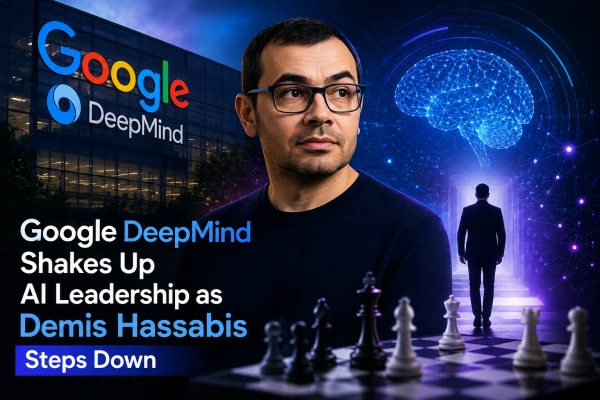
Google DeepMind is undergoing one of its biggest leadership changes since the organization became central to Google's artificial intelligence strategy, with co-founder Demis Hassabis stepping away from his day-to-day role as chief executive and taking on broader responsibilities at Alphabet.
The move comes at a critical moment for Google's AI ambitions, as the company faces increasingly intense competition from OpenAI, Anthropic and other AI developers while trying to turn Gemini into a leading platform for the next generation of artificial intelligence.
Hassabis will remain closely involved with DeepMind, becoming its chair while also serving as chief scientist at Alphabet, allowing him to focus more heavily on long-term AI research and the development of artificial general intelligence.
The change does not mean Hassabis is leaving Google or abandoning DeepMind. Instead, it represents a shift from managing the organization's daily operations toward a broader scientific and strategic role. Koray Kavukcuoglu, DeepMind's current chief technology officer and a longtime member of the company's leadership team, will take over responsibility for running the organization.
Hassabis has indicated that the change will give him more time to concentrate on some of the most important questions facing the AI industry, particularly the development of increasingly advanced systems and the challenges surrounding artificial general intelligence.
The timing of the leadership change is what makes the announcement particularly significant.
Google has invested enormous resources into artificial intelligence and has placed Gemini at the center of its strategy to compete with ChatGPT and Claude. The company has access to some of the world's strongest AI research teams, custom AI processors, enormous computing infrastructure and billions of users through products such as Search, Android, Gmail and YouTube.
Yet the competition has become increasingly difficult, with OpenAI and Anthropic pushing rapidly into advanced models, AI agents and enterprise software. The leadership restructuring therefore arrives at a point when Google's ability to execute its AI strategy is under intense scrutiny.
Hassabis has been one of the most influential figures in modern artificial intelligence. He co-founded DeepMind in 2010 before Google acquired the company in 2014, and DeepMind subsequently became one of the world's most respected AI research organizations.
Its work has produced major breakthroughs including AlphaGo, which demonstrated that AI could master the highly complex board game Go, and AlphaFold, which transformed the use of artificial intelligence in predicting protein structures. Hassabis shared the 2024 Nobel Prize in Chemistry for work related to AlphaFold, further establishing him as one of the most prominent scientific figures in the AI industry.
His decision to move away from operational leadership therefore carries symbolic weight. DeepMind has traditionally been associated with long-term research and ambitious scientific goals, while Google's broader AI strategy has increasingly focused on turning those breakthroughs into consumer and enterprise products.
Gemini represents the clearest example of that transition, bringing DeepMind's research capabilities into a commercial ecosystem that competes directly with some of the world's largest technology companies.
Google has been attempting to unify its AI efforts for several years, bringing DeepMind and Google's internal AI teams closer together while developing Gemini as a common model family. The strategy gives the company an unusual combination of research expertise and distribution.
Google can develop AI models and immediately deploy them across products used by billions of people. The challenge is making those products compelling enough for users to choose Google's AI services when alternatives from OpenAI, Anthropic and other companies are only a few clicks away.
The leadership change is also happening alongside another major departure. Jeff Dean, one of Google's most important computer scientists and a longtime leader in the company's AI efforts, is leaving to establish a new venture called Discovery Loop.
The company is expected to focus on using AI to automate aspects of scientific research, while Google plans to support the new organization. Dean's departure adds another layer to the restructuring because he has played a central role in Google's computing and machine-learning development for years.
Dean's exit is particularly notable because of his history at Google. He was one of the company's earliest engineers and became deeply involved in the development of the infrastructure that supported Google's internet services. He later became one of the most influential figures in the company's AI research organization.
Losing a scientist with that level of experience while simultaneously changing the leadership structure around DeepMind inevitably raises questions about how Google intends to organize its AI research going forward.
Google is not short of AI talent, but the industry's talent market has changed dramatically. OpenAI, Anthropic, Meta, xAI and numerous startups are competing aggressively for researchers and engineers capable of building frontier AI systems.
Researchers who once spent their careers inside major technology companies now have more opportunities to establish their own companies, join AI startups or build specialized research organizations. That creates a difficult environment for Google because maintaining a world-class research team is no longer simply a matter of offering competitive salaries.
The company's Gemini strategy is likely to be one of the biggest areas watched after the leadership change. Gemini has developed rapidly and is now integrated across Google's ecosystem, but the AI market has become extremely competitive.
OpenAI's ChatGPT remains one of the most recognizable AI products in the world, while Anthropic's Claude has built a strong reputation among developers and businesses. Google's advantage is its enormous distribution network, but distribution alone does not guarantee that users will prefer one model over another.
Hassabis moving into a broader scientific role could actually allow him to focus more directly on the long-term technological questions that originally motivated DeepMind. Rather than spending as much time on organizational management, he can concentrate on AI research, scientific strategy and the development of systems that could eventually move beyond today's narrow definitions of artificial intelligence.
Hassabis has repeatedly discussed the possibility that artificial general intelligence could arrive sooner than many people expect, making his continued involvement in long-term research particularly important.
The transition also highlights a tension that is becoming common across the AI industry. Companies building frontier models have to make decisions about both short-term product competition and long-term scientific research. The two goals overlap, but they are not always identical. A company may need to release better models quickly to compete in the market, while researchers may want to spend years exploring technologies that could fundamentally change what AI systems can do.
DeepMind has historically had more freedom to pursue ambitious research than many conventional product teams, and Hassabis has been one of the strongest advocates for that approach. His new role could therefore allow him to influence Google's AI direction at a higher level while leaving operational execution to a leadership team focused more directly on products, engineering and deployment.
For Google, however, the immediate challenge remains execution. The company has to keep Gemini competitive while simultaneously integrating AI into Search, Android, Workspace, cloud services and other major products. It also needs to manage the enormous computing requirements associated with advanced AI models. Google has an advantage in this area because it designs its own AI processors through its TPU program and operates one of the world's largest cloud and data-center infrastructures.
The company's AI ambitions also extend beyond chatbots. Google has been developing AI systems capable of reasoning, coding, searching for information and interacting with tools. The industry is increasingly moving toward AI agents that can perform multi-step tasks rather than simply answer questions.
That shift could make the underlying organization of Google's AI research even more important because future systems may require close cooperation between model researchers, software engineers, hardware teams and product developers.
The departure of senior figures such as Dean therefore comes at a moment when Google needs strong coordination across those areas. At the same time, the company is not losing its entire AI leadership team. Kavukcuoglu has been deeply involved in DeepMind's technical development and is positioned to provide continuity while the organization adjusts to the new structure. The transition appears designed to preserve DeepMind's research capabilities while giving Hassabis greater freedom to focus on long-term scientific questions.
Investors have nevertheless reacted cautiously to the news. Alphabet shares fell after the leadership announcements, reflecting concerns about the loss of senior AI talent and uncertainty surrounding the company's next stage of AI development. The reaction demonstrates how closely Google's market value is now tied to expectations surrounding artificial intelligence.
A few years ago, a change in leadership at a research organization might have attracted relatively little attention outside the technology industry. Today, decisions involving DeepMind can influence investor expectations about one of the world's largest technology companies.
The development also comes after a period in which Google has faced questions about the pace of its Gemini releases and the company's ability to maintain its lead in AI research. Google's resources are enormous, but the AI race has shown that money and computing power are not enough on their own. Model architecture, research talent, engineering speed, product integration and the ability to turn breakthroughs into reliable services all matter.
That is why Hassabis's new role could become more important than the headline "steps down" initially suggests. He is not disappearing from Google's AI operation. Instead, he is moving further toward the scientific and strategic side of the organization at a time when the biggest question facing the industry is no longer simply how to build a better chatbot, but how to create increasingly capable AI systems while keeping them useful, reliable and safe.
Google's next phase will therefore be watched closely by the entire AI industry. If Kavukcuoglu successfully leads DeepMind's operational transition while Hassabis focuses on long-term research, Google could use the restructuring to strengthen both its commercial AI products and its scientific ambitions. If the company struggles to maintain momentum or continues losing senior researchers, competitors could gain another opportunity to attract talent and market share.
For Gemini users, the changes may not produce an immediate difference. Google's AI products will continue operating, and the company has not announced that Gemini's development is being halted or fundamentally changed because of the leadership transition. The more important effects will appear over time through model releases, product decisions, research breakthroughs and the way Google chooses to organize its AI teams.
The larger story is that artificial intelligence has become important enough to reshape the leadership structures of the world's biggest technology companies. DeepMind is no longer simply a research laboratory working on experimental systems. It sits at the center of Google's strategy for competing in one of the most important technology markets in decades. Every major leadership decision inside the organization now has implications for Gemini, Google's products and the wider AI race.
Demis Hassabis stepping away from the CEO position should therefore not be read simply as the end of his involvement with DeepMind. It is better understood as a transition in which one of the industry's most prominent AI scientists is moving toward a role focused on what comes next.
With Gemini competing against OpenAI and Anthropic and researchers racing toward increasingly capable AI systems, the questions Hassabis chooses to focus on could ultimately matter far beyond Google.
For now, the immediate message from Google is one of restructuring rather than retreat. DeepMind remains central to the company's AI ambitions, Kavukcuoglu is taking on operational leadership, Hassabis is moving into a broader scientific role, and Google's wider AI organization is being reshaped around the next stage of the competition. The real test will be whether that structure helps Google move faster at a time when the AI race is becoming more competitive every month.