
Why Demis Hassabis Is Stepping Back From Google DeepMind
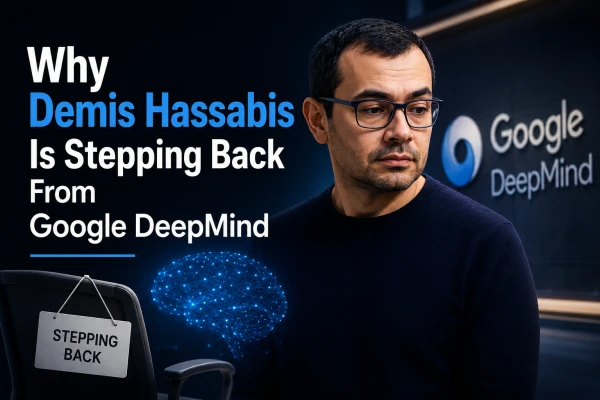
Demis Hassabis is stepping back from the day-to-day leadership of Google DeepMind at a moment when artificial intelligence has become one of the most important battles in the technology industry. The move has attracted attention because Hassabis is not an ordinary technology executive.
He is one of the people most closely associated with the modern AI revolution, having co-founded DeepMind and helped turn it into one of the world's most influential artificial intelligence research organizations.
His decision to move into a broader scientific role therefore raises an obvious question: why would one of Google's most important AI leaders step away from running DeepMind just as the competition around Gemini, ChatGPT and Claude is becoming more intense?
The answer is not that Hassabis is leaving Google or abandoning artificial intelligence. Instead, the change appears to be a shift in where he believes his time can have the greatest impact.
Hassabis is moving away from the daily operational responsibilities of running DeepMind and toward a role that allows him to concentrate more heavily on long-term scientific research and the future of advanced AI. He will remain closely connected to DeepMind while taking on broader responsibilities at Alphabet, meaning his influence over Google's AI direction is not disappearing.
That distinction is important because DeepMind has grown far beyond the research laboratory that Hassabis helped establish in 2010. Google acquired DeepMind in 2014, and the organization eventually became central to Google's wider artificial intelligence strategy.
Today, DeepMind is deeply involved in the development of Gemini and other AI technologies that Google is deploying across its enormous ecosystem. The organization is simultaneously expected to produce fundamental scientific breakthroughs and help Google compete in a rapidly changing commercial AI market.
Hassabis's history explains why his change in role matters so much. Under his leadership, DeepMind produced several landmark achievements that changed how researchers viewed artificial intelligence.
AlphaGo demonstrated that an AI system could defeat elite human players at the extremely complex game of Go, while AlphaFold used artificial intelligence to tackle one of biology's most difficult problems by predicting the structures of proteins. These achievements helped establish DeepMind as a research organization capable of applying AI to problems far beyond traditional computer science.
Hassabis later received the 2024 Nobel Prize in Chemistry alongside John Jumper for their work on AlphaFold, reinforcing his position as one of the most prominent scientific figures in artificial intelligence. His career has therefore been built around long-term research as much as commercial technology.
Moving toward a broader scientific role allows him to return more directly to that side of his work at a time when the AI industry is increasingly focused on questions that could take years to answer.
One of those questions is the future of increasingly capable AI systems. Hassabis has spent years discussing artificial general intelligence and the possibility that AI could eventually become capable of performing a much wider range of intellectual tasks.
The industry has moved significantly closer to that possibility with the emergence of advanced reasoning models, multimodal systems and AI agents capable of using tools and completing multi-step tasks. But the technology remains far from the fully general intelligence imagined by many researchers, leaving enormous scientific questions still unresolved.
Running a major AI organization requires enormous attention to operations, hiring, product development, budgets, infrastructure and coordination between hundreds or thousands of researchers and engineers.
Those responsibilities can consume the same time that a scientist might otherwise spend thinking about fundamental research. Hassabis stepping back from daily management could therefore allow him to concentrate on questions that require a longer horizon than the normal product-development cycle.
That does not mean Google is reducing its AI ambitions. In many ways, the opposite is true. Google is facing some of the strongest competition in its history as OpenAI continues developing ChatGPT, Anthropic expands Claude and other companies race to build increasingly capable AI systems. Gemini has become Google's main response to that competition, and the company is integrating it across Search, Android, Workspace, Cloud and other major products.
The challenge for Google is that the AI race is no longer simply a research competition. Companies must simultaneously develop better models, build enormous computing infrastructure, recruit top researchers and engineers, launch consumer products and convince businesses to adopt their technology. Google has enormous advantages in several of these areas, but the speed of the AI market means that having resources is not enough. The company must also be able to execute quickly.
This is where the new DeepMind leadership structure becomes important. Koray Kavukcuoglu, who has served as DeepMind's chief technology officer, is taking on greater operational responsibility. His technical background gives the organization continuity while allowing Hassabis to move toward a role that is more heavily focused on scientific direction.
The arrangement could ultimately benefit both sides. Kavukcuoglu can concentrate on running a large and complex organization while Hassabis focuses on the scientific questions that could determine where AI goes next. Rather than asking one person to simultaneously manage a huge research organization and think deeply about the future of artificial intelligence, Google is effectively separating those responsibilities.
The timing is also significant because Google's AI strategy has changed dramatically since DeepMind first became part of the company. In the early years, DeepMind was primarily known for ambitious research projects that could take years to mature.
Today, Google's AI work is tied directly to some of its most important commercial products. Gemini is being integrated into services that reach billions of users, and Google must constantly improve its AI systems to compete with products from OpenAI, Anthropic and other companies.
That commercial pressure creates a difficult balance. Researchers need freedom to pursue ideas that may not produce an immediate product, while Google's product teams need reliable technology that can be deployed at enormous scale. DeepMind has to operate in both worlds at the same time.
Hassabis stepping back from day-to-day management could give him more freedom to focus on the research side of that equation. His new position can allow him to think beyond the next Gemini release and focus on technologies that could influence the next several generations of AI.
There is another reason the move is attracting attention: the competition for AI talent has become extraordinarily intense. Researchers and engineers with experience building frontier AI systems are now among the most valuable people in the technology industry.
OpenAI, Anthropic, Meta, Google and numerous startups are competing aggressively for the same talent, and senior researchers increasingly have the option of creating their own companies or launching specialized research organizations.
Google therefore needs to maintain DeepMind's reputation as a place where ambitious researchers can pursue difficult scientific problems. Keeping Hassabis involved in that research culture could be important. His presence provides continuity and reinforces DeepMind's identity as a scientific organization rather than simply another product division.
The move also comes alongside the departure of Jeff Dean, another highly influential figure in Google's technology and AI history. Dean has been involved in Google's computing infrastructure and machine-learning research for decades and is now leaving to pursue a new venture focused on AI and scientific discovery. His departure has added to the attention surrounding Google's AI leadership changes.
However, it would be misleading to interpret these developments as evidence that Google is abandoning DeepMind or that Gemini is in trouble. Google continues to invest heavily in AI infrastructure, research and products.
The company has enormous computing resources, its own AI accelerators, a global cloud business and access to vast amounts of engineering talent. The leadership changes are better understood as part of the company's attempt to organize those resources for the next stage of the AI race.
Gemini remains central to that strategy. Google wants Gemini to become more than a chatbot that answers questions. The company's broader vision includes AI systems that can understand different types of information, reason through complicated tasks, interact with software and assist users across multiple products. That ambition requires close cooperation between research teams, software engineers, hardware developers and product organizations.
The future of AI agents makes this even more important. The industry is moving from systems that simply respond to prompts toward systems that can potentially perform actions. An AI agent could research a topic, write code, interact with applications, analyze information and complete several steps without requiring a user to provide a new instruction after every action. Building reliable systems with those capabilities is a much harder problem than building a conventional chatbot.
Hassabis's scientific focus could become especially important in that environment. The next major breakthroughs in AI may not come simply from making models larger. Researchers are exploring better reasoning, memory, planning, multimodal understanding, tool use and new ways for AI systems to learn. These are fundamental research questions that can take years to solve.
Google is in a particularly strong position to pursue them because it controls both research and infrastructure. DeepMind can develop new AI techniques, Google's hardware teams can build specialized processors, and the company's data centers can provide the computing resources required to train and operate the resulting systems. Few organizations have the same combination of scientific talent, hardware and global distribution.
The question is whether Google can turn that advantage into a sustained lead. Having some of the world's best AI researchers does not automatically guarantee that Gemini will dominate the market. Users care about reliability, speed, usefulness and how well AI fits into their daily lives. Businesses care about cost, security and performance. Developers care about tools, APIs and model capabilities. Google has to satisfy all of these groups simultaneously.
That is why Hassabis's new role could be more important than the phrase "stepping back" suggests. He is not simply reducing his involvement in AI. He is potentially moving toward the part of AI development where his scientific background is most valuable. Instead of spending as much time managing the organization, he can spend more time thinking about what comes after today's generation of models.
The impact will not be visible immediately. Users should not expect Gemini to suddenly change because of the leadership transition, and Google has not indicated that the company is changing its overall commitment to Gemini. The effects are more likely to appear gradually through future research breakthroughs, new AI architectures and the direction Google takes with advanced systems.
For the broader technology industry, the development is another sign that AI has moved into a completely different phase. Artificial intelligence is no longer just an experimental research field. It has become central to the strategies of the world's largest technology companies, and decisions about AI leadership can influence billions of dollars in investment and the future direction of major products.
Hassabis's decision also highlights a simple reality about building advanced AI: the people leading the research cannot always spend their time doing everything else. As organizations become larger and AI systems become more complicated, companies need different leaders for scientific research, engineering, product development and operations.
Google appears to be making that distinction clearer at DeepMind. Hassabis can focus more heavily on science and long-term AI development, while the organization's operational leadership moves to another experienced technical leader. If the structure works as intended, DeepMind could preserve its research identity while becoming more effective at turning those breakthroughs into products.
The next few years will reveal whether the strategy succeeds. Google has the resources to remain one of the most important AI companies in the world, but competition from OpenAI, Anthropic, Meta and other companies will continue to intensify. Gemini will have to improve, AI agents will become more capable and the underlying research will continue moving toward systems that can perform increasingly complex tasks.
For Demis Hassabis, however, stepping back from the daily running of Google DeepMind may ultimately mean stepping closer to the work that made him one of the most influential people in artificial intelligence.
The future of AI is likely to depend on scientific breakthroughs that have not yet been discovered, and Google is giving one of its most experienced AI researchers more room to concentrate on finding them.
That is why the leadership change should not simply be viewed as Demis Hassabis stepping away from Google DeepMind. It is better understood as a change in responsibility at a critical moment. Hassabis remains part of Google's AI future, but his focus is moving toward the bigger scientific questions that could shape what artificial intelligence becomes next.