
AMD Takes Aim at Nvidia With Helios as AI Chip Competition Enters a New Phase
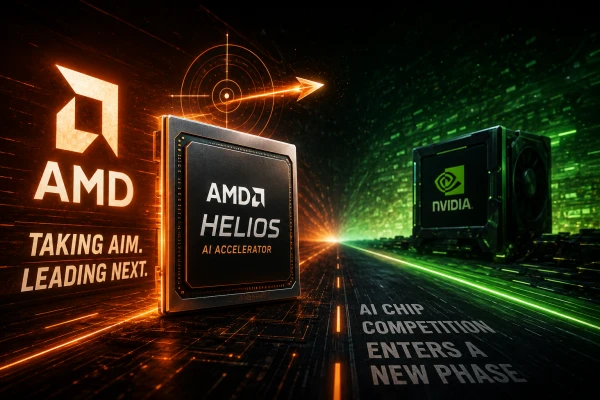
The competition between AMD and Nvidia is entering a new phase as AMD pushes deeper into the artificial intelligence infrastructure market with its Helios rack-scale platform, a system designed to combine processors, GPUs, networking and software into a single high-performance environment for large-scale AI workloads.
The move comes as demand for computing power continues to surge and technology companies race to secure the hardware needed to train and operate increasingly capable artificial intelligence systems.
AMD's latest financial results provide an indication of how important AI has become to the company's strategy. The chipmaker reported second-quarter revenue of $11.54 billion, up 50% from a year earlier, while revenue from its data-center business rose more than 100% year over year to $6.72 billion.
AMD also forecast third-quarter revenue of about $13 billion, above Wall Street expectations, although the company's shares fell sharply in after-hours trading as investors appeared to expect an even stronger outlook from its rapidly expanding AI business.
The results show that AMD is no longer competing with Nvidia only through individual graphics processors. The company is increasingly attempting to provide complete AI infrastructure that can be deployed by cloud providers and major technology companies.
Helios combines AMD's next-generation Instinct accelerators with EPYC server processors, Pensando networking technology and the company's ROCm software platform, creating a rack-scale system designed to handle the enormous workloads required by modern AI models.
Rack-scale computing is becoming increasingly important because frontier AI systems require many processors to work together as a single computing environment. Instead of treating individual servers as separate machines, rack-scale platforms connect large numbers of processors, memory systems and networking components so they can operate together with high-speed communication.
This approach is particularly important for AI training and inference, where delays between processors can reduce performance and increase the cost of running large models.
Nvidia has dominated this part of the market for years with systems built around its GPUs, networking technology and software ecosystem. AMD is now attempting to challenge that advantage by offering an alternative platform rather than simply trying to compete with Nvidia on the specifications of an individual chip.
AMD has described Helios as an open rack-scale architecture designed for large AI workloads, while Nvidia has continued developing its own increasingly integrated AI rack systems.
The difference could become particularly important as AI companies begin spending billions of dollars on infrastructure. OpenAI, Microsoft, Meta, Oracle and Anthropic are among the organizations that have announced plans involving AMD's Helios platform, giving AMD a growing list of major customers for its AI infrastructure strategy.
Microsoft has said it plans to deploy Helios at scale on Azure to support frontier-model inference and Azure AI services, while AMD and Anthropic have also announced a strategic partnership involving up to two gigawatts of AMD Instinct MI450-series GPUs.
For AMD, those partnerships could be critical because Nvidia's biggest advantage is not simply the performance of its processors. Nvidia has spent years building an extensive ecosystem around its hardware, including networking products, development tools and CUDA software that has become deeply embedded in AI research and commercial applications.
AMD therefore needs to convince customers that its combination of hardware and ROCm software can provide a competitive alternative without creating significant switching costs.
AMD's approach also places greater emphasis on open standards. The company says its Helios reference design is based on open rack standards and is intended to allow system manufacturers to build their own branded systems.
AMD argues that an open approach can help customers avoid being locked into a single vendor while giving data-center operators more flexibility in how they configure their AI infrastructure. The company expects volume deployments based on the Helios design during the second half of 2026.
The timing is important because AI infrastructure spending is expanding at extraordinary speed. Companies developing large language models, reasoning systems and AI agents need enormous amounts of computing power, and the demand does not end when a model has finished training.
Once an AI system becomes available to users, data centers must continuously process inference requests, meaning the same infrastructure has to support millions or potentially billions of interactions over time.
AI agents could increase those requirements even further. A conventional chatbot may generate a response from a single or relatively small number of model operations, while an autonomous AI agent may need to reason through a task, search the web, call software tools, access databases, write and execute code and repeatedly communicate with other systems before completing the job. That creates a much larger demand for processors and high-speed networking, making efficient AI infrastructure increasingly important.
AMD's growing data-center business suggests that the company is already benefiting from this trend. The challenge will be turning its recent gains into a sustained increase in market share against Nvidia, which remains the dominant supplier of AI accelerators.
AMD's Helios platform gives the company a way to compete at a higher level by selling an entire computing architecture rather than relying solely on the success of individual GPU products.
The competition could also benefit AI developers and cloud providers. More competition between AMD and Nvidia could give large customers additional choices when purchasing AI infrastructure and potentially improve pricing and availability.
Companies building massive data centers increasingly want alternatives because depending on one hardware supplier can create supply-chain risks and limit their ability to negotiate.
The battle is also likely to extend beyond the United States. AI infrastructure is becoming a strategic priority for governments and technology companies around the world, with Europe, Asia and the Middle East investing heavily in data centers and domestic AI capabilities. AMD's open approach could appeal to organizations that want to build their own AI infrastructure while retaining greater control over hardware, software and deployment.
For Nvidia, AMD's progress represents a challenge at a time when the AI chip market is becoming one of the most valuable segments of the global technology industry. Nvidia has built an enormous lead, but the rapid growth of AI means the overall market could become large enough to support several major suppliers.
AMD does not necessarily need to replace Nvidia to become a major winner from the AI boom; capturing a meaningful portion of the rapidly expanding market could generate substantial growth.
The next major test will be how quickly Helios moves from announcements and early deployments into large-scale production. AMD says volume deployments are expected in the second half of 2026, while major customers are already preparing to use the platform for AI workloads.
If those deployments perform well, they could give AMD additional credibility among cloud providers and AI developers that are currently heavily dependent on Nvidia's ecosystem.
AMD's latest results suggest that the company has already established itself as a serious competitor in AI computing, but Helios represents a much larger ambition. AMD is attempting to compete across the full AI infrastructure stack, from processors and accelerators to networking and software.
If the strategy succeeds, the company's rivalry with Nvidia could move beyond the familiar battle over which GPU is faster and become a much broader contest over who supplies the infrastructure powering the next generation of artificial intelligence.
The AI chip market is therefore entering a critical period. Nvidia remains the company to beat, but AMD is building the hardware, software and partnerships needed to challenge its position.
With data-center demand accelerating and AI companies committing enormous sums to computing infrastructure, the competition between the two chipmakers could become one of the defining technology battles of the second half of 2026.
