US Signs San Francisco AI Supply Chain Pact With Nine Partners
The US signs a San Francisco AI supply chain pact with nine partner governments, creating a shared framework for protecting sensitive technology and critical infrastructure used to build advanced artificial-intelligence systems. The declaration was signed November 15 at the Pax Silica Founders Retreat.
Australia, India, Israel, Japan, South Korea, Qatar, Singapore, the United Arab Emirates and the United Kingdom joined the United States. The agreement defines what the coalition considers strategically sensitive, but it does not impose binding export controls, announce funding or identify specific companies and products for restriction.
The San Francisco Declaration establishes four immediate commitments:
- Treat economic security as part of national security.
- Protect sensitive AI-related technologies from hostile acquisition.
- Secure physical and digital infrastructure across supply chains.
- Create working groups to turn the principles into joint programs.
US Signs San Francisco AI Supply Chain Pact
The declaration marks the next phase of Pax Silica, a US-led partnership launched less than a year ago. Under Secretary of State for Economic Affairs Jacob Helberg convened the retreat, and the ten governments released the text through the US State Department.
The participants argue that no country can independently secure every component required for advanced AI. Chip design, fabrication equipment, specialized materials, energy systems, data infrastructure and international logistics frequently sit in different jurisdictions, creating dependencies that can become security or economic pressure points.
Reuters independently confirmed the signing and described it as an effort to protect AI technology and infrastructure amid strategic competition with China. The declaration itself does not name China, designate an adversary or create a common sanctions regime.
The text uses the term “super intelligence” for the protected ecosystem, while a footnote states that some participants use “artificial intelligence” instead. That wording difference does not narrow the listed technologies or infrastructure covered by the common framework.
What the Declaration Defines as Sensitive Technology
The agreement uses a broad definition of sensitive technology. It covers goods, software, materials, knowledge, components, manufacturing inputs and the equipment used to produce them when they are essential to advanced AI supply chains.
Protection is triggered when theft, illicit transfer or hostile acquisition could provide a meaningful military or intelligence advantage, create undue economic leverage or pose significant economic and national-security risks. That language could encompass semiconductors, production machinery, technical know-how, specialized materials and software, depending on later decisions.
The scope is therefore wider than a conventional chip-export agreement. It reaches the methods and inputs needed to produce strategic systems, while leaving the participating governments to determine which technologies meet the threshold under their respective laws and policies.
Ports, Energy and Digital Platforms Enter the Security Perimeter
The declaration also defines critical infrastructure across both physical and digital systems. It explicitly includes ports, terminals, transport networks, communications, logistics, information technology, energy infrastructure and the digital platforms that coordinate those assets.
That definition recognizes that AI capacity depends on more than processors. A disruption to electricity, shipping, communications or logistics data can delay the delivery of chips and equipment, reduce data-center availability or expose sensitive information moving between suppliers.
The governments say harm can arise through disruption, degradation, hostile control or unauthorized exposure of data. Their proposed response combines supply-chain diversification with cooperation against economic coercion, market-distorting practices and improper access to critical systems.
Five Working Groups Must Turn the Pact Into Policy
The declaration proposes five working groups covering innovation policy, advanced-AI adoption in key sectors, cooperation across the technology stack, safe harbors and supply-chain security hubs, and system security and resilience. The State Department has not published membership, deadlines or deliverables for those groups.
The safe-harbor and security-hub concept could become especially important for companies operating across several signatory markets. Shared definitions or reporting channels could reduce conflicting requirements, while poorly aligned rules could add compliance costs without removing the underlying dependency.
The next evidence will be operational: joint risk lists, coordinated investment screening, incident-sharing arrangements, procurement rules or investments that diversify production. Until those measures appear, the San Francisco Declaration is a political baseline rather than an enforceable international AI supply-chain regime.
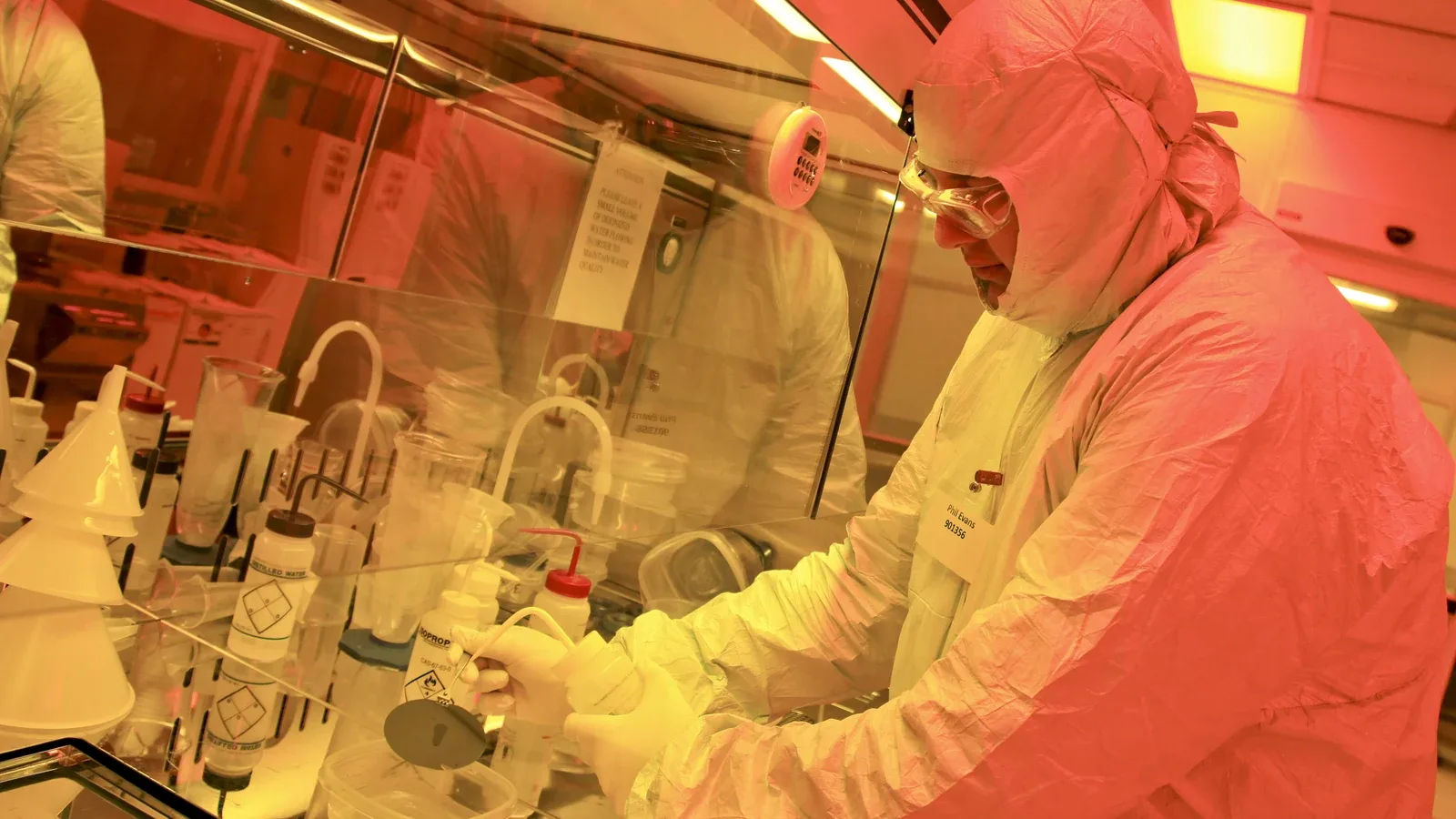
Illustrative feature photograph: Oak Ridge National Laboratory researcher Phil Evans handles a silicon-on-insulator wafer in a cleanroom. The photograph was sourced through Wikimedia Commons under CC BY 2.0, credited to Oak Ridge National Laboratory. It does not depict the San Francisco Declaration signing. The image was cropped to 16:9 and resized.

Related Research