
Runway Opens Praxis-1 Robot Weights Under Apache 2.0
Runway opens Praxis-1 weights and its robot-control code under the Apache 2.0 license, turning a September partner preview into a public release that developers can inspect, adapt and use commercially.
Praxis-1 is a 27.2-billion-parameter world-action model that predicts short video sequences and robot movements together. Runway has published base, single-arm and dual-arm checkpoints, plus inference and fine-tuning tools, on GitHub and Hugging Face.
The public release includes four practical components:
- A base checkpoint for new robot configurations
- DROID weights for single-arm manipulation
- YAM weights for dual-arm tasks
- Full and LoRA fine-tuning code
Related Research
Runway Opens Praxis-1 Weights for Commercial Robot Development
The November 11 release covers the model weights, reference inference pipeline and code for full or low-rank adaptation. Apache 2.0 permits commercial use, although Praxis-1 depends on separately distributed components whose licenses and deployment conditions still need to be checked.
The public artifacts include a checkpoint trained on the DROID single-arm dataset, a bimanual checkpoint for two YAM arms and a base model intended for adaptation to new hardware. Runway also released a policy server, a MuJoCo simulation and native integration with Hugging Face's LeRobot framework.
This availability milestone is distinct from Runway's September announcement. At that time, Praxis-1 was being tested with selected partners including Noble Machines, Standard Bots and Ultra. The weights were promised for a later release but were not yet generally downloadable.
Praxis-1 Predicts Video and Actions in the Same Loop
Most robot policies map sensor observations directly to motor commands. Praxis-1 adds an explicit video-prediction task: its backbone estimates what the scene should look like next, while an action expert uses the same internal representation to calculate the movement that could produce that future.
Runway's technical report describes a mixture-of-experts diffusion transformer with 27.2 billion parameters. A policy call processes camera views, a task instruction and recent robot state, then generates a video chunk and a 24-step action chunk executed at 15 hertz.
The training process begins with Runway's general video foundation model. It then shifts to embodied footage showing people and robots manipulating objects before learning robot actions. The design tests whether broad video pretraining can reduce the amount of expensive teleoperation data needed for each new machine.
Hardware-specific projections translate the shared model into each robot's action space. Developers still need demonstrations from their own cameras, arms and grippers, but LoRA fine-tuning can update a smaller set of parameters instead of retraining the entire network.
RoboLab-120 Results Remain Provider-Reported
Runway reports a 46.2% success rate across 1,200 episodes on Nvidia's RoboLab-120 benchmark. Its comparison table lists FLUX 3 Action at 42.9%, Cosmos3 Nano at 36.8% and Physical Intelligence's π0.5 at 28.0% under the same evaluation.
The company also says a Praxis-1 version fine-tuned for Google's RT-1 robot reached 80.0% on SimplerEnv, compared with 52.4% for the original RT-1 policy. Runway says the target robot was absent from pretraining, making the test an example of transfer to a new embodiment.
Those figures have not been independently reproduced. A 46.2% average also means more than half of benchmark episodes did not finish successfully, so the leaderboard result should not be read as evidence that the model is ready for unsupervised factory, warehouse or home deployment.
The research report identifies harder cases, including ambiguous instructions, scenes containing look-alike objects and multi-step jobs expressed as one long prompt. Runway suggests pairing the policy with a separate reasoning model that breaks complex work into smaller instructions.
Praxis-1 Deployment Demands Significant Hardware and Safety Testing
The released bfloat16 checkpoints occupy about 54.4 gigabytes, and the reference repository calls for an 80-gigabyte GPU for the standard configuration. An experimental NVFP4 route can reduce weight memory on newer desktop hardware, but its speed and closed-loop accuracy have not been fully measured.
Open weights improve inspection and give robotics teams control over fine-tuning and local deployment. They do not provide a safety case for a particular machine. Force limits, collision detection, emergency stops, guarded work areas and human supervision must be validated with the final hardware and task.
Praxis-1 gives researchers a substantial shared starting point for video-conditioned robot learning. The next evidence will come from outside replications, longer real-world trials and failure reporting across robots that differ from the rigs used in Runway's own demonstrations.
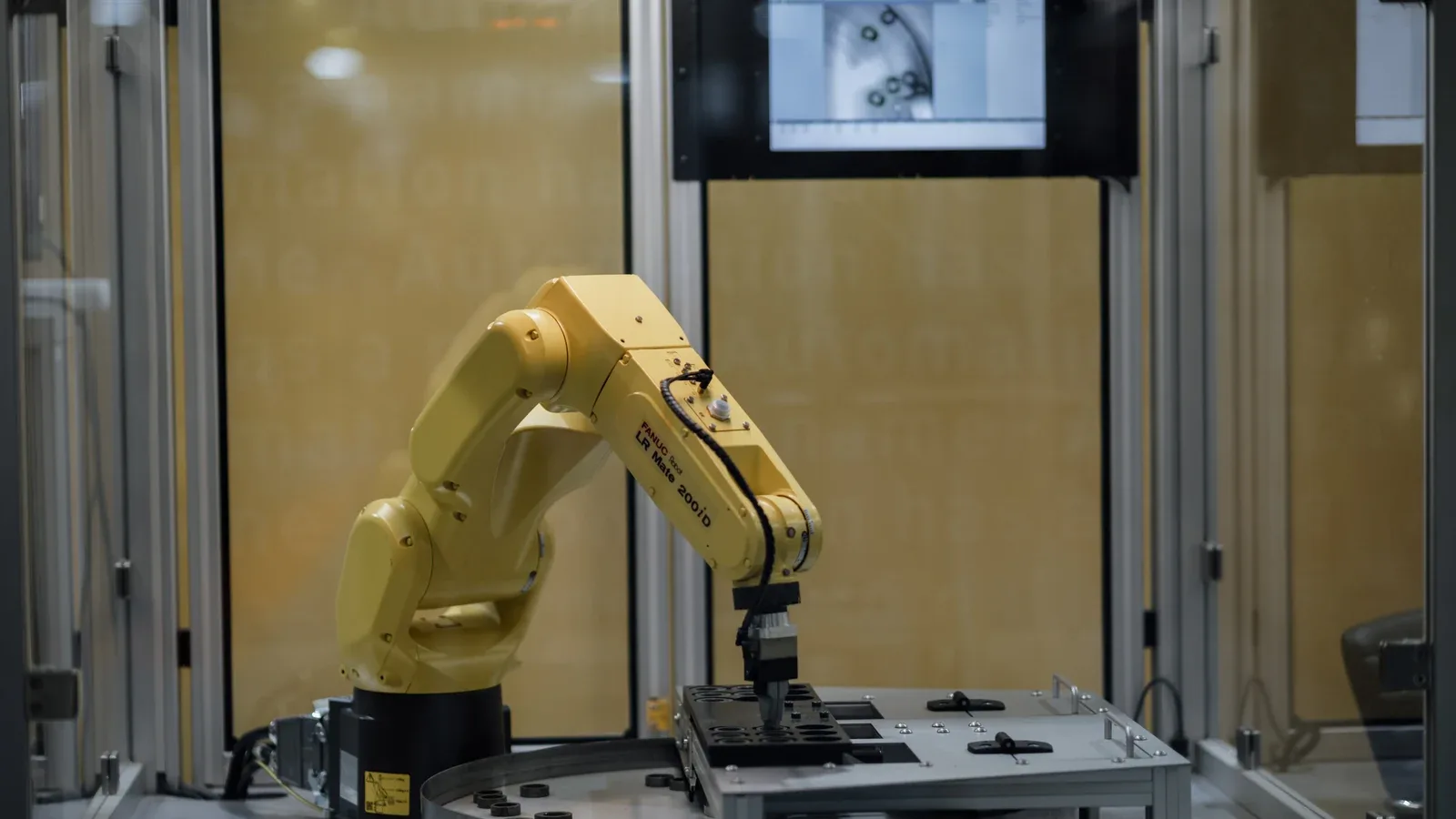
Illustrative photograph: a FANUC robot arm assembling a component in a laboratory, photographed by Nenad Stojković and published through Wikimedia Commons under CC BY 2.0. The image was cropped to 16:9 and resized; it does not depict Praxis-1 or a Runway deployment.