
GlobalFoundries Signs $2 Billion TSMC AI Packaging Deal
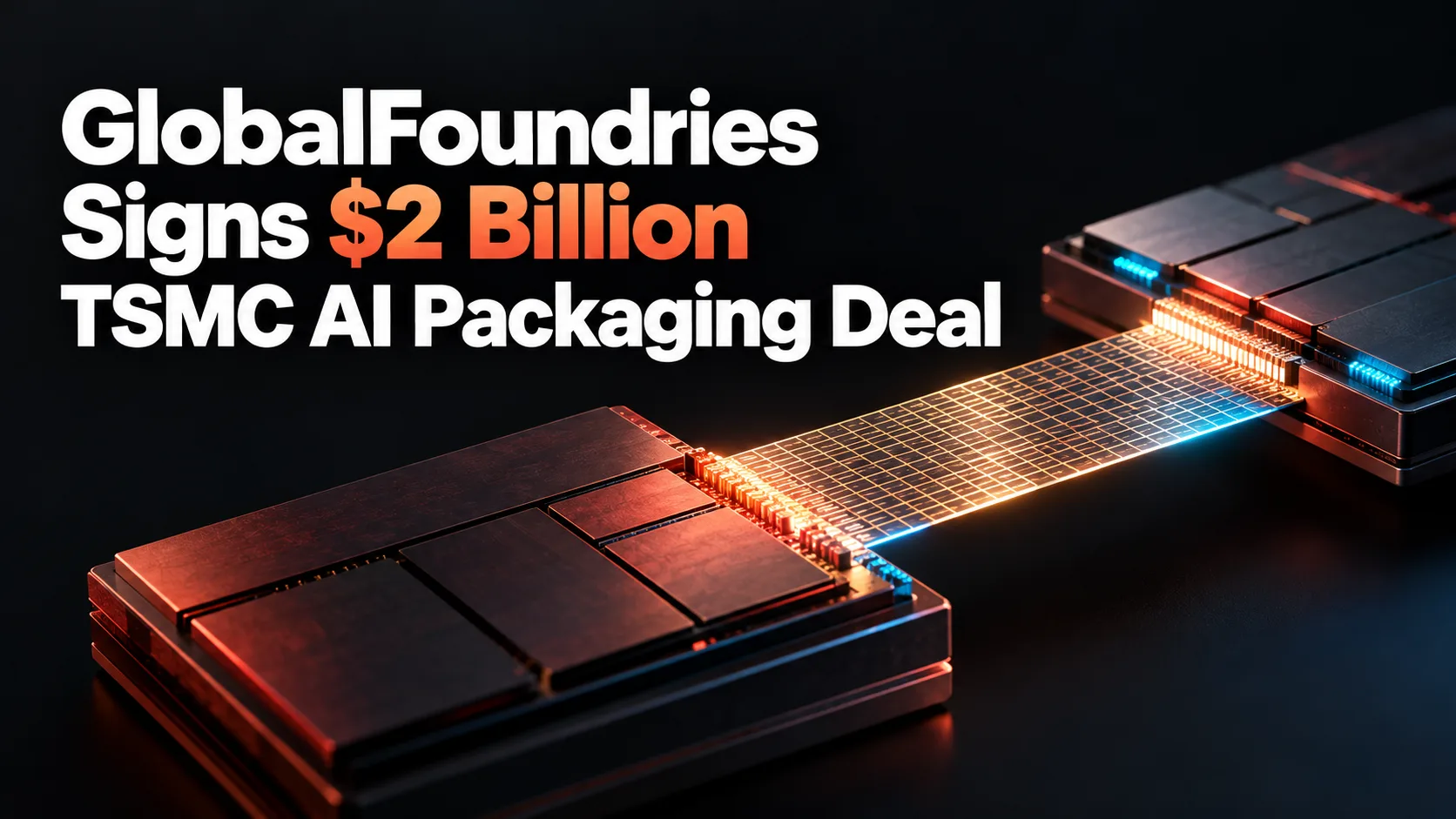
GlobalFoundries signs a $2 billion TSMC AI packaging deal to manufacture silicon interposers at its Malta, New York, facility. Announced October 8, the five-year agreement creates a U.S. supply source for components used in TSMC’s CoWoS advanced packaging ecosystem.
Volume production is scheduled to begin ramping during the first half of 2028. The deal links two major semiconductor foundries at a pressure point for AI hardware: assembling processors and memory into high-bandwidth packages at sufficient scale.
The agreement establishes four concrete commitments:
- A multi-year contract valued at $2 billion
- Additional interposer capacity in Malta, New York
- An initial term of five years
- A production ramp targeted for early 2028
Related Coverage
GlobalFoundries Signs $2 Billion TSMC AI Packaging Deal
GlobalFoundries will provide manufacturing services to TSMC and add fabrication capacity at its Malta campus. The companies structured the agreement so capacity can expand beyond the initial commitment if demand for advanced packaging continues to rise.
The published value should not be confused with a disclosed factory investment or acquisition price. GlobalFoundries describes it as the value of the manufacturing agreement, while neither company has released annual shipment volumes, unit pricing or the amount of capital spending required for the expansion.
The arrangement is unusual because both companies operate semiconductor foundries, although they compete most directly in different parts of the market. TSMC leads production of advanced processors, while GlobalFoundries concentrates on differentiated manufacturing technologies. Here, GlobalFoundries becomes a supplier to TSMC’s packaging ecosystem rather than a producer of the compute dies.
Reuters reported that GlobalFoundries shares gained about 4% in premarket trading after the announcement. The market response reflects the strategic importance of packaging capacity as AI companies seek more complete systems, not merely additional processor wafers.
How Silicon Interposers Support CoWoS AI Packages
A silicon interposer sits beneath processors and memory components inside an advanced package. Fine electrical connections across the interposer let those chips exchange data at high speed, allowing several specialized dies to function as one tightly integrated system.
This architecture is central to TSMC’s Chip-on-Wafer-on-Substrate, or CoWoS, platform. AI accelerators depend on rapid movement between compute engines and nearby memory. Increasing raw processor performance delivers limited gains if the package cannot supply data with sufficient bandwidth and acceptable power consumption.
GlobalFoundries says the new capacity will support multiple product generations and include embedded deep trench capacitor components. Those capacitors can help stabilize power delivery close to demanding chips, an increasingly important function as packages combine more compute, memory and interconnect density.
The interposer is therefore not a commodity mounting plate. Its wiring density, power characteristics, size and manufacturing yield affect how many chips can be connected and how reliably the finished package operates. Defects can reduce the value of other costly components assembled around it.
Malta Factory Becomes a U.S. Packaging Supply Node
GlobalFoundries says its Malta expansion will establish the first U.S.-based source of silicon interposers supporting these advanced packaging technologies. Production would add a domestic link to a supply chain whose most sophisticated capacity has historically been concentrated in Asia.
That does not make the entire CoWoS package American-made. Compute dies, memory, substrates and final assembly may still move through facilities in several countries. The agreement addresses one component and one manufacturing stage, although that stage has become a recognized constraint on AI system output.
For TSMC, a second manufacturing location can add flexibility as customers demand more packaged accelerators. For GlobalFoundries, the deal opens a path into high-growth AI infrastructure without requiring it to match TSMC’s most advanced transistor processes.
The partnership also illustrates how chip supply chains can mix competition and specialization. Foundries may compete for customer programs while cooperating where one has useful capacity, intellectual property or geographic reach. Advanced packaging is creating more of those interdependencies because no single wafer process supplies every part of an AI system.
Capacity, Yield and the 2028 Ramp Will Decide the Deal
The production date leaves a meaningful execution window. GlobalFoundries must install and qualify equipment, achieve acceptable yields and demonstrate that its interposers meet TSMC’s requirements. Customers will also need confidence that the new source performs consistently across successive product generations.
Demand conditions could change before volume ramps. The agreement includes a framework for expansion, but GlobalFoundries has not promised a fixed capacity number. That gives the partners flexibility while leaving investors without a direct measure of how much CoWoS supply the Malta site will ultimately add.
The deal nevertheless puts a price and timeline on a specific response to the AI packaging bottleneck. Rather than announcing another proposed fabrication plant, GlobalFoundries has named the customer, component, location, contract term and production target.
If the Malta ramp arrives on schedule, TSMC will gain a U.S. interposer source and GlobalFoundries will secure a visible role in advanced AI packages. The decisive evidence will come in 2028: qualified volume, reliable yields and capacity large enough to reduce pressure on a constrained part of the supply chain.
