
OpenAI Launches Dots With Access to More Than 4,000 Apps
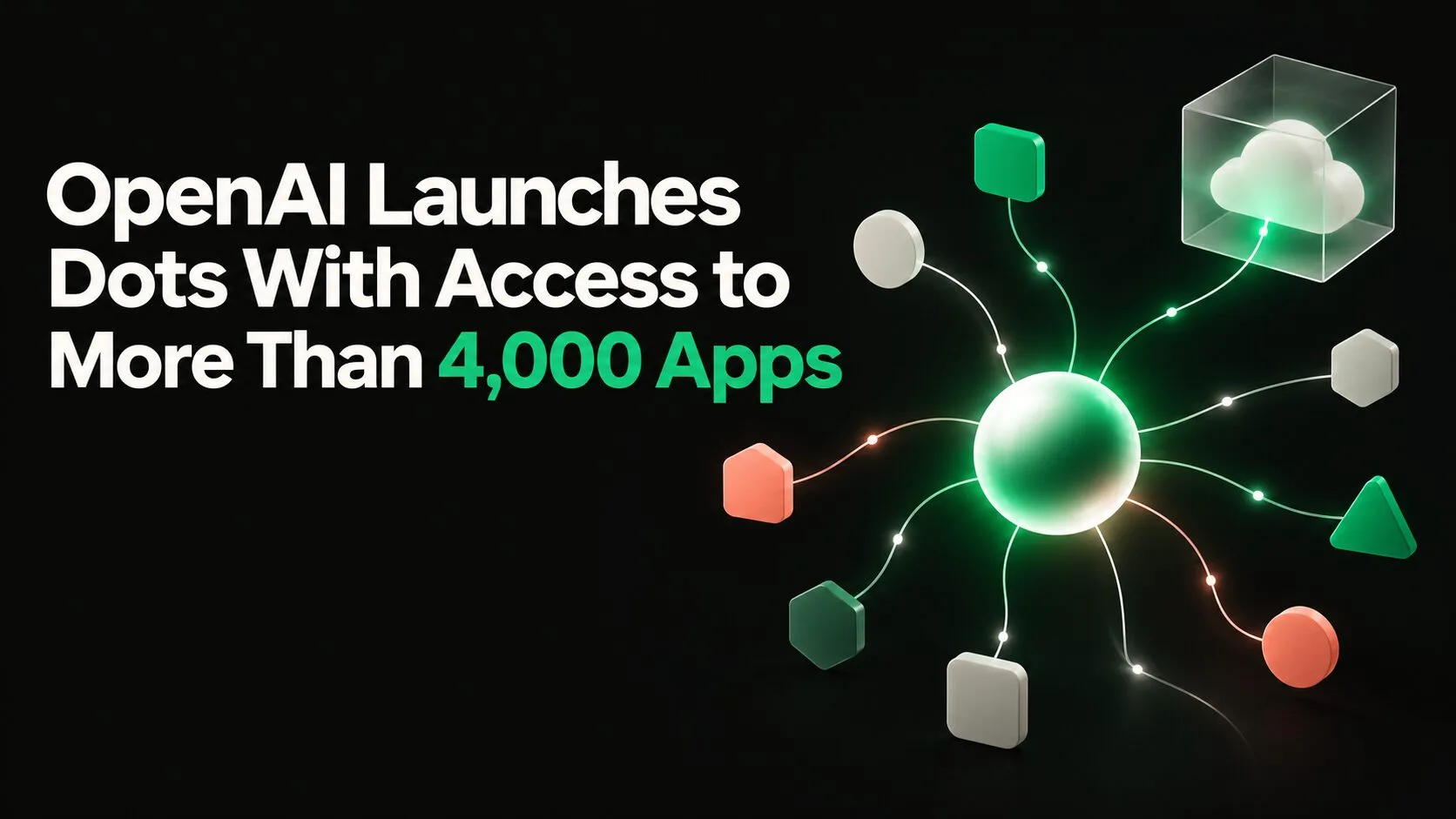
OpenAI launches Dots as always-on GPT-6 Astra agents that can keep working across more than 4,000 connected apps. Announced at DevDay 2026, each Dot runs on its own cloud computer and can continue tasks after a user leaves the conversation.
The product expands ChatGPT from an assistant that waits for prompts into a persistent work system. OpenAI is starting the rollout for Pro and Business Premium customers in eligible markets, with separate beta access for Enterprise, Education and Healthcare organizations.
The launch centers on four capabilities:
- Persistent work on a dedicated cloud computer
- Connections to more than 4,000 apps
- Rules and approvals for sensitive actions
- Access through ChatGPT, Slack and Microsoft Teams
Related Research
How OpenAI Dots Work Across 4,000 Apps
A Dot is an autonomous agent with a persistent environment rather than a single chat session. OpenAI says the agent can navigate websites, use connected applications and retain feedback about how its owner prefers work to be completed.
That architecture gives each agent continuity. A user might assign research, document preparation or coordination work, then check progress later without keeping a browser tab open. The cloud computer is separate from the user’s device unless the user explicitly connects a laptop.
OpenAI says Dots can use more than 4,000 apps through plugins. Users can reach them inside ChatGPT, Slack and Microsoft Teams, while text-message access is planned. The company is also previewing specialist Dots designed for narrower roles and workflows.
The product runs on GPT-6 Astra, the model OpenAI positioned for long-running agent work. Dots are designed to learn from corrections and repeat successful patterns, giving organizations a way to encode operating preferences without building a custom agent from scratch.
Approval Controls and Proactive Research
Persistent agents create a different risk profile from conventional chatbots because they can act while users are away. OpenAI is pairing Dots with custom rules that can allow an action, require approval or block it entirely, depending on the application and task.
An Activity View records what a Dot is doing, and OpenAI says its system automatically reviews actions. High-sensitivity operations, including password changes, must still be completed by the user. Those controls are intended to make autonomy visible rather than hiding it behind a finished result.
Dots can also conduct proactive research using connected services while inactive, but OpenAI describes that mode as read-only. This limitation matters because monitoring email, files or business systems can produce useful updates without giving an unattended agent permission to modify the underlying data.
Enterprises will still have to decide which connectors, data sources and actions fit their policies. The value of an always-on agent will depend as much on identity, permissions and auditability as on the model’s reasoning quality.
Dots Rollout for ChatGPT and Enterprise Plans
OpenAI is including one primary Dot at no additional charge for eligible Pro and Business Premium customers. Conversations with the Dot do not count against normal ChatGPT usage, although Codex and ChatGPT Work tasks launched through it retain their existing usage treatment.
Enterprise, Education and Healthcare customers are receiving beta access controlled by administrators. OpenAI says the feature remains off until an administrator enables it, an important distinction for organizations that need to assess data handling before employees connect workplace systems.
A planned Microsoft Agent 365 integration could place Dots inside another major enterprise agent ecosystem. That connection would also test whether businesses want a single autonomous assistant spanning vendors or prefer tightly separated agents with narrower permissions.
OpenAI Dots Enters the Race With Meta Muse
Dots arrives shortly after Meta introduced Muse for small businesses, creating a clearer competition around agents that perform ongoing work. The products target different entry points, but both seek to move beyond question answering into persistent execution across business software.
OpenAI’s immediate advantage is the breadth of its plugin catalog and existing ChatGPT distribution. Its challenge is trust: customers must be confident that an agent working continuously will respect boundaries, surface failures and request approval at the right moment.
The launch also gives developers a new distribution surface. If specialist Dots become widely available, software makers may compete to build focused agents that combine domain instructions with access to established tools, while OpenAI supplies the persistent runtime and user interface.
Adoption will reveal which tasks benefit from continuous operation and which remain better suited to direct human control. The most consequential measure will not be how long a Dot can run, but whether it can deliver dependable work without expanding permissions faster than organizations can govern them.