
Googlebook Launches in Seven Markets From $899
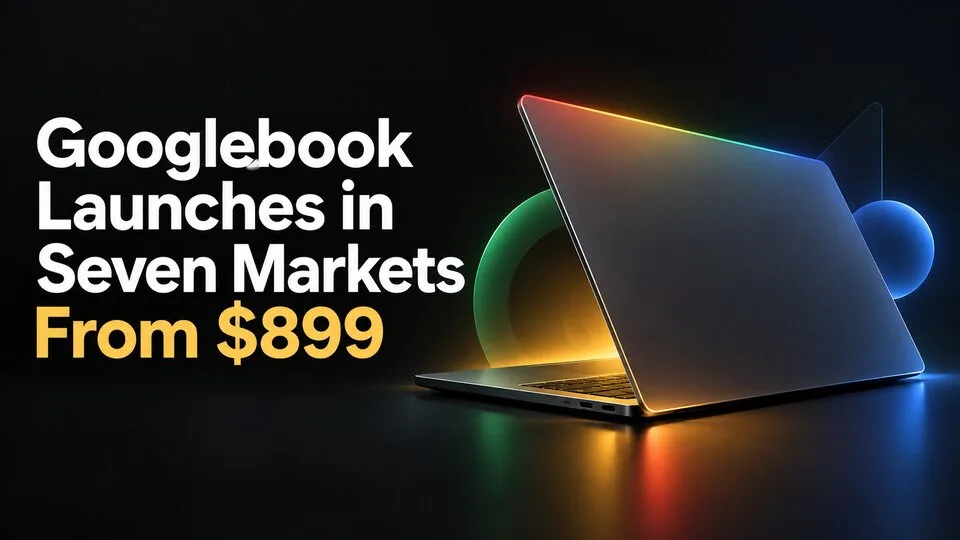
Googlebook launches in seven markets with five premium laptops from Acer, Asus, Dell, HP and Lenovo, giving Google a new AI-first computer category built around Android phones and Gemini. Prices start at $899, with U.S. sales beginning October 4 and six more countries following October 5.
The rollout is Google's clearest attempt to move beyond budget Chromebooks and compete for buyers considering a MacBook Air or premium Windows notebook. Googlebook combines Android's application ecosystem with desktop foundations from ChromeOS, while setting minimum hardware, security and update standards for manufacturing partners.
The first Googlebook wave has four defining elements:
- Five partner-built laptops priced from $899 to $1,299
- Gemini tools integrated into the desktop interface
- Android phone continuity for files, messages and applications
- Up to 10 years of software updates
Googlebook Launches Across Seven Markets
Google says Googlebook devices reached U.S. shelves on October 4. Availability expands October 5 to Canada, the United Kingdom, Ireland, France, Germany and Australia, turning the September preview into a commercial launch across seven markets.
The company is using a partner model similar to Android phones and Chromebooks. Acer, Asus, Dell, HP and Lenovo build the machines, but every device must meet Google's platform requirements and include the distinctive Glowbar light on the lid.
Google's baseline calls for premium materials, at least 16GB of memory, a touchscreen, a haptic trackpad, a backlit keyboard and an on-device neural processor capable of more than 45 trillion operations per second. Google also promises at least 14 hours of battery life across the category.
The Glowbar is more than a brand marker. It displays charging progress, responds when a user talks to Gemini and can expose programmable lighting behavior to application developers, giving otherwise unrelated partner laptops a common visual identity.
Five Googlebook Models Start at $899
The Acer Googlebook 14 is the entry model at $899 and the only convertible in the first group. It combines an Intel Core Ultra processor with a 14-inch OLED touchscreen, while Acer advertises as much as 16 hours of battery life.
Dell's XPS Googlebook starts at a promotional $999 and uses Qualcomm's Snapdragon X Elite platform. The 13.4-inch machine is among the lightest of the group, although its two USB-C ports leave it with fewer physical connections than the Asus or Lenovo alternatives.
Lenovo's 15.3-inch Googlebook begins at $1,149, according to updated pricing reported by The Verge. Asus and HP start at $1,299; the Asus emphasizes a 3K OLED display and broader port selection, while HP offers storage configurations reaching 1TB.
Every purchase includes 12 months of Google AI Pro with 5TB of cloud storage. Google is also bundling shorter trials for services including YouTube Premium and Adobe Photoshop, plus a year of Nvidia GeForce Now for cloud gaming.
Gemini Tools Meet Android Phone Continuity
Googlebook's main differentiation is software rather than processor choice. During setup, an Android phone can transfer settings, saved passwords, Wi-Fi networks and messages with end-to-end encryption, reducing the work required to configure a new computer.
Continue On moves an active task from a phone to the laptop, while the Files application can search and open phone photos and documents. Cast My Apps streams a phone application into a desktop window, letting users interact with services that do not yet have a full laptop interface.
Gemini appears through Magic Pointer, which opens contextual AI actions after the user wiggles the cursor over visible content. Google says the feature can translate selected text, organize calendar information or answer questions about an image without requiring the user to move material into a separate chatbot.
Rambler turns spoken notes into structured writing, removing false starts and supporting multiple languages. Create My Widget generates desktop widgets from plain-language descriptions, making Google's model part of interface customization rather than only a conversational assistant.
Googlebook's Software and Security Bet
The operating system pairs desktop Chrome, including browser extensions, with access to Android applications. Google and its partners are dividing Play Store software into desktop-ready, desktop-optimized and web-preferred tiers, signaling that application quality will vary during the platform's early stage.
Wired reported that roughly 20 applications were optimized for desktop or built specifically for the format at launch. Googlebook therefore starts with a broader mobile catalog than a conventional new operating system, but its ability to challenge Windows and macOS will depend on developers delivering full desktop experiences.
Developers receive a Linux terminal and Google's Antigravity agent-development environment. Google says an isolated Linux workspace runs through a Level 5 security-certified pKVM hypervisor, separating development tools and autonomous agents from the rest of the system.
The promised decade of software updates could make the platform attractive to buyers who keep laptops longer than phones. The harder test is whether Google can sustain premium hardware standards, persuade developers to optimize applications and make its AI conveniences useful enough to justify prices that overlap established competitors.
Background Reading
