
AWS Built Together Launches With $1 Billion Commitment
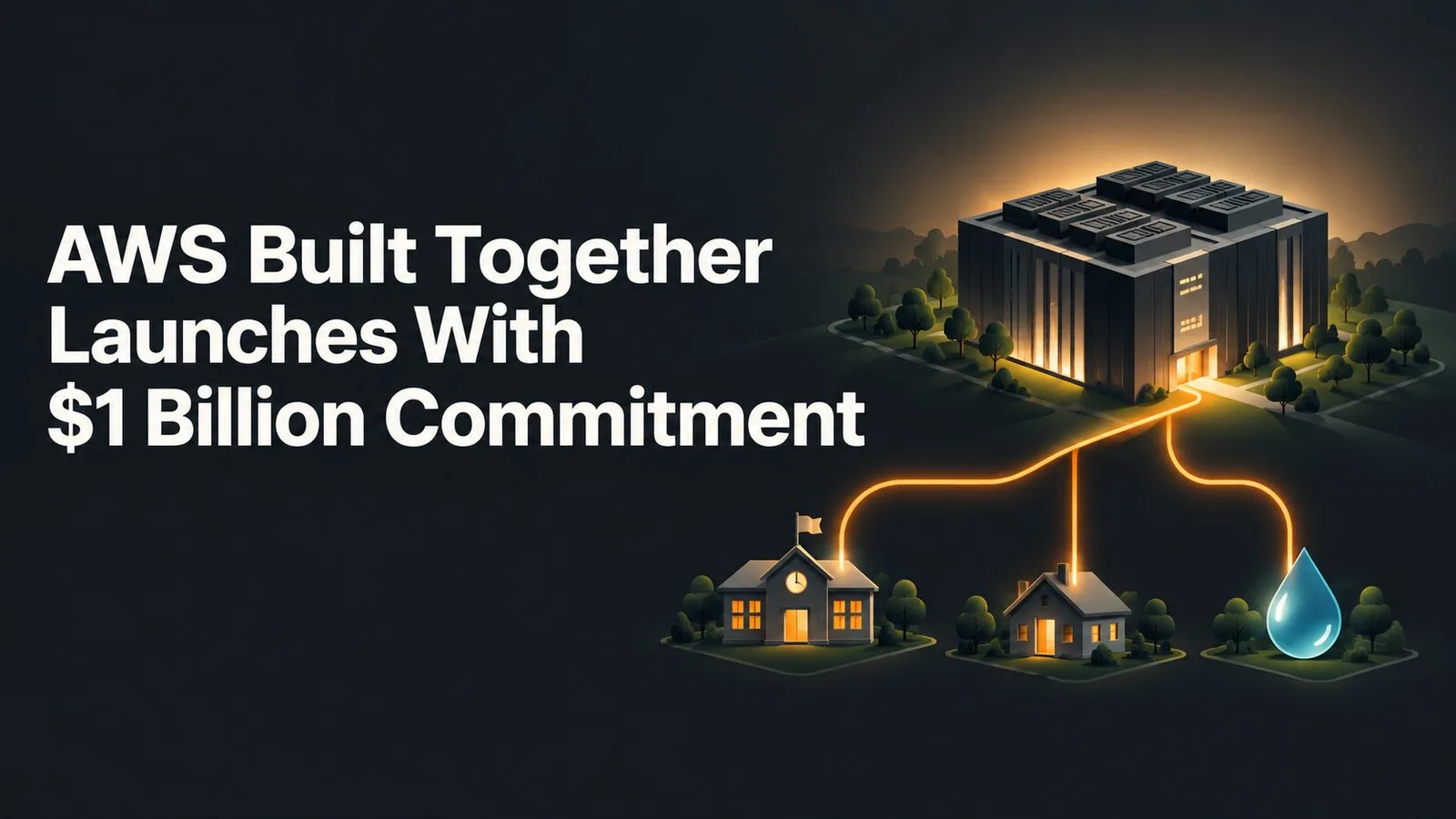
AWS Built Together launches with more than $1 billion in new spending over five years for communities that host Amazon data centers across the United States. The program links the company’s AI infrastructure expansion to education, skilled-trade training, energy upgrades, water projects and locally chosen investments.
Amazon unveiled the program on October 2 as local resistance to large data centers becomes a constraint on the AI buildout. Built Together sets four headline targets:
- Free community college access for more than 300,000 students
- Up to 100,000 workers trained annually by the end of 2028
- Energy upgrades for over 30,000 homes and 300 public buildings
- Millions of dollars a year for priorities chosen locally
AWS Built Together Sets Five-Year Targets
Built Together is an additional investment, not a repackaging of Amazon’s existing community spending. Amazon says it has already contributed more than $1 billion during the past three years in US areas where it has a significant data center presence.
The new framework directs more than $1 billion toward three areas: education and workforce pathways; energy affordability and water solutions; and flexible funding led by local residents. Eligibility is limited initially to US communities where Amazon operates data centers, with participation details to be distributed through local partners.
Amazon has not published a full allocation of the five-year budget. The company told GeekWire that it expects to commit more than $100 million initially to community-college endowments and roughly another $100 million to expand training centers, leaving much of the overall program to be detailed as local agreements are completed.
Free College and 25 Modular Training Centers
Amazon plans to cover remaining out-of-pocket costs after financial aid for certificates and associate degrees at participating community colleges. Eligible fields include electrical trades, heating and cooling, fiber optics, information technology, healthcare, education, public safety and advanced manufacturing.
The company estimates that more than 300,000 students could receive free degree access over five years. Agreements with 26 colleges are being developed, according to GeekWire, while Amazon says the first programs should launch within months.
Amazon will also expand a network of modular training centers located on or near data center sites. Three are operating, six are under development and 16 more are planned, bringing the total network to 25 facilities.
Courses will run for four to 16 weeks and use electrical trainers, fiber-splicing equipment, simulated data halls and outdoor training yards. Amazon says each center can train roughly 2,000 to 4,000 learners a year, supporting its goal of preparing as many as 100,000 people annually by the end of 2028.
Energy Upgrades and Water Projects Target Local Costs
Built Together will fund heat pumps, insulation, water heaters, batteries, solar systems and other efficiency improvements. Amazon targets more than 30,000 homes and over 300 schools and community buildings, estimating energy-cost reductions of 20% to 40%, although actual savings will depend on rates, weather and household use.
Water work is broader than the US program. Amazon says it has contracted more than 65 replenishment projects worldwide that are expected to return over 8 billion gallons annually—more than twice the water its data centers used in 2025.
Separately, local foundations will receive annual funding for priorities such as roads, parks, fire equipment, housing, food security and disaster preparedness. Amazon says residents and local organizations will make allocation decisions, while the company publishes outcome reports.
Amazon Adds a Data Center Commitment as Opposition Grows
The investment arrives alongside an Amazon Data Center Commitment covering jobs, community engagement and resource use. Among the most concrete changes, Amazon says it no longer uses nondisclosure agreements with government agencies on new projects and will publish annual energy and water metrics.
Amazon also promises that power prices paid by its data centers will cover their energy demand and related grid upgrades. New sites will use backup generators meeting the US Environmental Protection Agency’s Tier 4 emissions standard or an equivalent standard elsewhere.
The timing is political as well as operational. Reuters reported that more than 100 data center moratoriums are under consideration across the country, while Amazon has major projects or expansions underway in states including Indiana, Louisiana, North Carolina, Virginia and Mississippi.
Public skepticism is substantial. An Associated Press report cited polling showing about six in 10 Americans support limits on new data centers, with majorities highly concerned about electricity prices and water supplies.
That makes Built Together part community investment and part permission strategy. Amazon’s cloud growth requires land, electricity, water, construction labor and local approvals at unprecedented scale. The program gives host communities measurable promises to track, but its credibility will depend on execution, transparent reporting and whether household costs remain insulated as facilities come online.
Further Reading
