Bull Opens Angers Factory to Double Supercomputer Output
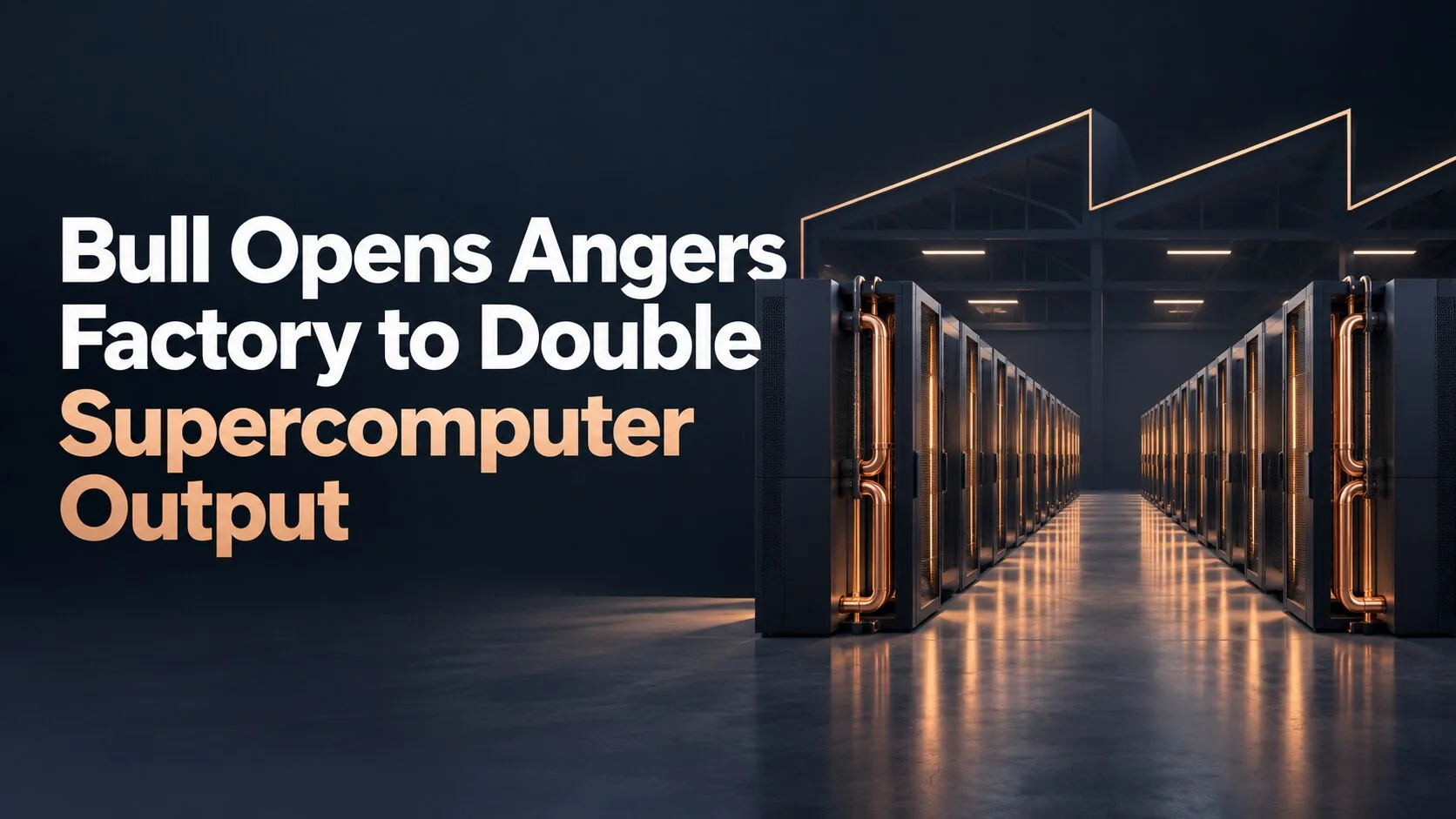
Bull opens Angers factory capacity to twice its previous level as Europe tries to build more of the computing infrastructure required for artificial intelligence at home. The French company inaugurated the €80 million expansion on October 2 at the continent's only industrial site able to assemble large-scale supercomputers.
The new building increases current output from six to 12 computing racks a month, according to executives interviewed by Reuters. Bull says the reconfigured plant can raise that figure to 24 racks in 2027 if demand supports another step-up.
The Angers expansion adds four immediate capabilities:
- Twice the former production capacity
- Parallel assembly of major European systems
- Industrial support for outside AI and quantum developers
- More automation and reconfigurable production areas
Further Reading
Bull Opens Angers Factory With Twice the Capacity
Bull's new production building is the central milestone in a reconstruction and modernization program scheduled to finish in 2028. The complete site covers 20,000 square metres, including 10,700 square metres dedicated to production.
The company reports a 30% productivity increase and a 30% reduction in building-maintenance costs. Production areas can be rearranged for different systems, while automation, virtualization and collaborative robots are intended to shorten the transition between designs.
That flexibility is important because a supercomputer factory does not produce one standardized box. Rack designs, processors, cooling, interconnects and validation requirements vary by customer, and large contracts may occupy assembly space for months before delivery.
Reuters reported that Bull has won 15 of the 18 tenders issued by EuroHPC, the European organization that co-finances national supercomputers. Chief executive Emmanuel Le Roux said the company has received more orders this year than in any previous year.
Alice Recoque and LUMI-AI Fill the New Lines
The expanded plant can build two flagship orders at the same time. Alice Recoque, an exascale system for France's Atomic Energy Commission, accounts for 94 racks and is due to begin staged delivery near the end of 2026.
LUMI-AI, a €387.8 million system for Finland, is Bull's largest contract to date. Both projects are scheduled for delivery in 2027, and executives told Reuters that the factory could not have assembled them in parallel before the expansion.
Bull also built JUPITER, Europe's first exascale supercomputer, now operating at the Jülich Supercomputing Centre in Germany. OVHcloud and Commission-backed Domyn are among the organizations attempting to train frontier-class AI models on that machine, Reuters reported.
The orders connect industrial capacity to Europe's broader computing program. The European Union committed €7 billion from 2021 through 2027 to a network of supercomputers intended to narrow the region's compute gap with the United States and China.
Open Factory Extends Beyond Bull Systems
Bull launched an Open Factory program alongside the new building. The company plans to offer its integration, testing and production capabilities to European developers working on AI, advanced computing and quantum technologies that need to move from prototypes into repeatable manufacturing.
The first concrete example is Bull's partnership with Foxconn. Nvidia Vera Rubin NVL72 systems will be manufactured and initially tested at Foxconn facilities in the Czech Republic before final assembly, integration and validation in Angers.
The arrangement does not make the underlying accelerators European. It moves more system-level manufacturing and operational expertise into Europe while continuing to rely on Nvidia's architecture and Foxconn's global supply chain.
Bull says future Open Factory projects could support AI gigafactories, neocloud providers and hybrid systems combining high-performance and quantum computing. Additional industrial partnerships are expected in early 2027, but no counterparties or production volumes have been announced.
The building also includes 3,500 photovoltaic panels with 1,500 kilowatts of peak capacity. A heat-recovery system targets five gigawatt-hours a year for the local district network, which Bull says is equivalent to the annual energy needs of about 600 households.
Europe Still Depends on Imported Memory
The expansion advances Europe's ability to design, assemble and test complete systems, but it does not eliminate foreign dependencies. Bull told Reuters that European-made components now represent about 70% of the machines assembled at Angers, up from 20% to 30% five years ago.
Boards, interconnects, cooling equipment and a growing share of processors can be sourced within the region. Memory remains the largest gap: Samsung, SK Hynix and Micron collectively produce more than 90% of the global supply, and Le Roux said Bull sees no near-term European alternative.
That distinction sets a practical limit on claims of computing sovereignty. A European factory can control integration, cooling, software and system validation while still depending on imported accelerators or memory whose prices and availability are determined elsewhere.
Angers nevertheless gives Europe an industrial capability that is scarce even before individual chips are considered. The next test is whether Bull can sustain demand beyond current public contracts, raise output toward 24 racks a month and turn Open Factory partnerships into systems delivered at competitive cost.