
XPeng Opens IRON Humanoid Robot Production Line
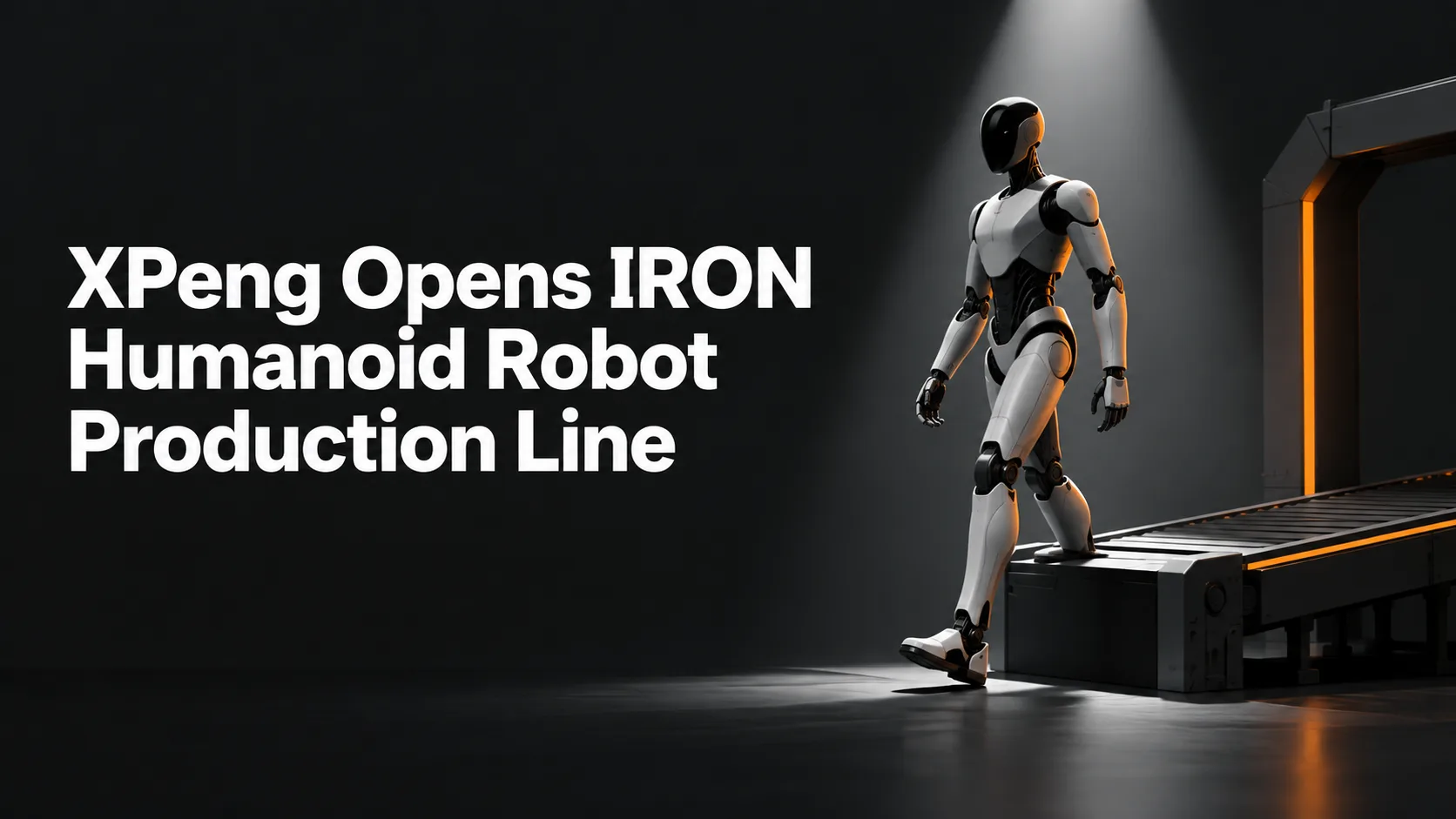
XPeng has opened its IRON humanoid robot production line, moving the machine from research prototypes toward repeatable manufacturing. The first completed unit autonomously walked off the newly commissioned line, while the company said more than 80% of its core manufacturing processes are automated.
XPeng’s production plan has four measurable milestones:
- The robot line was commissioned on September 8.
- Mass production is targeted by the end of 2026.
- Initial deployments will begin in XPeng stores and campuses.
- China and overseas deliveries are planned for 2027.
XPeng Opens the IRON Robot Production Line
XPeng’s September 8 announcement frames the factory milestone as a transition from research-and-development prototyping to production-line manufacturing. The company has extended processes developed for electric vehicles into a facility designed for humanoid robots.
XPeng says the line applies automotive-grade quality systems to the tighter mechanical and assembly requirements of humanoids. More than 80% of core processes are automated, and the facility is intended to support consistent critical-process quality, flexible production and faster capacity expansion.
The first IRON walking away from the line is a visible proof that one complete unit passed through the process. It is not yet evidence of high-volume output, manufacturing yield or field reliability. Those measures will become clearer only as XPeng increases production and begins deploying larger fleets.
Independent reporting from Autoweek also described the facility as XPeng’s formal entry into commercial humanoid manufacturing. The timing puts the automaker among companies trying to turn robotics demonstrations into products that can be built repeatedly rather than assembled as laboratory prototypes.
IRON Combines 76 Degrees of Freedom With Onboard AI
IRON has 76 degrees of freedom across its body, including 21 in each hand. That mechanical range is designed to support human-like movement and manipulation while a fully enclosed flexible lattice structure covers the machine’s internal mechanisms for safety and appearance.
Three of XPeng’s Turing AI chips provide up to 2,250 TOPS of effective computing performance. The company says that capacity allows its physical-AI foundation model to run directly on the robot, supporting low-latency decisions and keeping more operational data on the device.
XPeng says IRON can perform complex tasks without remote operation. That is a significant claim, but capability depends on the working environment, task definition and required intervention rate. General-purpose hardware does not automatically mean reliable autonomy across every shop, factory or home.
The automaker is carrying technology across its vehicle and robotics programs, including perception, planning, batteries, motors and manufacturing controls. That shared base may shorten development, although humanoid balance, dexterous manipulation and safe physical interaction introduce engineering demands beyond those of road vehicles.
Background Reading
XPeng Targets Mass Production by the End of 2026
The company plans to start mass production before the end of 2026. Its first commercial scenarios will be controlled environments inside XPeng’s own stores and campuses, where the robots are expected to provide tours, assist shoppers and support patrol or guidance tasks.
Those deployments offer a practical bridge between a factory launch and broad sales. XPeng can limit the environment, train staff, observe recurring failures and update its systems before external customers depend on the machines. They should also produce operational evidence about uptime, intervention and maintenance.
Official market launches and deliveries in China and overseas are planned for 2027. XPeng has not provided a public unit price, delivery volume or country-by-country rollout schedule in the production-line announcement, so the target remains a roadmap rather than a completed commercial launch.
The robotics unit raised more than $900 million in August at a post-money valuation above $6.3 billion. XPeng says the capital will support model training, hardware and software development, production capacity and international expansion. Manufacturing progress will determine how efficiently that funding becomes deployed robots.
The Manufacturing Test Now Moves Beyond One Robot
Humanoid companies are competing on models, dexterity and demonstrations, but manufacturing adds a different set of constraints. Components must arrive consistently, calibration must be repeatable, software and hardware versions must stay synchronized, and completed units must meet safety and reliability thresholds at an acceptable cost.
XPeng’s automotive background could help with supplier management, quality control and production engineering. It could also create pressure to move quickly toward volume before the robot’s tasks and economics are fully proven. A highly automated line still needs demand, service capacity and dependable field performance.
The strongest evidence over the coming year will be production numbers, customer deliveries, intervention rates and sustained task completion in real workplaces. The new line makes IRON more than a prototype program, but XPeng’s 2026 and 2027 targets will be judged by output and deployment—not by the first walk off the factory floor.