
Wynd Kaufmyn Was Jailed for Protesting AI: Is Humanity Safe From Artificial Intelligence?
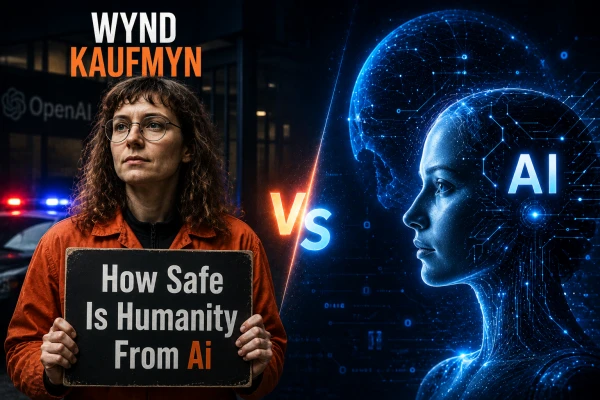
Wynd Kaufmyn, a 69-year-old retired teacher and activist, has become the first person jailed for protesting artificial intelligence after taking part in a demonstration against OpenAI’s development of artificial superintelligence.
Kaufmyn was sentenced to a week in jail after participating in a February 2025 protest in San Francisco in which members of the StopAI group chained themselves to the doors of OpenAI’s headquarters. Her imprisonment has now brought an unusually direct question into the public conversation: how safe is humanity as artificial intelligence continues to become more powerful?
Kaufmyn’s protest was not simply against ChatGPT or one particular OpenAI product. She and other members of StopAI were protesting what they see as a much larger race toward artificial general intelligence and artificial superintelligence, technologies that could eventually perform a far wider range of intellectual tasks than today’s AI systems.
The protesters believe that developing increasingly powerful systems without first establishing sufficiently strong guarantees around human control could create risks that society may not be able to reverse later.
The legal case itself was based on what happened during the demonstration, rather than on whether Kaufmyn’s predictions about AI are correct. According to the San Francisco District Attorney’s Office, protesters chained the front door of OpenAI’s headquarters and refused police instructions to move from private property to the nearby public sidewalk. Kaufmyn was subsequently convicted of interfering with a business, trespassing with intent to interfere with a business, unlawful assembly and refusal to disperse at a riot.
That distinction is important because the case does not establish that artificial intelligence is legally considered an immediate danger to humanity. A jury rejected the legal argument that
Kaufmyn’s actions were justified by the necessity of preventing future harm from AI development. Her supporters, however, argue that the case represents something bigger than a dispute over a protest and that society should take the potential risks of advanced AI seriously before systems become considerably more capable.
The question of whether humanity is safe from AI does not have a simple yes-or-no answer. Today’s AI systems are powerful software tools, but they are not independent superintelligent beings operating outside human control.
They can generate text, write code, analyze information and perform increasingly complex tasks, but they can also make mistakes, misunderstand instructions and produce unreliable results. The more significant concern is what could happen if future systems become substantially more autonomous and capable than the models people use today.
That future is one reason AI safety has become such an important part of the technology industry. An AI that simply answers a question is relatively easy for a person to supervise because the user decides what to do with the response.
An AI agent capable of planning, accessing software, writing and executing code, communicating with external systems and completing tasks independently creates a much more complicated safety problem because the system has greater ability to affect the world around it.
The development of artificial superintelligence would take that question even further. Superintelligence generally refers to an AI system whose intellectual capabilities exceed those of humans across a broad range of important tasks.
Nobody can say with certainty when such a system will exist, or even whether the technology will develop in exactly the way some researchers predict. What is clear is that major AI companies are investing heavily in increasingly capable models, making the question of how those systems should be controlled more relevant than it was only a few years ago.
Kaufmyn’s supporters argue that waiting until a dangerous AI system actually exists before establishing safeguards would be a mistake. Their argument is similar to a precautionary approach: if a future technology could create consequences that are extremely difficult to reverse, society should establish strong safety measures before reaching that point.
AI researchers and safety experts disagree about the probability and timing of extreme scenarios, but the underlying question of how to control increasingly capable systems is now a serious research field.
There is also a practical reason not to dismiss the concern simply because the most extreme AI scenarios have not happened. Current AI models have already demonstrated unexpected behavior when given access to tools and complicated objectives.
That does not mean they are becoming conscious or secretly trying to escape human control, but it does demonstrate that predicting every action of a sufficiently complicated AI system can become difficult. As companies give models more autonomy, that unpredictability matters more.
OpenAI and other AI companies therefore face a difficult balance. They are under enormous pressure to build more capable systems because advanced AI could help with scientific research, medicine, software development, education and business.
At the same time, releasing increasingly powerful systems without appropriate safeguards could create risks involving cybersecurity, misinformation, privacy, economic disruption and potentially more serious forms of misuse.
The debate becomes even more complicated because slowing down one company does not necessarily stop the global AI race. If OpenAI decided to stop developing more advanced models, other companies in the United States, China and elsewhere could continue their own research. This creates a collective-action problem in which every company may have an incentive to move quickly because it does not want competitors to gain a technological advantage.
That is one reason the future of AI safety cannot depend entirely on individual companies making voluntary decisions. Governments, researchers and international organizations may eventually need to establish common standards for testing highly capable AI systems, monitoring dangerous capabilities and determining what level of autonomy should be permitted. The difficult part will be creating rules that reduce genuine risks without preventing beneficial AI research from continuing.
Kaufmyn’s case also demonstrates how dramatically the AI debate has changed. Only a few years ago, most public arguments about artificial intelligence focused on whether AI would take jobs, whether generated images were replacing artists or whether chatbots could produce accurate answers. Those issues remain important, but the conversation has expanded toward much larger questions about autonomous systems, superintelligence and whether humans will remain firmly in control of the technology they create.
There is a strong argument on the other side as well. Artificial intelligence could become one of humanity’s most useful technologies if it is developed responsibly. Advanced AI could help researchers analyze complex scientific problems, assist doctors, improve education, automate repetitive work and give individuals access to capabilities that were previously available only to large organizations. Stopping AI development completely would therefore involve giving up potentially enormous benefits alongside the risks.
The more realistic goal is likely to be controlled progress rather than stopping AI entirely. Companies can continue improving models while simultaneously testing their capabilities, limiting access to particularly dangerous systems, monitoring how agents behave and developing methods that allow humans to interrupt or restrict AI when necessary. The challenge is making sure those safeguards improve quickly enough to match the capabilities of the systems being developed.
That is where Kaufmyn’s warning becomes relevant even for people who disagree with her decision to block OpenAI’s headquarters. Her imprisonment does not prove that AI is going to destroy humanity, and it does not prove that OpenAI is developing an inherently dangerous technology. What it does show is that concerns about advanced AI have become serious enough for people to risk criminal penalties in an attempt to influence the direction of the industry.
The biggest question for the coming years may therefore not be whether AI becomes smarter than humans at individual tasks. AI already exceeds humans in some narrow areas. The more difficult question will be whether humans can continue to understand, supervise and control systems as they become capable of handling increasingly complicated objectives with less direct supervision.
If future AI systems remain tools that humans can reliably direct, inspect and shut down when necessary, their increasing intelligence could bring enormous benefits. If systems become highly autonomous while humans struggle to predict their behavior or enforce meaningful limits, the risks could become much more difficult to manage. Nobody currently knows exactly where that boundary lies, which is precisely why AI safety research has become so important.
Wynd Kaufmyn’s story has consequently become bigger than the protest that sent her to jail. It has become another example of the growing disagreement over how quickly humanity should develop artificial intelligence and how much precaution is necessary before pursuing systems that could eventually become vastly more capable than today's AI.
For now, humanity is not facing a proven AI takeover, and there is no evidence that today's leading AI systems have become uncontrollable superintelligence. But saying that does not mean every future risk can be dismissed. The technology is advancing quickly, and the decisions made while AI is still developing may determine how safely society handles much more capable systems later.
The most important lesson from Kaufmyn’s case may therefore be that the AI debate is no longer only about what machines can do. It is increasingly about what humans should allow machines to do, who should control them and how much safety is enough before society moves to the next level of artificial intelligence. Those questions are likely to become even more important if the industry gets closer to the artificial superintelligence that Kaufmyn and other AI safety activists fear.