
Why Personal AI Could Know You Better Than You Know Yourself
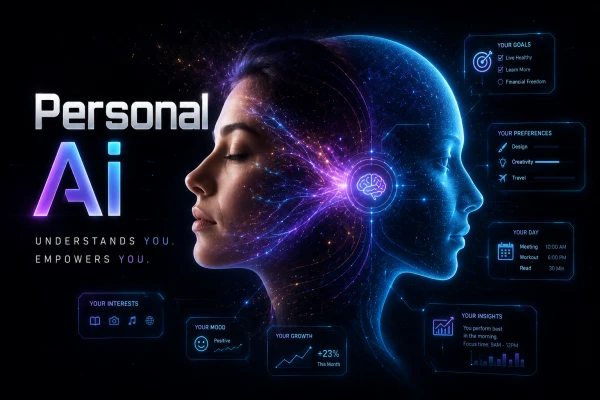
Artificial intelligence is entering a stage where the most important AI may not be the one that knows the most information, but the one that knows the most about you. For years, people have used AI by opening a chatbot, typing a question and waiting for an answer. That relationship is beginning to change.
Technology companies are increasingly building AI systems that can understand a person's context, connect to applications, remember information and take actions instead of simply responding to individual prompts.
Meta's latest AI developments provide an early look at this direction, with its AI already capable of making plans, connecting to email and calendar applications, creating slides and handling tasks on a user's behalf.
The idea sounds simple, but it could completely change what people expect from artificial intelligence. A normal chatbot waits for you to tell it what you want. A personal AI system could eventually understand what you normally do, what you are trying to accomplish and what information matters to you before you even write a prompt.
Instead of saying, “Help me plan my week,” you could eventually have an AI that already understands your meetings, deadlines, projects, preferences and routines and prepares your week automatically.
That is a very different relationship between humans and machines. The first generation of generative AI was mostly reactive. You asked a question, and the system responded. The next generation is becoming increasingly proactive.
AI agents can use tools, interact with applications and complete multiple steps toward a goal. Meta describes its current direction as a step toward personal superintelligence: an AI that understands your context, remains available when needed and handles things so you do not have to.
The real breakthrough, however, may happen when personal AI stops treating every conversation as a separate event. Imagine an assistant that understands that you are working on a business website, knows which tasks you have already completed, remembers the decisions you made last week and recognizes which deadlines are approaching. You would no longer need to explain your entire situation every time you ask for help. The AI would already have the context necessary to understand what you mean.
This is where the phrase “personal AI” becomes much more meaningful. Personalization today often means an application recommends something based on your previous activity. A future personal AI could go much further. It could understand your work, interests, schedule, communication patterns, documents, goals and preferred ways of doing things, then use that information to make decisions on your behalf within boundaries you define.
Google has already been moving in a similar direction with its Personal Intelligence features, which connect information from services such as Gmail and Photos to provide more personalized responses in AI Mode and Gemini. Google says users can control which applications are connected and can turn those connections on or off.
The difference between today's personalized AI and tomorrow's personal AI could therefore be enormous. Today, an AI might recommend a restaurant because it knows where you have eaten before. Tomorrow, it could understand that you are preparing for a trip, check your calendar, look at previous travel preferences, identify the dates that work best and prepare options without requiring you to start the process manually.
That does not necessarily mean AI will have unlimited access to your life. In fact, privacy may become one of the biggest factors determining whether people trust personal AI at all. The more useful an AI becomes because it knows about you, the more sensitive the information it needs to understand becomes.
An assistant that knows your favorite foods is one thing. An assistant that can access your emails, financial information, private documents, health-related information, conversations and calendar is something entirely different.
This creates a difficult trade-off. The most useful personal AI may also be the AI that knows the most about its user. But the more information the system knows, the greater the consequences if that information is misused, exposed or accessed without permission.
Personal AI therefore cannot become truly powerful simply by becoming more intelligent. It also needs strong privacy controls, permission systems and clear boundaries around what it can remember and what it can do. There is another important difference between a personal AI and today's digital assistants.
Traditional assistants generally wait for instructions. A personal AI could eventually be expected to notice things and act proactively. If it sees that a deadline is approaching, it could prepare the required document. If it notices that several meetings overlap, it could suggest a solution. If a task repeatedly takes you an hour every Friday, it could eventually ask whether you want it automated.
The question then becomes: How much should AI be allowed to do without asking first?
That may become one of the biggest questions in consumer AI over the next few years. People want AI to save them time, but they do not necessarily want a machine making important decisions without permission. The ideal personal AI may therefore need different levels of autonomy. It could perform routine actions automatically while requiring confirmation for sensitive or irreversible decisions.
For example, an AI might be allowed to organize your calendar automatically but require permission before cancelling an important appointment. It might draft an email without asking but require approval before sending it. It might compare products and prepare a recommendation but wait before purchasing anything. It could monitor your work continuously while keeping certain actions behind a confirmation screen.
This would turn AI permissions into something similar to the permissions people already give smartphone applications. But instead of asking whether an app can access your camera or location, future AI systems may ask whether they can read your email, modify your calendar, communicate with other people, purchase products, edit documents or operate software on your behalf.
The technology is already moving in this direction. Meta says its Muse Spark 1.1 model is designed to plan, work with applications and follow through on tasks from beginning to end. The company has positioned those capabilities as an early step toward an AI that can act on behalf of the user rather than simply provide information.
That changes the value of intelligence itself. If an AI can answer almost any question but cannot do anything with the answer, humans still have to perform the next step. If an AI can understand the objective and execute the necessary actions, the value becomes much greater. The system is no longer just an information source. It becomes an active participant in the user's workflow.
This could have a major impact on work. Imagine opening your computer in the morning and discovering that your personal AI has already summarized overnight messages, identified the most important tasks, prepared responses to routine emails, organized your schedule and highlighted decisions that require your attention.
You would not necessarily spend the day asking AI questions. Instead, AI would continuously prepare work for you. The biggest productivity improvement may therefore come from eliminating the need to constantly tell AI what to do.
That is an important distinction because today's AI still requires considerable human direction. Even advanced systems often need prompts that explain the objective, provide context and specify the desired format. Personal AI could reduce that burden by remembering the context and learning how its user prefers to work.
Over time, this could create something resembling a digital extension of a person's memory. You might ask, “What did I decide about that project?” and the AI could search through your previous conversations, documents and notes. You might ask, “What do I need to finish this week?” and it could combine information from your calendar, task list and recent work.
That would make personal AI fundamentally different from a search engine. Search engines retrieve information from the internet. Personal AI would increasingly retrieve information from your own digital life and combine it with knowledge from the wider internet.
The distinction is important because the internet contains billions of pieces of information, but most people do not need all of them. They need the information relevant to their circumstances. Personal AI could become the layer that filters the enormous amount of available information down to what matters for one particular person.
This could also change how people interact with software. Instead of opening ten different applications to complete a task, a user could tell an AI what they want and allow it to coordinate the applications behind the scenes. The AI could retrieve information from one service, place it into another, create a document, schedule a meeting and notify the relevant people.
Software would become less visible.
The AI would become the interface.
That possibility could be particularly disruptive to traditional applications. Today, people learn how to use software by navigating menus, buttons and workflows designed by developers. In a future dominated by personal AI, users may increasingly describe the result they want while the AI determines which software tools are required to produce it.
A business owner might say, “Prepare this month's sales report and send it to the team.” The AI could potentially retrieve sales data, calculate the relevant figures, create charts, write an explanation and prepare an email. The user would not need to manually open each application and perform every step.
That is where AI agents and personal intelligence begin to overlap. An agent provides the ability to act. Personal intelligence provides the context needed to decide what actions are useful for a particular person.
The combination could be much more powerful than either technology alone.
But there is another side to this future that deserves serious attention. If personal AI becomes deeply integrated into people's lives, switching AI providers could become increasingly difficult. Your AI may eventually learn years of preferences, decisions, documents and personal context. If all of that information becomes locked inside one company's ecosystem, moving to another AI provider could feel like starting your digital life over again.
That could give major technology companies enormous influence over personal AI. The company controlling your personal intelligence layer could potentially become one of the most important technology providers in your life.
This is why the competition between OpenAI, Google, Meta, Anthropic and other AI companies may eventually be about much more than who has the smartest model. The bigger competition could be over who becomes the AI that people trust with their daily lives.
The winning AI may not necessarily be the one that scores highest on a benchmark.
It could be the one that understands the user best.
That is also why memory could become one of the most valuable features in AI. A system that remembers previous conversations and preferences can provide a fundamentally different experience from one that starts from zero every time. But memory introduces difficult questions about accuracy as well.
If an AI remembers something incorrectly, that incorrect information could influence future decisions. Personal AI therefore needs a way to distinguish between what it knows, what it remembers and what it assumes.
That may become one of the most important design problems in the next generation of AI systems. An AI assistant cannot simply accumulate everything a person says forever. It needs to understand which information is temporary, which information is important, which information should be forgotten and which information requires confirmation before being used.
The future personal AI may therefore have its own form of digital memory management.
It could remember that you prefer certain types of documents, forget temporary instructions after a project ends and ask for confirmation when information appears contradictory. Instead of simply storing more data, the goal would be to build a more useful representation of the person.
This could make AI increasingly feel less like software and more like a persistent digital companion.
That phrase may sound futuristic, but the basic components are already appearing. AI systems can remember information, access tools, connect to applications, reason over large amounts of context and perform multi-step tasks. The remaining challenge is combining those abilities safely and reliably enough that people can trust them with meaningful parts of their lives.
Reliability will be critical.
A personal AI that occasionally produces a wrong answer is annoying. A personal AI that misunderstands a task and sends the wrong email, changes an important appointment or makes a costly purchase is much more serious.
The more autonomous AI becomes, the more important it becomes for the system to know when it should act and when it should stop and ask the human.
That could lead to a future where the most valuable AI feature is not maximum autonomy but controlled autonomy.
The AI does as much as possible without bothering the user, but it understands where the boundaries are. It knows which actions are routine, which require approval and which should never be performed automatically.
If companies solve that problem, personal AI could become one of the biggest changes in everyday computing since the smartphone.
People may stop thinking about AI as a website they visit when they need help.
They may start thinking about it as something that is always available, understands their context and quietly works in the background.
That is the future that makes personal intelligence so interesting.
The next generation of AI may not ask, “What question do you have?”
It may ask, “What are you trying to accomplish?”
And once AI can answer that question for itself using everything it has been permitted to learn about you, the relationship between humans and artificial intelligence could change permanently.
The biggest AI breakthrough of the next few years may therefore not be a model that can answer harder questions.
It could be an AI that knows when you need help before you ask.