
What Is Meta Personal Intelligence and How Will It Work?
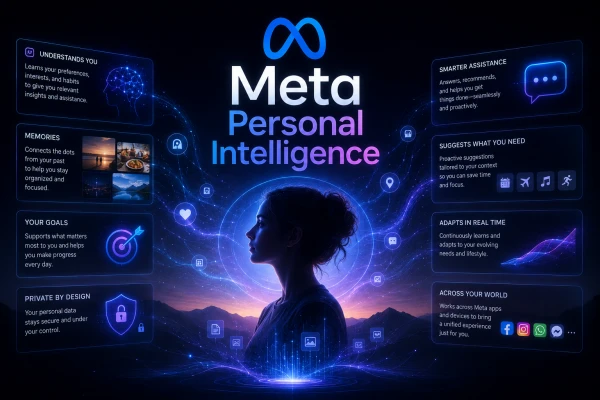
Meta is moving toward a different idea of artificial intelligence that could change the way people interact with computers. Instead of treating AI as a chatbot that waits for a question, the company is describing a future built around personal intelligence — AI that understands an individual user's goals, interests and context and can continuously help that person accomplish things.
Mark Zuckerberg laid out the vision in a lengthy essay published this week, arguing that advanced AI should become a tool available to individuals rather than something controlled only by a small number of institutions.
The phrase “personal intelligence” may sound like another name for an AI assistant, but Meta's vision goes considerably further. A normal assistant might answer a question about the weather, write an email or summarize a document when asked. A personal intelligence system would ideally understand more about the person using it and use that context to make its assistance more useful. Instead of repeatedly explaining who you are, what you are working on and what you are trying to accomplish, the AI could potentially remember those details and use them when helping with future tasks.
That distinction could become one of the most important changes in AI over the next several years. Today's AI is largely based on prompts. You tell the system what you want, provide the necessary context and wait for a response. Personal intelligence points toward a system that already has much of that context. The AI would not necessarily need you to explain that you are preparing for a meeting, working on a project or planning a trip because it could already understand those circumstances from information you have deliberately allowed it to access.
Meta's vision is closely connected to its broader push toward personal AI agents. The company has been developing systems that can plan and perform tasks rather than simply generate answers, and it has increasingly described AI as something that can operate across different parts of a person's digital life. In its latest vision, Meta argues that personal superintelligence should empower individuals and small businesses rather than remain concentrated inside a few organizations.
The most interesting part is what this could mean in everyday life. Imagine waking up and having your AI already understand what needs to happen that day. It could know which meetings are important, which messages require responses, which projects are approaching deadlines and which tasks you have repeatedly postponed. Instead of asking the AI to organize your day from scratch, you could simply review what it has prepared and decide what you want it to handle.
That would represent a major shift in the role of AI. The system would no longer be just a tool that you open when you need something. It could become a persistent layer sitting between you and many of the digital services you already use. Your email, calendar, documents, messages, notes and other applications could potentially become sources of context that help the AI understand what you need.
This is also where personal AI becomes different from personalization in ordinary applications. A streaming service may recommend a movie based on what you watched last week. An online store may recommend products based on what you purchased. Personal intelligence would attempt to build a much broader understanding of the user and use that understanding across many different tasks.
For example, an AI could learn that you prefer short emails, usually schedule meetings in the afternoon, dislike unnecessary calls and often work on certain projects during weekends. Those details could allow the system to make more useful suggestions without requiring you to repeat your preferences every time.
But the technology raises an obvious question: how much should an AI actually know about you?
The usefulness of personal intelligence depends heavily on context, but context can also be extremely sensitive. An AI that knows your favorite music is relatively harmless. An AI that can access private conversations, business documents, financial information, personal schedules and other sensitive material has a completely different level of responsibility.
That means privacy could become one of the biggest factors determining which personal AI systems people ultimately trust. Meta's vision assumes that personal intelligence can become deeply integrated into people's lives, but the more deeply integrated the AI becomes, the more important it becomes for users to understand exactly what information the system can access and what it can do with that information.
Meta has also emphasized broad access to advanced AI rather than restricting the technology to a small group. Zuckerberg's essay argues that the future of AI should involve personal empowerment and widespread availability, while acknowledging that increasingly capable systems will create new safety concerns.
The company's strategy therefore has two parts. One is building increasingly capable AI models and agents. The other is making those capabilities available to a massive consumer audience. Meta has an unusual advantage in the second area because it already operates Facebook, Instagram, WhatsApp and other products used by billions of people.
If Meta succeeds, users may not need to go looking for a personal AI application. The assistant could gradually become part of products they already use.
That could make the competition between Meta, OpenAI, Google and Anthropic increasingly interesting. The companies are not only competing to build the smartest model. They are competing to become the AI system people trust with their everyday digital lives.
Google has a similar opportunity through Android, Search, Gmail and its other services. OpenAI has the advantage of the enormous ChatGPT user base. Anthropic has built a strong position around Claude and increasingly capable AI systems. Meta's potential advantage is the combination of AI agents with billions of existing users across its social and communication platforms.
The next stage of the AI race could therefore be decided partly by distribution.
The smartest AI does not automatically become the most important AI. If a slightly less capable system is available inside the applications people already use every day, it can potentially reach far more people and become part of their routines much faster.
Meta appears to be betting heavily on this idea.
The company's personal intelligence vision also connects with its push toward AI-powered wearable devices. Smart glasses could eventually give an AI access to information about what the user is seeing and hearing, creating a form of context that a traditional chatbot on a screen cannot easily obtain. Zuckerberg has previously described personal devices such as glasses as potentially becoming primary computing devices because they can understand the user's surroundings and interact throughout the day.
That could make personal AI considerably more powerful.
A chatbot knows what you type.
A personal AI connected to wearable devices could potentially understand what you are looking at, where you are going, what you are doing and what you are asking about in the real world, subject to the permissions and sensors available to it.
Imagine walking into a store and asking your AI whether a particular product is suitable for a project you are working on. Instead of starting from a blank conversation, the AI could already know the project and the requirements you previously discussed. It could compare the product with your needs and provide a recommendation immediately.
Or imagine attending a meeting while your AI keeps track of the discussion, identifies tasks assigned to you and prepares a summary afterward. The value would not come simply from transcription. It would come from connecting the meeting to everything else the AI knows about your work.
This is the deeper idea behind personal intelligence: context becomes intelligence.
An AI does not necessarily need to know everything about the world if it understands exactly what information matters to the individual using it.
That could also make AI more useful for small businesses. A business owner could have an AI that understands the company's products, customers, marketing strategy, financial targets and daily operations. Instead of using separate software tools for every small task, the owner could increasingly communicate with one AI system that coordinates those tools.
A request such as “prepare this week's customer report” could eventually trigger a chain of actions. The AI could collect information, organize the numbers, identify unusual changes, prepare a report and present the important findings. The human would still make the important decisions, but much of the repetitive work could happen automatically.
This is where personal intelligence overlaps with AI agents.
An agent gives AI the ability to act.
Personal intelligence gives the agent context about who it is acting for.
Together, those capabilities could be much more powerful than either one alone.
However, there is a major challenge. An AI that understands a person's goals can also misunderstand them.
If an assistant incorrectly remembers a preference or makes a wrong assumption about what matters to its user, that mistake could influence future decisions. The system therefore needs more than memory. It needs a way to distinguish between confirmed information, temporary instructions and assumptions.
For example, if someone tells an AI, “I don't want meetings this week,” the system should understand whether that is a permanent preference or simply a temporary instruction. If it remembers everything forever, personal intelligence could become frustrating rather than useful.
The best personal AI may therefore need something resembling human judgment about memory.
It should know what to remember, what to forget and when to ask for confirmation.
That becomes even more important when AI is allowed to act independently. An assistant that only provides suggestions can be corrected easily. An agent that sends messages, changes schedules, purchases products or modifies documents can create real consequences when it makes a mistake.
This is why the future of personal intelligence will probably involve different levels of permission.
Users may allow an AI to perform harmless routine actions automatically while requiring confirmation for sensitive actions. The system might be allowed to organize a calendar but not cancel an important appointment without permission. It might prepare an email but wait before sending it. It could research products but require approval before spending money.
That type of controlled autonomy could become the foundation of trustworthy personal AI.
Meta's vision is ambitious because it suggests that advanced AI should eventually become something much more personal than a chatbot. Zuckerberg is arguing for AI that can empower individuals directly and remain available throughout their daily lives.
But there is another issue that could become just as important: who controls the personal AI?
If an AI becomes responsible for remembering your preferences, managing your information and coordinating your digital life, changing AI providers could become difficult. Users may accumulate years of personal context inside one system. Moving to another provider could mean losing that memory.
That could create enormous power for whoever owns the personal intelligence platform.
The company controlling your AI assistant could potentially become more important than the company providing your search engine or smartphone operating system. The assistant could sit between you and dozens of other services.
This is one reason Meta's current strategy deserves attention even if the company's ultimate vision takes years to materialize.
Meta is not simply trying to release another chatbot.
It is positioning AI as a personal computing layer.
That could eventually change how people interact with software itself. Instead of opening an application and figuring out which buttons to press, users could describe the outcome they want and allow an AI agent to determine how to accomplish it.
The interface would become conversational.
The applications would increasingly operate behind the scenes.
And the AI would become the layer coordinating everything.
This could have a particularly large impact on smartphones. If personal AI becomes capable enough, users may spend less time opening individual applications. They could ask an assistant to find information, organize a schedule, create a document, send a message or perform another task without manually navigating through several apps.
That does not necessarily mean smartphones disappear.
It means the way people use them could change.
Instead of the application being the primary interface, the AI could become the primary interface.
Meta's interest in glasses makes this possibility even more significant because glasses could allow AI to remain available without requiring the user to constantly look down at a screen. The device could potentially provide information when needed while understanding more of the user's surroundings.
That would bring AI much closer to being a continuous personal assistant.
The technology is not fully there yet, and Meta's vision should not be confused with a product that already performs all of these capabilities today. Much of the idea remains a roadmap for where AI could go as models, agents, hardware and infrastructure improve.
But the direction is clear.
The AI industry is moving from answering questions toward understanding context and completing tasks.
Meta's new personal intelligence strategy is one of the clearest examples of that transition.
The biggest change may eventually be psychological rather than technical. People could stop thinking of AI as a website they visit when they need help and start thinking of it as a persistent digital assistant that is always available.
Instead of asking, “What can AI do?”
People may increasingly ask, “What should I let my AI do for me?”
That is the question Meta's personal intelligence vision is beginning to raise, and it could become one of the defining questions of consumer AI over the next few years.