
What Happened to Google Bard and Why Google Renamed Its AI Chatbot to Gemini
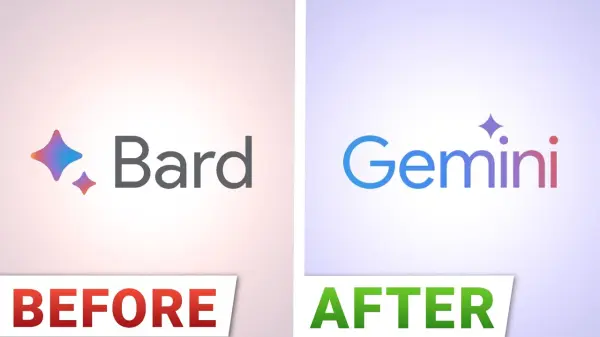
If you have recently searched for Google Bard, you may have noticed something confusing. Instead of finding Google's AI chatbot under its original name, you are now redirected to Google Gemini. Many users continue searching for Google Bard every day, wondering whether the service was discontinued or replaced. The answer is simple: Google Bard has not disappeared—it has been officially renamed Gemini.
Google originally introduced Bard in 2023 as its answer to OpenAI's ChatGPT. Built on Google's large language model technology, Bard allowed users to ask questions, generate text, write emails, summarize documents, create code, and receive conversational responses powered by artificial intelligence. Bard quickly became one of the world's most popular AI chatbots as Google entered the rapidly growing AI race alongside OpenAI and Microsoft.
In early 2024, Google officially retired the Bard brand and introduced Gemini as the new name for its entire family of artificial intelligence products. The decision was not simply a marketing change.
Google wanted a single AI brand that would represent its most advanced models across Search, Android, Gmail, Google Docs, Google Workspace, Pixel smartphones, and cloud services. By replacing Bard with Gemini, the company unified all of its AI products under one identity.
The technology behind Gemini is significantly more advanced than the original Bard. Google's newest Gemini models are capable of understanding text, images, audio, video, computer code, and complex documents within a single conversation.
This multimodal capability allows Gemini to analyze screenshots, explain charts, generate software, summarize lengthy PDF files, solve mathematical problems, and assist with creative writing far more effectively than earlier versions of Bard.
One of Gemini's biggest strengths is its deep integration across Google's ecosystem. Users can access AI assistance inside Gmail to draft emails, Google Docs to create reports, Google Sheets for data analysis, Google Meet for meeting summaries, and Android devices for voice-powered assistance. Instead of existing as a standalone chatbot, Gemini has become Google's universal AI assistant across nearly every major product the company offers.
Many people still search for Google Bard because the name became widely recognized during the early AI boom. Search engines continue receiving millions of Bard-related searches every month from users who are unaware of the rebranding.
Google itself recognizes these searches and automatically directs users toward Gemini, ensuring that people looking for Bard can still access the latest version of the company's AI assistant without interruption.
Today, Gemini competes directly with OpenAI's ChatGPT, Anthropic's Claude, Microsoft's Copilot, and Elon Musk's Grok. Each platform offers unique strengths. ChatGPT remains popular for writing, programming, and general productivity.
Claude has earned praise for handling long documents and advanced reasoning. Microsoft's Copilot focuses heavily on Windows and Microsoft 365 integration, while Gemini benefits from Google's enormous ecosystem of consumer services and real-time information.
Google continues investing billions of dollars into Gemini's development as artificial intelligence becomes one of the company's highest priorities. Every new Gemini release introduces improvements in reasoning, coding, research capabilities, and multimodal understanding.
Google has also expanded Gemini into enterprise products, educational tools, developer platforms, and AI-powered search experiences, making it one of the most comprehensive AI ecosystems available today.
So, if you are wondering whether Google Bard still exists, the answer is yes—but under a different name. Google Bard has officially evolved into Gemini, bringing with it more powerful AI models, broader capabilities, and deeper integration across Google's products.
While the Bard name may have disappeared, the technology behind it has become smarter, faster, and significantly more capable, positioning Gemini as one of the leading artificial intelligence platforms in 2026.