
Tesla Locks In September 3 Cybercab Launch Event in Austin for Steering-Wheel-Free Robotaxi
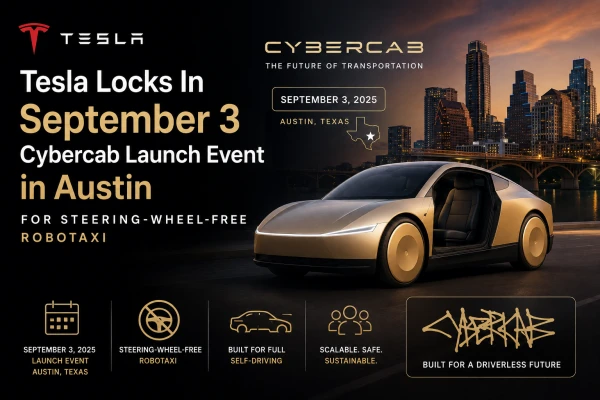
Tesla has confirmed a formal launch event for its purpose-built Cybercab robotaxi on September 3, 2026, in Austin, Texas. Invitations have gone out to selected Robotaxi riders and others, marking a key milestone for the two-seat vehicle that has no steering wheel and no pedals.
The Cybercab is designed exclusively for autonomous ride-hailing. Unlike Tesla’s existing Robotaxi service, which currently uses modified Model Y vehicles that still retain traditional controls in many cases, the Cybercab eliminates any human driving interface.
Passengers sit in a compact cabin with screens, relying entirely on Tesla’s Full Self-Driving software and AI4 computer hardware for operation.
Production of the Cybercab began at Gigafactory Texas earlier in 2026. The first production unit rolled off the line in February, with continuous production confirmed in the second quarter.
EPA certification documents released mid-year detailed its specifications: a single front-mounted permanent-magnet motor producing 219 horsepower, a roughly 48 kWh lithium-ion battery pack, a curb weight of 3,113 pounds, and an unadjusted combined EPA range figure of about 418 miles (adjusted real-world estimates closer to 290–300 miles).
It is front-wheel drive and ranks among the most efficient vehicles Tesla has produced on a watt-hour-per-mile basis.
Tesla already operates limited driverless Model Y Robotaxi services in parts of Austin, Dallas, Houston, Miami, Orlando and Tampa. The September 3 event is intended to fold the Cybercab into that existing commercial network rather than launch a brand-new service from scratch.
Internal employee rides in production Cybercabs began on private roads around the Austin campus in July, with public-road engineering tests of production units underway since earlier in the summer.
The company has also conducted emergency-response training with Austin first responders so that fire, police and rescue teams know how to handle the vehicles if needed.
Invitations for the September 3 event have been distributed through multiple channels. Some went to riders who completed Robotaxi trips between mid- and late August via a sweepstakes that selected a small number of winners.
Others arrived as direct “Exclusive Access” emails requiring RSVP by August 30. Guests must be at least 21 years old and will face ID checks; the event is invitation-only and curated rather than a large public gathering. Tesla’s own materials describe it as a celebration of the Cybercab robotaxi launch.
The absence of a steering wheel and pedals raises the regulatory stakes. With no manual fallback available to a human occupant, every decision rests with the autonomy stack.
Texas allows higher levels of autonomy under a self-certification approach for vehicles designed to operate without a conventional driver position, which has enabled Tesla to move forward more quickly than in jurisdictions with stricter exemption processes.
Federal Motor Vehicle Safety Standards compliance has been addressed through self-certification, allowing the company to avoid certain volume caps that apply to experimental vehicles. Broader NHTSA approval for unsupervised commercial operation across more states remains a longer-term question.
Elon Musk has previously indicated that the Cybercab could eventually be sold to private owners for under $30,000, though the near-term focus is fleet deployment for ride-hailing.
Musk has also noted that the new chassis requires additional, platform-specific driving data before large numbers of Cybercabs can be placed into service.
Volume production targets remain ambitious, with long-term goals in the millions of units annually once multiple factories reach capacity, but the 2026 ramp is still in its early stages.
For the AI and autonomy industry, the Cybercab launch represents a concrete test of purpose-built robotaxi hardware. Most current robotaxi fleets from other companies still use vehicles that retain steering wheels and pedals as a safety net or for regulatory reasons.
Tesla’s decision to remove them entirely forces the software and sensing stack to perform at a level that supports zero human intervention. Real-world performance data from the Austin deployment, including any incidents, will be closely watched by regulators, competitors and investors.
Public commercial access after the September 3 event is expected to start limited. Tesla’s prior Robotaxi rollouts have expanded gradually, often beginning with employees or small trial groups before broader availability.
The company has not detailed exact pricing, geographic coverage or the initial number of Cybercabs that will enter the fleet. Observers will look for clarity on those points at the event itself and in the days immediately following.
The Cybercab was first shown publicly in concept form in October 2024. Nearly two years later, with production underway and a firm launch date set, the vehicle moves from prototype and limited testing into a more visible phase of commercial introduction.
Whether the software maturity matches the hardware ambition will determine how quickly the service can scale beyond Austin and how competitive Tesla’s robotaxi offering becomes against other autonomous mobility efforts.
Next steps include the invitation-only event on September 3, initial integration into the Austin Robotaxi network, continued data collection on the Cybercab platform, and eventual expansion decisions based on safety metrics and regulatory feedback.
For now, the confirmed date provides a clear near-term focal point for one of the more closely watched autonomy programs in the industry.
