
Sam Altman Says Humanity Has Entered the AI Singularity: What It Means for the Future
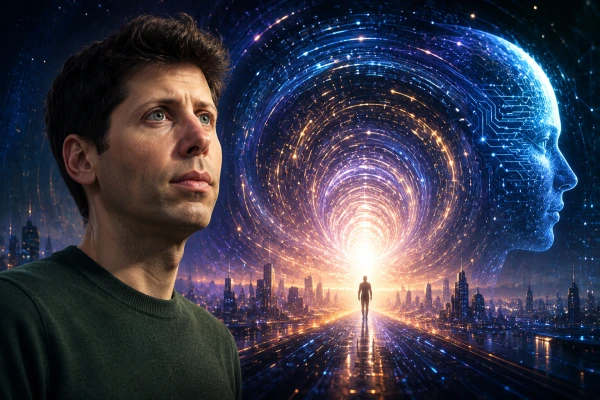
Artificial intelligence has reached another defining moment after OpenAI Chief Executive Officer Sam Altman declared that humanity has effectively entered what many researchers have long referred to as the AI singularity.
The statement has sparked widespread discussion across the technology industry because the singularity has traditionally been viewed as the point where artificial intelligence advances so rapidly that it fundamentally changes how people live, work and innovate.
While the concept has often been associated with science fiction, Altman believes recent breakthroughs suggest the world is now experiencing the early stages of that transformation rather than waiting for it to happen in the distant future. His comments have reignited debate among researchers, governments and businesses about how quickly AI is progressing and what that means for society.
The term AI singularity has been discussed for decades, but its meaning varies depending on who is using it. In general, it describes a period when artificial intelligence improves at an accelerating rate, leading to technological progress that becomes increasingly difficult for humans to predict.
Some researchers associate the singularity with the arrival of artificial general intelligence, while others use it more broadly to describe the growing influence of AI across industries. Altman's remarks suggest he sees today's rapid improvements in reasoning models, coding assistants, autonomous AI agents and scientific discovery as evidence that this acceleration is already underway rather than remaining a theoretical possibility.
One reason the discussion has intensified is the remarkable pace of AI development during the past few years. Modern AI systems can now write software, generate realistic images and videos, summarize lengthy documents, assist researchers with scientific analysis, translate languages in real time and automate increasingly sophisticated business workflows.
Companies including OpenAI, Google DeepMind, Anthropic, Microsoft and Meta continue investing billions of dollars into frontier AI models, creating intense competition that pushes innovation forward at an unprecedented speed. Every major model release introduces stronger reasoning, larger context windows and more capable AI agents, reinforcing the perception that AI progress is accelerating rather than slowing down.
Related post
Altman's comments also come as businesses increasingly integrate artificial intelligence into everyday operations. Financial institutions use AI to analyze market data, healthcare organizations deploy AI to assist with diagnostics, manufacturers optimize production through intelligent automation, and software companies rely on AI to accelerate development.
Educational institutions, marketing agencies and government organizations are also adopting AI-powered tools to improve productivity and decision-making. This widespread adoption means that AI is no longer confined to research laboratories but has become an important part of the global economy.
Despite the optimism surrounding AI's potential, Altman's comments have also generated debate among experts who believe the term "singularity" should be used carefully. Some researchers argue that although today's AI systems are extraordinarily capable, they still have important limitations and should not be confused with fully autonomous human-level intelligence.
Others point out that significant challenges remain, including improving factual accuracy, reducing hallucinations, strengthening cybersecurity and ensuring that increasingly powerful AI systems remain safe, transparent and aligned with human goals. These differing perspectives illustrate why discussions about the future of AI continue to generate strong interest across the technology community.
Governments are paying close attention as well. Around the world, policymakers are developing regulations covering AI transparency, security, privacy and responsible deployment. As AI systems become more powerful, discussions surrounding international safety standards and governance frameworks have become increasingly important.
Technology leaders generally agree that innovation should continue, but many also support stronger evaluation procedures to ensure advanced AI models are released responsibly. The balance between encouraging innovation and protecting society will likely remain one of the defining policy challenges of the coming decade.
For businesses, Altman's remarks highlight both opportunity and urgency. Companies that successfully adopt AI may improve productivity, reduce operating costs and create entirely new products and services.
At the same time, organizations that delay AI adoption risk falling behind competitors that use intelligent automation to accelerate decision-making and streamline operations. This is why investment in AI infrastructure, employee training and digital transformation continues increasing across nearly every industry.
Whether or not humanity has truly entered the AI singularity remains a subject of ongoing debate, but one fact is becoming increasingly difficult to ignore: artificial intelligence is advancing faster than most experts predicted only a few years ago.
As OpenAI, Google, Anthropic, Microsoft and other technology leaders continue developing increasingly capable AI systems, the conversation is shifting from whether AI will transform society to how quickly that transformation will occur.
Sam Altman's statement has therefore become more than a headline—it reflects the growing belief that the future shaped by artificial intelligence may already be unfolding before our eyes.
