
Nvidia Backs OpenAI's Massive AI Data Center Project in $250 Billion Infrastructure Push
Artificial intelligence is no longer driven solely by smarter software. Increasingly, the race to build the world's most capable AI models depends on access to enormous computing infrastructure, and the latest development highlights just how large those investments have become.
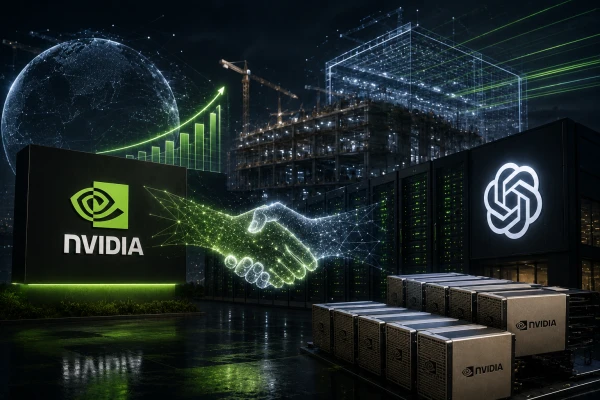
Nvidia is reportedly in discussions to support OpenAI's next-generation AI data center expansion by providing a financing guarantee that could reach $250 billion, helping secure funding for one of the most ambitious technology infrastructure projects ever proposed.
The planned facility would dramatically expand the computing capacity needed to train and operate increasingly powerful artificial intelligence models while reinforcing the strategic partnership between two of the industry's most influential companies.
The proposed project reflects the explosive growth in demand for AI computing power. Every major language model released today requires massive clusters of advanced graphics processing units (GPUs), specialized networking equipment and enormous amounts of electricity.
As AI systems become larger and more capable, companies such as OpenAI must build infrastructure capable of supporting trillions of calculations every second. According to reports, the planned Ohio project could eventually require around 10 gigawatts of electricity, making it one of the largest AI-focused computing campuses ever planned.
Nvidia sits at the center of this transformation because its AI chips have become the preferred hardware for training and running frontier artificial intelligence models. From OpenAI and Microsoft to Google, Meta and Anthropic, nearly every major AI company depends heavily on Nvidia's GPUs to power large-scale machine learning workloads.
Demand has become so intense that AI infrastructure has evolved into one of the most competitive sectors in technology, with governments and private companies investing hundreds of billions of dollars to secure computing resources for the next generation of AI development.
For OpenAI, expanding infrastructure is essential to supporting increasingly advanced models. Each new generation of AI requires more computational resources to improve reasoning, coding, multimodal understanding and autonomous agent capabilities.
As millions of businesses and consumers rely on AI every day, maintaining reliable performance requires continuous expansion of data centers capable of handling billions of AI requests. Large infrastructure projects also provide the foundation needed for future innovations that extend beyond chatbots into scientific research, robotics, healthcare and enterprise automation.
The reported financing arrangement illustrates how the AI industry is evolving. Instead of simply selling hardware, Nvidia is increasingly becoming a strategic infrastructure partner, helping enable projects that might otherwise be difficult to finance because of their unprecedented scale.
By reducing financial risk, such guarantees could allow OpenAI to secure more favorable borrowing terms while accelerating construction of facilities capable of supporting future AI breakthroughs. This type of collaboration demonstrates how hardware manufacturers, cloud providers and AI developers are becoming more closely connected as competition intensifies.
The expansion also has important geopolitical implications. Artificial intelligence has become a strategic priority for governments around the world, with the United States, China and several other countries investing heavily in AI research, semiconductor manufacturing and high-performance computing.
Access to cutting-edge infrastructure is increasingly viewed as a national competitive advantage because it influences scientific research, economic productivity, cybersecurity and technological leadership. Large-scale data center investments therefore represent not only commercial opportunities but also long-term strategic assets.
Despite the excitement surrounding the project, significant challenges remain. AI data centers require enormous quantities of electricity, advanced cooling systems and reliable semiconductor supply chains. Environmental concerns, permitting requirements and power infrastructure must all be addressed before facilities of this scale can become fully operational.
Technology companies are therefore investing not only in AI hardware but also in renewable energy, advanced cooling technologies and more efficient computing architectures that reduce the environmental impact of large-scale AI operations.
The reported partnership between Nvidia and OpenAI demonstrates that the future of artificial intelligence will depend as much on physical infrastructure as on software innovation. The companies capable of building, financing and operating the world's most advanced computing facilities are likely to play a decisive role in shaping the next generation of AI.
As investment in data centers, AI chips and cloud computing continues to accelerate, projects of this magnitude may soon become the foundation upon which tomorrow's most powerful artificial intelligence systems are built.