
PAL Robotics Launches TIAGo Pro Arm for Physical AI Research
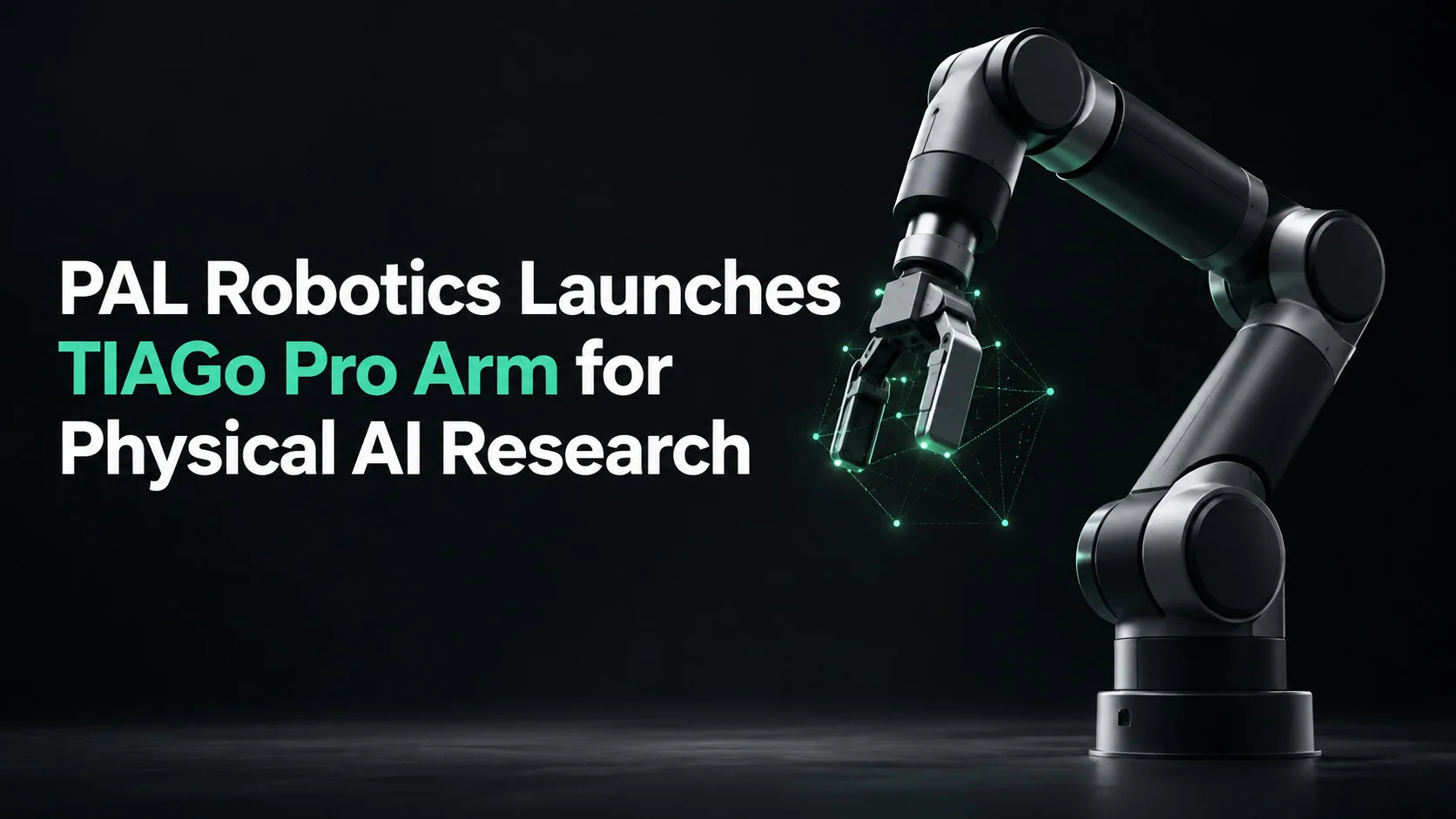
PAL Robotics launches TIAGo Pro Arm as a standalone manipulation platform for physical AI, robot learning and advanced robotics research. The Barcelona company is presenting the system at IROS 2026 in Pittsburgh, where the conference runs from September 27 to October 1.
The seven-axis arm is designed to move research from simulation into repeatable physical experiments. It combines open ROS 2 software, direct low-level control, torque sensing and swappable end-effectors in a compact system that can operate alone or attach to a mobile base.
PAL Robotics lists four central capabilities:
- Seven degrees of freedom with continuous rotation on three joints
- ROS 2-native control over a real-time 1kHz EtherCAT bus
- A 6 kg continuous payload and 0.3 mm repeatability
- Fixed or mobile deployment with interchangeable tools
Related Research
PAL Robotics Launches TIAGo Pro Arm at IROS 2026
PAL Robotics describes TIAGo Pro Arm as its newest standalone platform for manipulation, perception, robot learning and AI-driven applications. Researchers can mount it in a fixed setup or combine it with the company’s TIAGo Pro OMNI Base to test mobile manipulation.
The launch matters because physical-AI research needs more than a capable arm. Teams must reproduce experiments, inspect sensor and actuator data, change control methods and connect their own cameras, tactile sensors or compute without being confined to a closed software stack.
PAL Robotics has built the new arm around ROS 2 LTS, the PREEMPT-RT real-time framework and ros2_control-compatible tools. Its software package also supports MoveIt 2, RViz plugins, a URDF model and simulation in both MuJoCo and Gazebo.
A Docker image containing the PAL software development kit is intended to simplify setup on a laptop or compact PC. The decentralized architecture removes the external control cabinet common in industrial systems, making the platform easier to move between laboratories and experimental stations.
Seven Axes Combine Reach, Payload and Repeatability
The TIAGo Pro Arm stands 110 centimeters tall, weighs 9.5 kilograms and occupies a 15-by-15-centimeter footprint. PAL Robotics specifies a 75-centimeter horizontal reach and a total workspace of 1.85 cubic meters.
Its seven joints provide movement similar to a human arm, while joints one, three and five can rotate continuously. Removing hard rotation limits on those axes can reduce the need to unwind the arm during long experiments and give planners more options in crowded workspaces.
The arm is rated for a 6 kg continuous payload and a 7 kg peak payload, with a stated repeatability of 0.3 millimeters and maximum speed of 1.1 meters per second. Those are manufacturer specifications, not independent benchmark results, but they define the operating envelope available to research teams.
Torque sensing is built into every arm actuator. Series Elastic Actuators add a compliant element that can absorb impacts, while six joint-level safety brakes and wrist status indicators provide additional hardware safeguards for experiments conducted near people or delicate equipment.
Open Control Targets Robot-Learning Experiments
The platform exposes position, velocity, effort and torque control modes over its 1kHz EtherCAT bus. PAL Robotics says developers receive low-level access to command the hardware, run custom controllers and collect high-frequency data instead of working only through predefined motion functions.
That access is especially relevant to reinforcement learning and imitation learning. Researchers often need to change feedback loops, record joint-level behavior and compare simulated policies with physical execution. A closed interface can hide the signals needed to diagnose why a policy succeeds in simulation but fails on hardware.
The quick tool changer automatically detects attached components and reconfigures the software through PAL Robotics’ Robot Reflection System. Supported options include the company’s parallel gripper, multi-finger robotic hands, tactile sensors and a six-axis force-and-torque sensor.
An optional Nvidia Jetson computer can add local GPU capacity for perception and inference. Researchers may also connect external sensors, allowing the same arm to support experiments in computer vision, grasp planning, tactile manipulation and learned control.
IROS Demonstrations Will Test the Platform’s Research Appeal
PAL Robotics is showing TIAGo Pro Arm at IROS 2026 rather than announcing a factory deployment or a commercial automation contract. Its immediate market is laboratories, universities and development teams that need an adaptable hardware bridge between algorithms and real-world manipulation.
The platform’s strongest proposition is integration: open software, direct control, simulation support and modular hardware in one system. That combination could shorten the time required to move a manipulation project from a simulated environment to repeatable experiments on physical equipment.
Important commercial details remain undisclosed. PAL Robotics has not published a standard price, shipment volume or independent performance testing, and its product page directs buyers to request a quote while advertising early-bird terms around the IROS showcase.
The next evidence will come from researchers using the arm outside company demonstrations. Reproducible experiments, third-party benchmarks and public software integrations will show whether TIAGo Pro Arm becomes a common physical-AI platform or remains one option in a crowded research hardware market.