
Mysterious Ox Alpha Stealth Model Surges on OpenRouter With 1M Context and No Named Maker
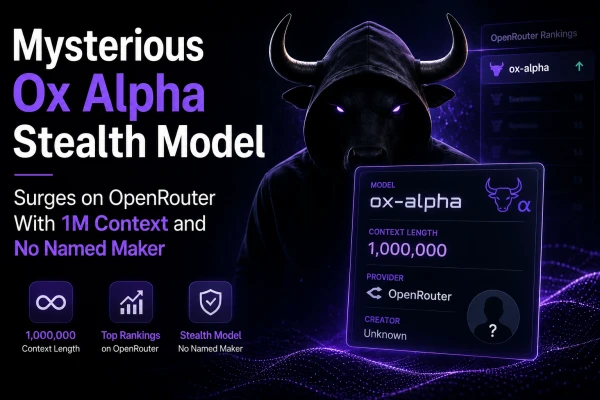
A free, anonymous AI model calling itself Ox Alpha has rocketed to the top of developer attention after appearing on OpenRouter on August 20, 2026.
Listed under the provider tag “stealth,” the model offers a 1,048,576-token context window, accepts text, image and video inputs, supports tool calling, and is currently priced at zero for both input and output tokens during its preview window.
OpenRouter states that it merely routes requests to a third-party provider that has chosen to remain anonymous. The platform is not the developer, owner or host of the model. Prompts and completions are retained by that provider and are not used for training, according to the listing’s terms.
Within days the model logged extraordinary usage. Independent trackers reported more than 13 trillion tokens processed on OpenRouter alone by August 24, with additional heavy traffic through coding-agent clients such as OpenCode.
Early community tests positioned Ox Alpha as competitive on software-engineering and long-horizon agent tasks, though full benchmark numbers remain limited and sample sizes vary.
The model is marketed as a reasoning system aimed at coding, sustained agentic work and production workloads. Its combination of large context, multimodal support and free access during the stealth period has driven rapid experimentation among developers building agents and complex coding pipelines.
Speculation about the model’s origin has been intense. Multiple independent technical probes—tokenizer fingerprinting across dozens of discriminating strings, matching API error messages, video-token accounting patterns and serving-layer signals—have aligned closely with the GLM model family developed by Chinese company Z.ai (also associated with Zhipu).
Z.ai has previously previewed models anonymously on the same platform. No company has publicly claimed Ox Alpha, and alternative theories, including unreleased models from other labs, continue to circulate.
OpenRouter’s own description is careful: “Ox Alpha is a stealth model. It is developed and operated by a third-party provider who has chosen to remain anonymous during this preview.” The free access window was initially indicated to last roughly one week from the August 20 launch, though exact end dates have varied across clients.
The appearance of a high-capability, free, anonymous frontier-class model raises practical questions for teams integrating it. Because the provider retains prompts and completions, organizations handling proprietary code or sensitive data must weigh the convenience of free high-context access against data-handling risk.
The lack of published weights also means the model cannot be self-hosted or audited in the conventional open-source sense.
For the broader AI ecosystem the episode illustrates two parallel trends. First, the continued rise of “stealth” or anonymous model releases as a way for labs to gather real-world usage data and feedback before formal branding.
Second, the growing importance of routing platforms such as OpenRouter that can surface new models to large developer audiences almost instantly.
Early qualitative feedback has been largely positive on coding and agentic tasks, with some developers reporting strong performance relative to better-known frontier systems on limited internal evaluations.
At the same time, full independent leaderboards and rigorous contamination-controlled benchmarks are still sparse. Community results have already shown variance when moving from small task subsets to larger suites.
Whether Ox Alpha ultimately resolves to a known GLM variant, a new internal checkpoint, or an entirely different origin remains unconfirmed. What is already clear is that a model with no public maker, no published paper and no official announcement can still command massive developer attention when it delivers useful capability at zero marginal cost and with a million-token context window.
Developers and researchers watching the space will be looking for two signals in the coming days: any formal claim of ownership, and the transition from free preview pricing to a paid tier.
Until then, Ox Alpha remains one of the most closely watched—and least officially documented—models currently available through public routing infrastructure.
The episode also underscores how quickly capability can circulate once it reaches a widely used API aggregator. In less than a week, an unbranded model moved from total obscurity to multi-trillion-token usage and active discussion across developer communities, agent frameworks and social platforms. That speed of diffusion is itself a notable feature of the current AI tooling landscape.