
Nvidia in Early Talks With South Korean AI Chip Startup Rebellions for Possible Partnership or Deal
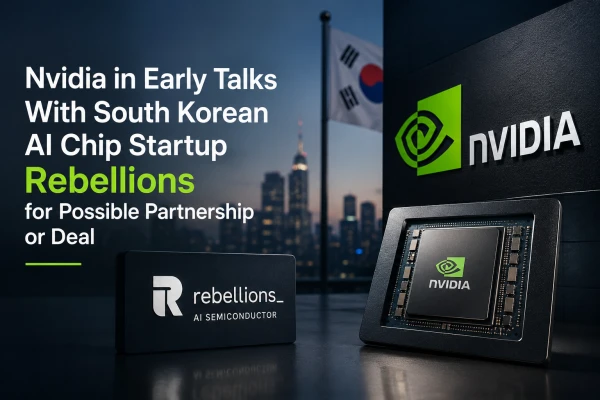
Nvidia is in early discussions with South Korean AI chip designer Rebellions about possible collaborations that could range from a technical partnership and investment to a full acquisition, according to people familiar with the matter.
The talks were confirmed by Bloomberg on August 21, 2026. Nvidia chief executive Jensen Huang met Rebellions co-founder and CEO Sunghyun Park at Nvidia’s headquarters in Santa Clara, California, this week. The discussions remain preliminary and may not result in any transaction.
Rebellions, founded in 2020 and based in the Bundang area near Seoul, specializes in neural processing units optimized for AI inference rather than training. Inference—the process of running trained models to generate responses—has become the higher-volume and often more power-sensitive workload as large language models move into widespread commercial use.
The company has raised roughly $850 million to date. Its most recent round, a $400 million pre-IPO financing closed in March 2026 and led by Mirae Asset Financial Group and South Korea’s National Growth Fund, valued Rebellions at approximately $2.3 billion to $2.34 billion. Earlier investors include Samsung Ventures, SK Hynix, Arm Holdings, KT and a direct stake from the Korean government under its “K-Nvidia” initiative aimed at building domestic AI semiconductor capability.
Rebellions designs chips and outsources manufacturing. Its current-generation Rebel100 accelerator uses a four-chiplet design connected by UCIe interconnect, pairs them with 144 GB of HBM3E memory, and targets energy-efficient inference performance.
The company has also introduced system-level products including RebelRack and RebelPod for data-center deployments. Customers have included operators in South Korea, Japan, Saudi Arabia and the United States.
Nvidia has pursued an aggressive investment and partnership strategy to reinforce its central position in the AI infrastructure stack. In late 2025 the company reached an unusual arrangement with U.S. inference specialist Groq that included a non-exclusive license and the absorption of substantial engineering talent while allowing Groq to continue operating independently.
The Rebellions conversations fit the same pattern of exploring complementary inference technology.
Any deeper commercial or ownership link would carry strategic weight on both sides of the Pacific. South Korea treats advanced semiconductors as a national priority, and Samsung and SK Hynix already sit at the center of the global memory supply chain that feeds Nvidia’s GPUs. An acquisition or major equity stake could face regulatory scrutiny in Seoul as well as potential antitrust review in the United States, where Nvidia’s dominance in training accelerators already attracts attention.
For the broader AI industry the talks highlight the continuing search for alternatives and complements to Nvidia’s CUDA-centric ecosystem, especially in the inference layer where power efficiency, latency and total cost of ownership matter as much as raw peak performance.
Specialized NPUs from companies such as Rebellions, Groq, Cerebras and others are competing for share of the growing inference market even as Nvidia itself expands its own inference offerings.
Rebellions has publicly stated ambitions to compete more directly with Nvidia over time and has emphasized an open software stack built around components such as vLLM, PyTorch and Hugging Face rather than a proprietary programming model. Whether a partnership would accelerate that roadmap or fold the technology more tightly into Nvidia’s portfolio remains an open question.
Neither company has issued an official comment on the Bloomberg report. A Rebellions representative declined to comment, and Nvidia did not respond to inquiries. Market reaction and further reporting will determine whether the early conversations progress into a concrete deal or remain exploratory.
The discussions come at a moment when AI infrastructure spending continues at high levels, sovereign AI programs are expanding in multiple regions, and the distinction between training and inference silicon is becoming sharper. Any confirmed Nvidia–Rebellions arrangement would immediately become one of the more closely watched semiconductor moves of 2026.