
Microsoft Opens Surface Laptop Ultra Preorders at $2,599
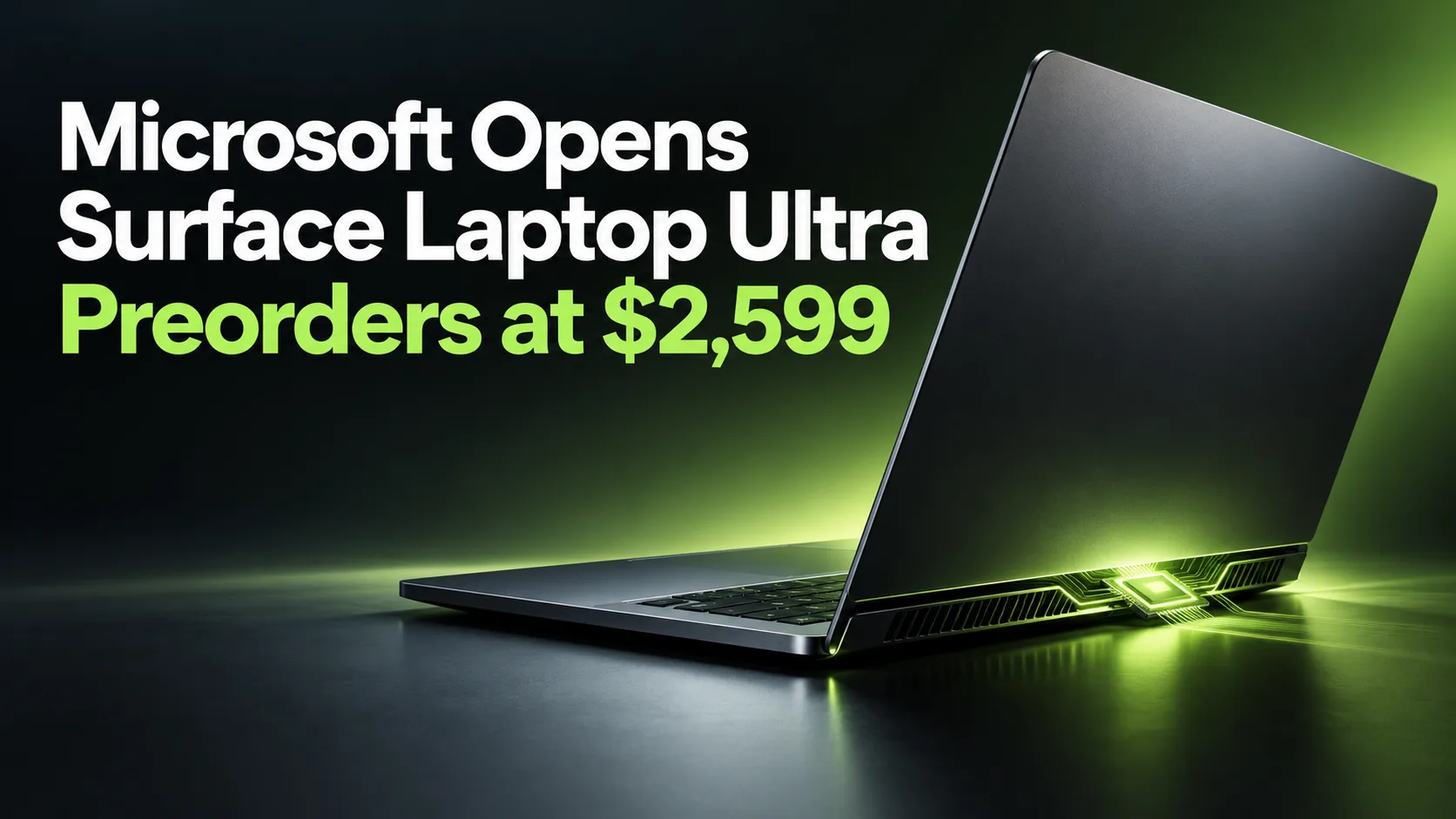
Microsoft opens Surface Laptop Ultra preorders at $2,599.99, turning its high-end local-AI notebook from a previously announced concept into an orderable product. The October 7 opening also gives buyers a final price ladder reaching $5,899.99 for the top listed configuration.
The 15-inch system pairs Nvidia’s RTX Spark platform with Windows 11 and arrives as Microsoft promotes a broader “hybrid intelligence” strategy: keep suitable AI work on the PC, send harder jobs to the cloud, and contain autonomous tools with operating-system controls.
The October 7 release locks in four important details:
- U.S. pricing starts at $2,599.99.
- The highest listed configuration costs $5,899.99.
- RTX Spark supports up to 128GB of unified memory.
- Microsoft Execution Containers are now generally available.
Further Reading
Microsoft Opens Surface Laptop Ultra Preorders Across Its U.S. Store
Microsoft’s U.S. product page lists the Surface Laptop Ultra at a starting price of $2,599.99 and marks it for preorder. The company’s configuration page shows several higher tiers, including 32GB, 48GB, 64GB and 128GB unified-memory options built around the Nvidia RTX Spark N1X platform.
The top listed model combines a 20-core CPU, 128GB of unified memory and a 1TB solid-state drive for $5,899.99. Microsoft also lists a 64GB version with 2TB of storage at $4,699.99, while the 32GB, 1TB model is priced at $3,699.99.
Those prices position the Ultra above conventional premium laptops and squarely inside mobile-workstation territory. Reuters noted that the $2,599 entry model carries 24GB of memory, compared with 16GB in Apple’s $1,999 base MacBook Pro, while cautioning that the products are not directly comparable.
The price spread matters because Microsoft is selling local computation as an alternative to paying for every AI task in the cloud. Organizations must now compare the upfront cost of specialized hardware with cloud inference bills, data-control requirements and the value of running models without a network round trip.
RTX Spark Brings Blackwell Graphics and Unified Memory
The Surface Laptop Ultra is built around Nvidia’s RTX Spark Superchip, which combines Blackwell RTX graphics, an Nvidia Grace CPU and unified memory shared across the processor and GPU. Microsoft says configurations can reach a 20-core CPU and 128GB of unified memory.
Microsoft rates the system for up to one petaflop of AI compute and says it can run models with as many as 120 billion parameters locally. That figure is based on theoretical FP4 performance with sparsity, so real-world speed will depend on the model, precision, software stack and workload.
The chassis weighs under 4.5 pounds and measures less than 18 millimeters thick, according to Microsoft. Its 15-inch touchscreen supports a 120Hz refresh rate, Dolby Vision IQ and full DCI-P3 color coverage, with peak HDR brightness rated at 2,000 nits over a limited display window.
Connectivity includes three USB-C ports, USB-A, HDMI, an SD card reader and a headphone jack. Microsoft also introduced a magnetic USB-C charging connection and says its enlarged cooling system offers up to 2.5 times the thermal capacity of the 15-inch Surface Laptop, 8th Edition.
Windows MXC Controls What AI Agents Can Reach
The hardware launch is tied to a security change in Windows. Microsoft Execution Containers, or MXC, are now generally available on Windows 11, letting organizations define which files and networks an agent may access and enforce those restrictions while the agent is running.
Microsoft says MXC can use several containment levels, including process and session isolation, Windows Subsystem for Linux containers, virtual machines and Windows 365 for Agents. The company lists OpenAI Codex, GitHub Copilot, OpenClaw, Replit, LM Studio, Nvidia OpenShell and Unsloth AI among tools already supporting MXC.
That containment layer addresses a practical obstacle to local agents. A coding assistant or automation tool can write files, execute commands and connect to services, so giving it full desktop permissions creates risks that do not arise with a conventional chat interface.
Microsoft is also connecting MXC to Agent 365 and Intune so enterprises can distinguish actions taken by an agent from actions taken by a person, apply policy and monitor risk. Support from Anthropic Claude Code, Perplexity, Box and several other developers is expected later.
Hybrid Intelligence Splits Work Between PCs and the Cloud
Microsoft’s larger pitch is that Windows should route AI work to the most appropriate place. Local models can handle tasks where latency, privacy or recurring cloud cost matters, while cloud systems remain available for workloads that exceed the PC’s memory or compute limits.
The company says an on-device coding model uses 3-bit precision to cut model size by nearly 80% while retaining a 256,000-token context window. GitHub Copilot is also expected to choose between local intelligence and cloud-scale models, rather than treating every request as a cloud call.
The approach gives Surface Laptop Ultra a clearer purpose than simply being Microsoft’s fastest notebook. It is a test of whether developers, creators and enterprises will pay workstation prices for local inference, CUDA support and tighter control over sensitive code or data.
Preorders make that test measurable. Microsoft and Nvidia now have a real price, a set of orderable configurations and a Windows security layer to support their local-agent argument; the next evidence will come from shipping performance, software compatibility and customer adoption.
