
Micron Commits $10 Billion to New U.S. AI Memory Research Labs in Boise
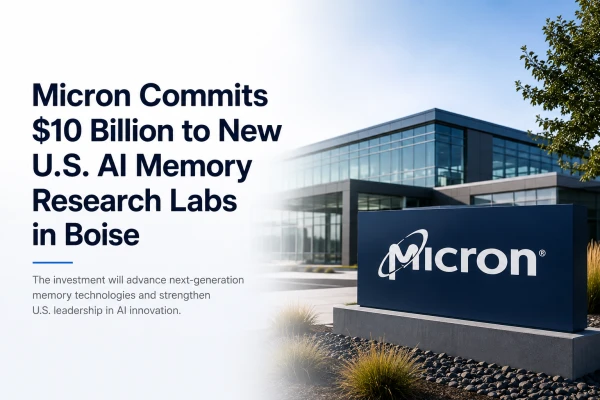
Micron Technology has announced a major new commitment to the foundations of artificial intelligence infrastructure. On August 20, 2026, the company unveiled Micron Research Labs, a U.S.-based long-horizon research institution headquartered in Boise, Idaho, backed by a planned $10 billion investment over the next decade.
The lab will focus on critical memory technologies, advanced memory and compute architectures, packaging, and future semiconductor manufacturing—areas that have become decisive bottlenecks as AI systems scale.
The announcement positions the effort as the first dedicated memory research hub of its kind in the United States. It will center on a flagship Boise campus designed to host hundreds of researchers and will connect to Micron’s existing research and technology footprint across the U.S., Europe, Japan, India, Singapore, and Taiwan.
Groundbreaking is expected in 2027. The investment sits on top of more than $250 billion Micron has already committed to U.S. manufacturing and R&D, a program the company says will support more than 90,000 jobs.
Memory has moved from a supporting component to a central constraint in the AI era. High-bandwidth memory is required to keep accelerators fed with data at the speeds modern models demand.
As training and inference workloads grow larger and more continuous, the ability to move and store information efficiently has become as important as raw compute. Micron, Samsung, and SK Hynix have all benefited from this surge in demand.
Micron’s decision to create a dedicated, long-horizon research institution signals that the company sees the next decade of progress as dependent on fundamental advances rather than incremental product roadmaps alone.
Company leadership framed the lab in strategic terms. Chairman, President and CEO Sanjay Mehrotra stated that “the decisions we make today will determine who leads the AI economy of tomorrow, and America’s AI future will be built on American-made memory.”
He added that the $10 billion commitment looks beyond current technology roadmaps to the memory and compute systems future AI workloads will require. Scott DeBoer, Executive Vice President and Chief Technology and Products Officer, described the labs as giving Micron’s nearly 50-year legacy “a dedicated home for long-horizon innovation, the kind of research that sits upstream of every product we build.”
The initiative has drawn explicit support from both government and industry. Commerce Secretary Howard Lutnick called memory a core component of U.S. technological leadership and said the lab would strengthen American innovation while creating hundreds of jobs.
Michael Kratsios, Director of the White House Office of Science and Technology Policy, said the effort advances the administration’s goal of securing the nation’s technological edge and ensuring the next generation of breakthroughs is invented and scaled in the United States.
Industry partners reinforced the same theme. Nvidia founder and CEO Jensen Huang described reinventing memory technologies and architectures as “one of the great challenges of the AI era” and said Micron is helping drive the breakthroughs that will define the next era of AI and computing.
Apple CEO Tim Cook noted Micron’s two-decade partnership supplying memory for Apple products and expressed support for the company’s expansion of leading-edge manufacturing and R&D in the United States.
Additional statements of support came from the CEOs of Applied Materials and Lam Research, the President of the National Academy of Engineering, the Chairman of imec, and the presidents of Stanford University and the University of Texas at Austin.
The lab is structured to operate as a collaborative network rather than a closed corporate research center. It will bring together Micron researchers with customers, academia, government, startups, and the broader semiconductor ecosystem.
Planned activities include university collaborations, global satellite labs, and industry partnerships. The Boise facility is expected to host research conferences, workshops, and innovation forums. Micron emphasizes that the challenges of advanced memory and compute architectures are too complex for any single organization to solve alone.
This approach aligns with the practical realities of semiconductor progress. Advances in materials, process technology, packaging, and system-level architectures must move together. High-bandwidth memory, new memory hierarchies, and closer integration of memory and compute are all under active exploration across the industry.
By creating a dedicated institution focused beyond a 10-year horizon, Micron is attempting to accelerate the path from scientific discovery to manufacturable technology while simultaneously training the next generation of memory researchers.
The announcement arrives against a backdrop of intense competition and policy focus on domestic semiconductor capacity. The United States has prioritized reducing foreign dependence in critical technologies, and memory sits near the center of that effort. Micron is the only major U.S.-based manufacturer of leading-edge memory.
Its existing manufacturing expansion plans already represent one of the largest private commitments to U.S. chip production. The research labs add a complementary layer aimed at ensuring that production capacity is matched by technological leadership.
For the AI industry, the practical implications are straightforward. Larger models, longer context windows, multi-agent systems, and real-time inference all increase pressure on the memory subsystem.
Throughput, latency, power efficiency, and cost per bit of memory directly affect what systems can be deployed at scale. Research that improves any of those dimensions has downstream effects across training clusters, data centers, edge devices, and specialized AI hardware.
Micron has not provided a detailed public roadmap of specific projects the labs will pursue first. The company has stated that key research areas include critical memory technologies, advanced memory and compute architectures, packaging, and future semiconductor manufacturing.
Breakthroughs in these domains are expected to make AI systems more powerful, scalable, accessible, and sustainable, with applications extending into agriculture, healthcare, education, and other industries.
The $10 billion figure is a planned investment over a decade, not a single-year outlay. Actual spending will depend on research progress, partnership development, and facility construction timelines. Groundbreaking in 2027 means the physical campus will not be fully operational for several years. In the interim, the company intends to expand collaborations and begin work through its existing network of research sites.
The creation of Micron Research Labs reflects a broader recognition that the AI boom is constrained as much by memory and data movement as by compute silicon. By committing substantial long-term resources to fundamental research and by inviting external partners into the effort, Micron is positioning itself—and the U.S. semiconductor ecosystem—to address those constraints directly.
Whether the lab delivers the expected breakthroughs will be measured over years, not months. What is clear today is that one of the central suppliers of the AI infrastructure stack has decided the problem is large enough to warrant a dedicated, decade-scale institution.