
Meta Hires OpenAI Veteran Luke Metz for Superintelligence Labs
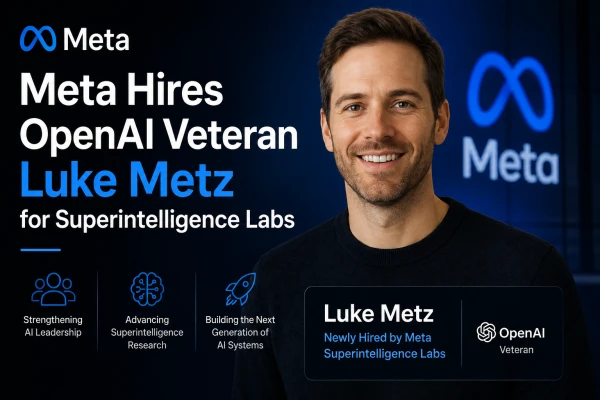
Prominent AI researcher Luke Metz has joined Meta’s Superintelligence Labs, according to a source familiar with the matter who confirmed the move to Axios on August 24, 2026.
Metz begins work this week and will report directly to Alexandr Wang, Meta’s chief AI officer and the executive overseeing the company’s accelerated push toward advanced AI systems.
The hire marks the latest high-profile transfer in the intense competition for top AI talent among frontier labs. Metz left OpenAI in 2024 to become a founding member of Mira Murati’s Thinking Machines Lab.
He rejoined OpenAI earlier in 2026 before making this latest move to Meta. The pattern of researchers circulating among OpenAI, Anthropic, Google DeepMind, Meta, and newer startups has become a defining feature of the industry as companies race to attract specialists capable of advancing large-scale model development and research.
Meta has been particularly aggressive in its recruiting since mid-2025, when it struck a multibillion-dollar partnership with Scale AI that brought Wang into the company to lead its restructured AI efforts.
Under Wang, Meta Superintelligence Labs has consolidated research, product, and infrastructure teams with a stated focus on developing more capable systems, including the Muse family of models. Recent months have seen Meta release updates and new models as it seeks to close performance gaps with rivals.
Metz’s arrival fits this pattern of targeted hires. He is known for contributions to core machine learning research and has moved between several of the field’s leading organizations.
Industry observers note that such transfers often bring specialized knowledge of training techniques, scaling methods, and evaluation practices that can accelerate progress at the receiving lab.
Meta has previously recruited researchers with backgrounds at OpenAI, Google, Anthropic, and other groups as part of the same campaign.
The broader context is a talent market in which compensation packages for leading researchers have reached unprecedented levels, sometimes reported in the tens of millions of dollars annually when equity and bonuses are included.
Companies view elite researchers as critical bottlenecks: the ability to design, train, and refine frontier models depends heavily on a relatively small pool of individuals with the relevant experience.
As a result, moves like Metz’s are closely watched as indicators of which organizations are successfully assembling the teams needed for the next phase of AI development.
Meta’s Superintelligence Labs operates with a degree of internal autonomy and has been structured to reduce bureaucratic layers that previously slowed decision-making. Wang has publicly emphasized load-bearing roles and faster iteration.
The addition of researchers with recent experience at competing labs is intended to inject both technical expertise and external perspectives into that environment.
For OpenAI, the departure continues a period of researcher movement that has included both departures and returns. The company has simultaneously expanded its own hiring and research programs while managing high-profile safety and cybersecurity incidents earlier in the year. Talent fluidity of this kind is now treated as a structural feature of the industry rather than an anomaly.
The competitive implications extend beyond any single hire. Meta’s ability to attract researchers who have worked on multiple generations of frontier systems strengthens its capacity to iterate on training recipes, post-training techniques, and evaluation methodologies.
At the same time, the concentration of talent at a handful of well-funded labs raises ongoing questions about research diversity, openness, and the distribution of advanced capabilities.
Looking ahead, further personnel shifts are expected as labs continue to scale compute, data, and research teams. Metz’s move is one data point in a larger pattern of researchers optimizing for the environments they believe offer the greatest resources, scientific freedom, and likelihood of producing breakthrough results.
Meta’s recent model releases and infrastructure investments appear to have made it a more attractive destination for some of those researchers.
Industry analysts will watch whether additional high-profile departures from OpenAI or other labs follow, and whether Meta’s Superintelligence Labs converts the influx of talent into measurable gains on public and internal benchmarks.
For now, the confirmed transfer of Luke Metz underscores that the AI talent wars remain intense and that leading researchers continue to move fluidly among the organizations best positioned to push the frontier.
Credible next steps include formal announcements from Meta regarding Metz’s specific research focus within the labs, potential follow-on hires, and any early contributions to upcoming model releases.
The broader market will also track whether the pace of cross-lab movement accelerates or stabilizes as compensation and project scopes continue to evolve.
